Lesson planHanukkah Dreidel Probability Game
Math40 minutesGrades: 2nd, 3rd, 4th, 5th
Overview
Spin a homemade dreidel and graph the results.
Description
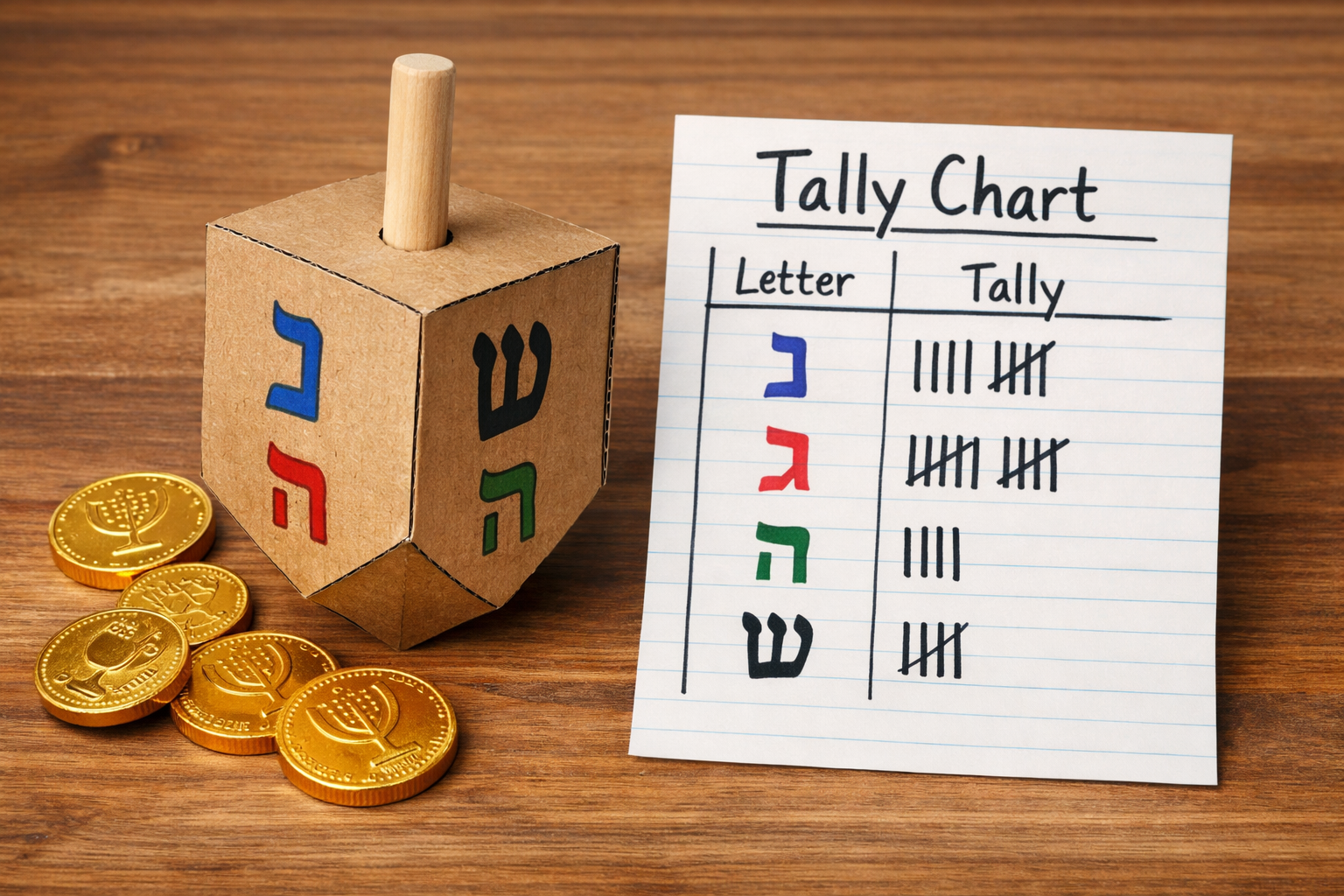
Your child makes a 4-sided paper spinner with the Hebrew dreidel letters, plays the traditional dreidel game, and records 24 spins in a tally chart and bar graph to see whether each letter really lands 1 out of 4 times.
Objective
Your child will explain the dreidel letters and rules, predict that each side has a 1-in-4 chance, collect spin data, and show it in a bar graph.
Standards
2.MD.10Math · Grade 2 · Measurement & Data 10. Draw a picture graph and a bar graph (with single-unit scale) to represent a data set with up to four categories. Solve simple put-together, take-apart, and compare problems using information presented in a bar graph.
3.MD.3Math · Grade 3 · Measurement & Data Draw a scaled picture graph and a scaled bar graph to represent a data set with several categories. Solve one- and two-step "how many more" and "how many less" problems using information presented in scaled bar graphs.
Materials
| Item | Quantity |
|---|
| Square of thin cardboard (cereal box), about 3 x 3 inches | 1 per child |
| Short pencil (sharpened) | 1 per child |
| Ruler and marker | 1 each |
| Pennies, buttons, dry beans or wrapped chocolate coins (gelt) | 10 per player |
| Paper for the tally chart and graph | 2 sheets |
Vocabulary
Hanukkah
An eight-night Jewish festival of lights.
Dreidel
A four-sided spinning top with a Hebrew letter on each side.
Probability
How likely something is to happen.
Tally
A quick mark you make to count, grouped in fives.
Preparation
- Cut the cardboard into 3 x 3 inch squares.
- Copy the letter chart from 'Dreidel letters and rules' onto a sheet of paper so everyone can see it.
Introduction
Spin a coin and ask: what's the chance it lands heads? Now imagine a top with 4 sides. What's the chance of each side?
Have you ever played a spinning top game?
If something is 'fair,' what does that mean in a game?
Steps
1Step 1
Learn about Hanukkah
(6 min) Read 'About Hanukkah' and 'Dreidel letters and rules' together. Point to each of the 4 Hebrew letters on your chart and say its name and what it tells a player to do.
2Step 2
Make the spinner
(8 min) Use the ruler and marker to draw both diagonals on the cardboard square, making 4 triangles, and write one letter (Nun, Gimel, Hei, Shin) near each edge. Adult supervision required: an adult pokes the sharpened short pencil through the exact center, point down, so it can spin like a top.
3Step 3
Predict
(3 min) On a sheet of the paper, your child makes a tally chart with 4 rows, one for each letter. Ask: if we spin 24 times and it's fair, about how many times should each letter come up? (About 6 each.)
4Step 4
Play and tally
(15 min) Each player starts with 10 pennies or gelt and puts 1 in the middle pot. Take turns spinning the cardboard spinner, follow the rule for the edge that lands down, and make a tally mark for that letter every spin until you reach 24 spins.
5Step 5
Graph and compare
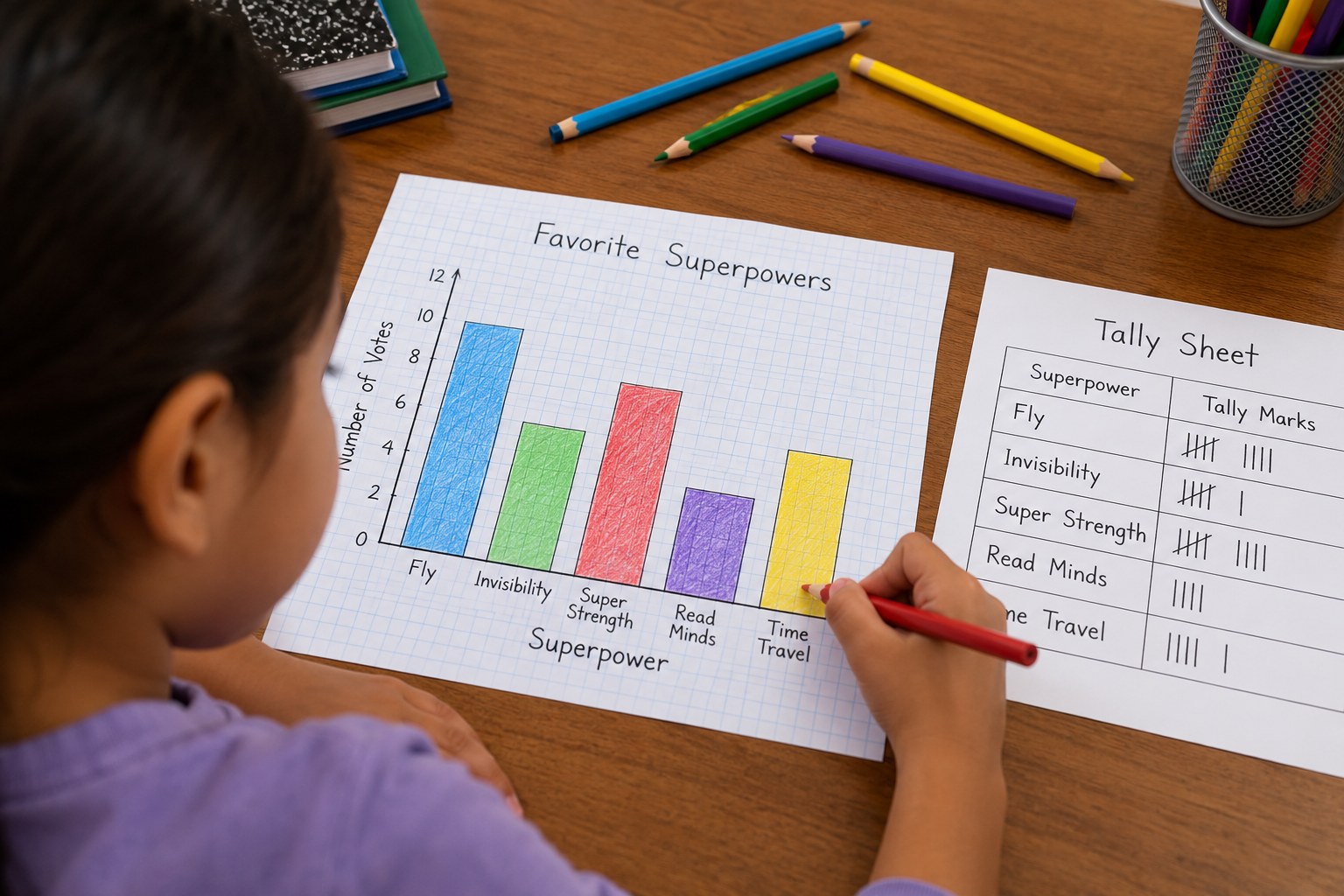
(6 min) Your child draws a bar graph of the 24 spins on the second sheet of paper, where each box equals 2 spins. Compare it to the prediction of about 6 each and talk about why a homemade spinner might not be perfectly fair.
Conclusion
Ask: which letter came up most? If you spun 100 times, do you think the bars would get closer to equal? Try it another night of Hanukkah.
Make your own lesson plan in minutes
Describe a topic and Resource Portal AI writes the objectives, materials and steps for your group.
Try Resource Portal AI