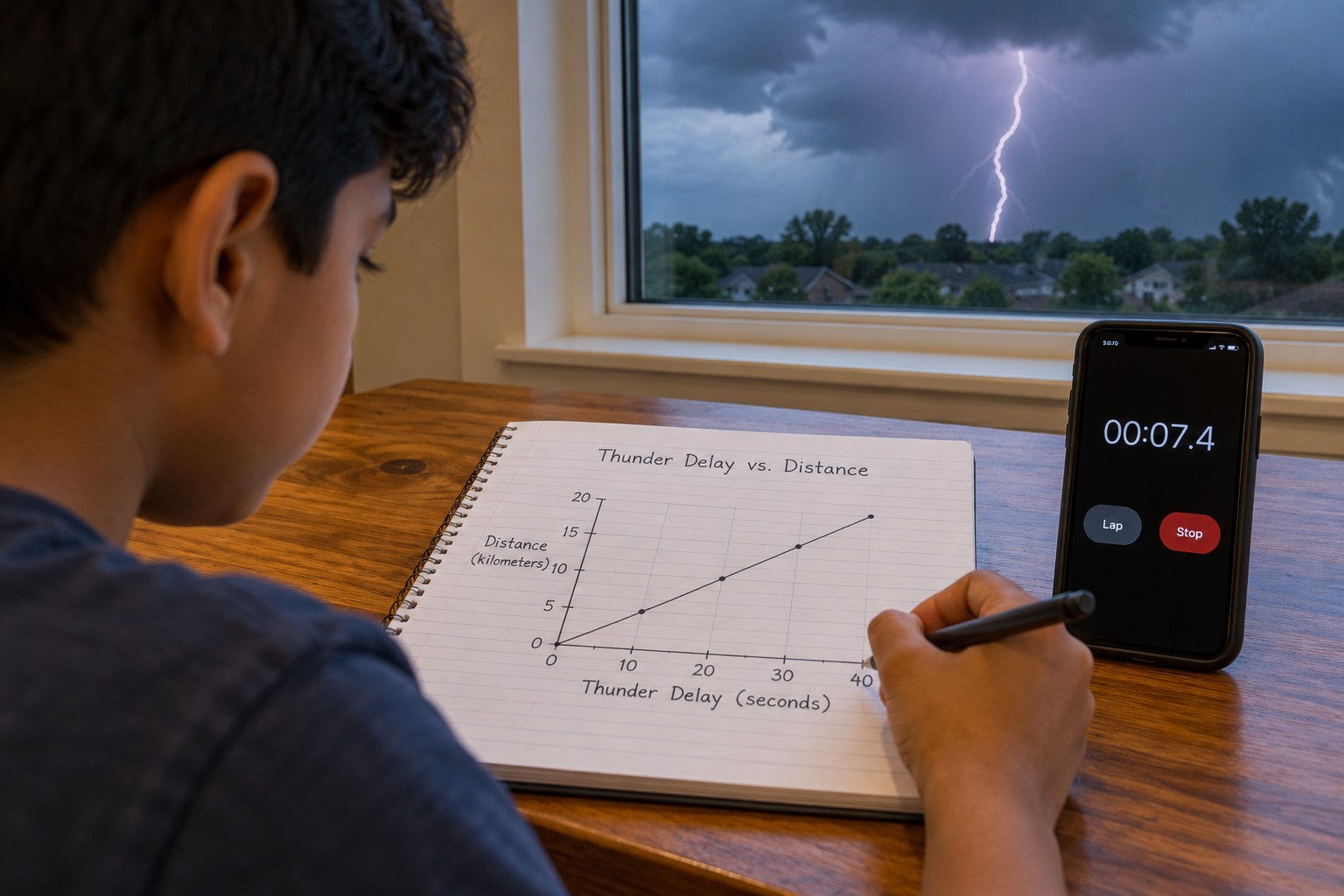
Lesson planFlash-to-Bang Math: Graph How Far Away the Lightning Struck
Math45 minutesGrades: 7th
Overview
Turn flash-to-bang seconds into miles with a proportional graph.
Description
Your teen uses the speed of sound to turn the seconds between a lightning flash and its thunder into a distance, tests whether storm-spotter data is proportional, graphs it, writes the equation and uses it to decide when it's time to get indoors.
Objective
Your teen will test a table for equivalent ratios, find the constant of proportionality (unit rate) for distance versus time, write the equation d = 0.2t, graph it and explain what the points (0, 0) and (1, 0.2) mean in context.
Standards
7.RP.2aMath · Grade 7 · Ratios & Proportional Relationships Decide whether two quantities are in a proportional relationship, e.g., by testing for equivalent ratios in a table or graphing on a coordinate plane and observing whether the graph is a straight line through the origin.
7.RP.2bMath · Grade 7 · Ratios & Proportional Relationships Identify the constant of proportionality (unit rate) in tables, graphs, equations, diagrams, and verbal descriptions of proportional relationships.
7.RP.2cMath · Grade 7 · Ratios & Proportional Relationships Represent proportional relationships by equations.
7.RP.2dMath · Grade 7 · Ratios & Proportional Relationships Explain what a point (x, y) on the graph of a proportional relationship means in terms of the situation, with special attention to the points (0, 0) and (1, r) where r is the unit rate.
Materials
| Item | Quantity |
|---|
| Graph paper | 2 sheets |
| Ruler and pencil | 1 each |
| Phone stopwatch | 1 |
| Calculator | 1 |
| Optional: a thunderstorm video with visible lightning and audible thunder | 1 |
Vocabulary
Constant of proportionality
The unchanging ratio y/x in a proportional relationship; here, miles traveled per second.
Proportional relationship
A relationship where y = kx; its graph is a straight line through the origin.
Speed of sound
About 1,125 feet per second (343 meters per second) in air at room temperature, or roughly 1 mile every 5 seconds.
Flash-to-bang
The time between seeing lightning and hearing its thunder.
Preparation
- Copy the storm-spotter table from the section below onto paper.
- Set up axes on graph paper: x-axis 'seconds' from 0 to 40, y-axis 'miles' from 0 to 8.
Introduction
Ask: why do you see lightning before you hear the thunder, even though they happen at the same moment? Light reaches you almost instantly, but sound plods along at about 1,125 feet per second. That delay is a built-in ruler for measuring storms.
If thunder took 10 seconds to reach you, would the lightning be closer or farther than if it took 3 seconds?
What would the graph of a proportional relationship look like?
Steps
1Step 1
Calibrate your counting
(7 min) Your teen counts 'one-one-thousand, two-one-thousand' up to 10 while you secretly time them with the stopwatch. Repeat twice and decide if their counting runs fast or slow, since storm spotters without a watch rely on counting.
2Step 2
Find the unit rate
(8 min) Your teen converts the speed of sound to miles per second: 1,125 feet per second divided by 5,280 feet per mile is about 0.21, which rounds to 0.2 miles per second. That's why spotters say: divide the seconds by 5 to get miles.
3Step 3
Test the table
(9 min) Your teen calculates miles divided by seconds for each row of the storm-spotter table. One row has an error; they find it, explain why it breaks the pattern and correct it.
4Step 4
Graph and write the equation
(10 min) Your teen plots the corrected data, draws the line and checks that it passes through the origin. They write the equation d = 0.2t and explain what (0, 0) and (1, 0.2) mean about the storm.
5Step 5
Use it for safety
(8 min) Your teen uses the equation or graph to answer the safety questions in the answer key, including the 30-second rule. If you have a storm video, they time several flash-to-bang gaps and compute the distances.
Conclusion
Ask: why is this relationship proportional? What would change about the graph if sound traveled faster? Remind your teen that lightning can strike 10 or more miles from a storm, so if you can hear thunder at all, go indoors.
Make your own lesson plan in minutes
Describe a topic and Resource Portal AI writes the objectives, materials and steps for your group.
Try Resource Portal AI