Full lesson previewWhy Lunar New Year Moves: Moon Phases and Calendar Days
Science40 minutesGrades: 3rd, 4th, 5th
Overview
Model moon phases and count why the holiday date moves.
Description
Your child models the moon's phases with a ball and a lamp to see why a new moon starts each lunar month, then uses a calendar to count the days between Lunar New Year dates and discover why the holiday lands on a different day each year.
Objective
Your child will model and name the main moon phases, explain that a lunar month is about 29 and a half days, and solve elapsed-time problems in days to explain why Lunar New Year always falls between January 21 and February 20.
Standards
4.MD.2Math · Grade 4 · Measurement & Data Use the four operations to solve word problems involving distances, intervals of time, liquid volumes, masses of objects, and money, including problems involving simple fractions or decimals, and problems that require expressing measurements given in a larger unit in terms of a smaller unit. Represent measurement quantities using diagrams such as number line diagrams that feature a measurement scale.
Materials
| Item | Quantity |
|---|
| Lamp with the shade removed (or a bright flashlight) | 1 |
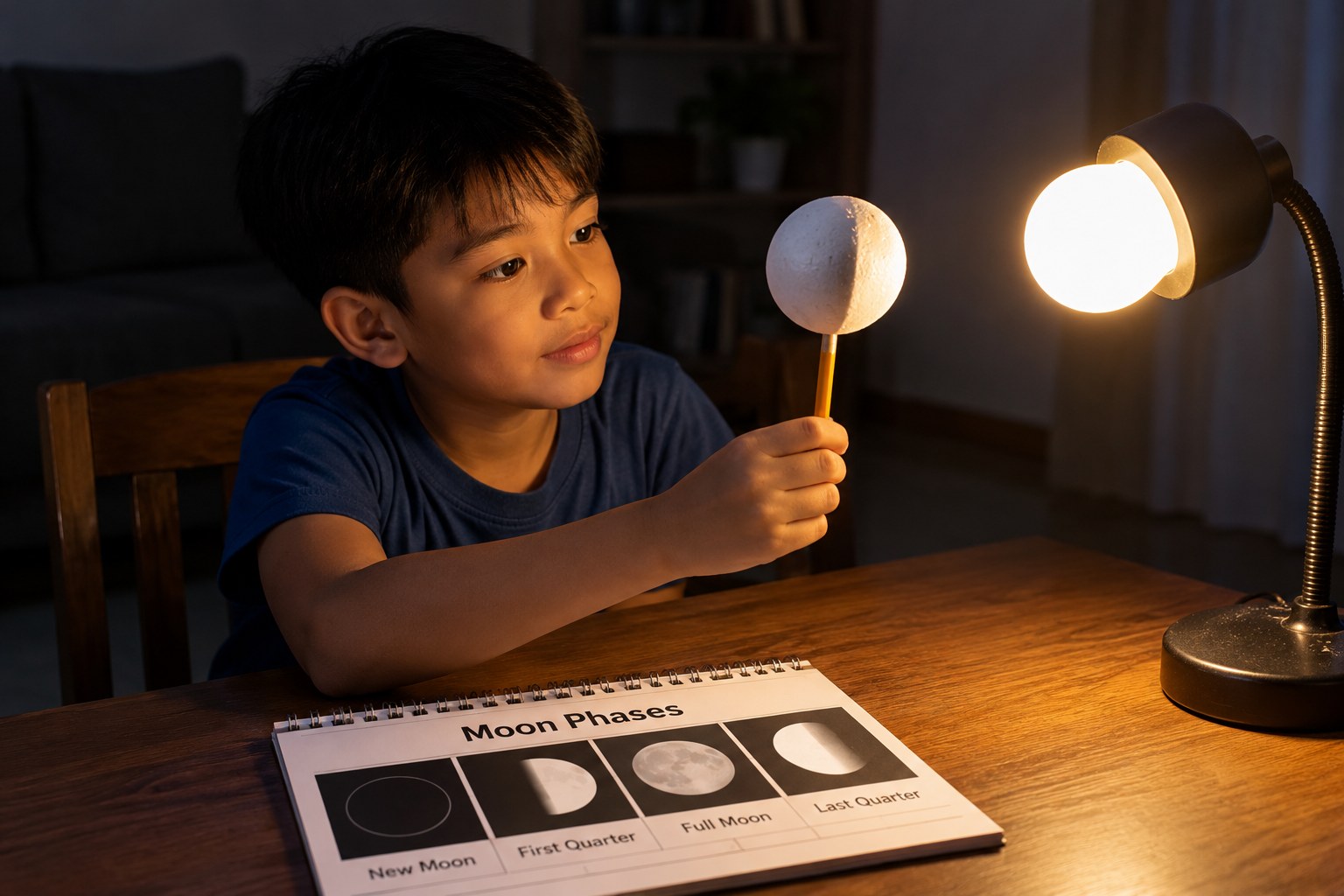
| Styrofoam ball, orange or round fruit on a pencil or fork | 1 |
| Wall calendar or printed calendar for this year and next | 1-2 |
| Paper, pencil and calculator | 1 each |
| Dark room | 1 |
Vocabulary
Lunar
Having to do with the moon.
New moon
The phase when the moon is between Earth and the sun and its lit side faces away, so we see almost nothing.
Lunar month
The time from one new moon to the next, about 29 and a half days.
Lunisolar calendar
A calendar whose months follow the moon but which adds an extra month sometimes to stay in step with the seasons.
Elapsed time
The amount of time that passes between a start and an end.
Preparation
- Set the bare-bulb lamp on a table at one end of a darkened room. Push a pencil into the ball to make a handle.
- Copy the 'Lunar New Year dates' table from the additional sections onto paper.
Introduction
Ask: what date is the Fourth of July? (Always July 4.) What date is Lunar New Year? Show the table of dates and ask your child to spot the pattern. Today they will find out why it jumps around.
Have you ever noticed the moon change shape over a few weeks?
If a calendar followed the moon, would its months match ours?
Steps
1Step 1
Model the phases
(10 min) Your child stands facing the lamp (the sun) and holds the ball (the moon) at arm's length, slightly above their head (they are Earth). They turn slowly in a circle to the left and watch the lit part of the ball grow and shrink, naming new moon, first quarter, full moon and last quarter.
2Step 2
Connect to Lunar New Year
(5 min) Explain that a lunar month starts on a new moon, so Lunar New Year starts on a new moon, and the Lantern Festival 15 days later is near a full moon. Your child shows both positions with the ball.
3Step 3
Count the days
(10 min) Using a calendar, your child counts the days from Lunar New Year 2026 (February 17) to Lunar New Year 2027 (February 6). They check with math: 11 days left in February 2026, plus the days in March through December, plus 37 days in 2027, which equals 354 days.
4Step 4
Compare with a solar year
(8 min) Your child finds the difference between a regular year of 365 days and 12 lunar months of about 354 days (11 days) and explains why the date moved 11 days earlier. Then they work the Practice problems to see what happens when the calendar adds an extra month.
5Step 5
Explain the pattern
(5 min) Your child explains in their own words why the date moves earlier most years and then jumps later. Check with the answer key together.
Conclusion
Ask: why can Lunar New Year never be in December or in March? Look at the moon tonight and predict how many days until the next new moon.
Make your own lesson plan in minutes
Describe a topic and Resource Portal AI writes the objectives, materials and steps for your group.
Try Resource Portal AI