Lesson plan

Kitchen Science Raisin Rehydration: Weigh the Water They Soak Up
Math50 minutesGrades: 3rd, 4th
Kitchen Science Raisin Rehydration: Weigh the Water They Soak Up

Overview

Soak raisins and weigh how much water they gain.

Description

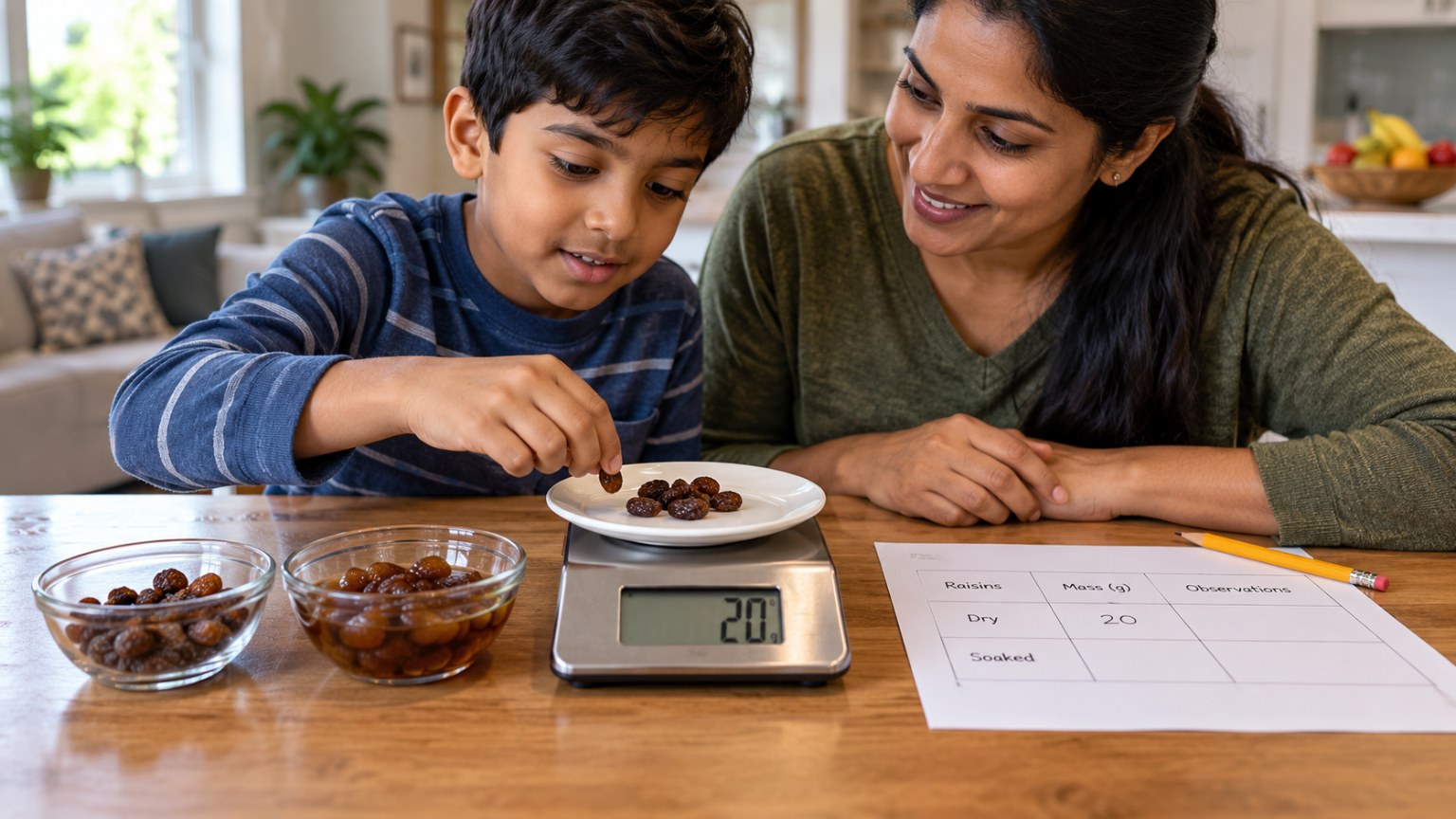
Your child weighs raisins in grams, soaks one batch in warm water and one in cold water, and weighs them again after 30 minutes to find how many grams of water each batch soaked up. While they wait, they solve word problems about grapes drying into raisins.

Objective

Your child will measure masses in grams on a kitchen scale, find the change in mass by subtracting, compare warm and cold water results, and solve word problems about mass.

Standards

3.MD.2Math · Grade 3 · Measurement & Data
Measure and estimate liquid volumes and masses of objects using standard units of grams (g), kilograms (kg), and liters (l). Add, subtract, multiply, or divide to solve one-step word problems involving masses or volumes that are given in the same units, e.g., by using drawings (such as a beaker with a measurement scale) to represent the problem.
4.MD.2Math · Grade 4 · Measurement & Data
Use the four operations to solve word problems involving distances, intervals of time, liquid volumes, masses of objects, and money, including problems involving simple fractions or decimals, and problems that require expressing measurements given in a larger unit in terms of a smaller unit. Represent measurement quantities using diagrams such as number line diagrams that feature a measurement scale.

Materials

ItemQuantity
Raisinsabout 1/2 cup (60 g)
Digital kitchen scale that reads grams1
Small bowls or cups2, plus 1 to weigh in
Warm tap water and cold water from the fridge1 cup each
Strainer and paper towels1 strainer, 4 towels
Recording sheet and pencil (see below)1 each
Timer1

Vocabulary

Mass
How much matter is in an object; we measure it in grams (g) and kilograms (kg).
Gram
A small unit of mass; a raisin is about half a gram to one gram.
Dehydrated
Dried out; having lost most of its water.
Osmosis
Water moving through a thin skin or layer toward the side with more dissolved stuff, like sugar.

Preparation

Introduction

Hand your child one grape (if you have one) and one raisin. Ask: "These started out the same. Where did the raisin's water go, and can we put it back?"
How many grams do you think 20 raisins weigh?
Will warm or cold water put water back into raisins faster?

Steps

1Step 1
Estimate and weigh
(8 min) Your child estimates the mass of 20 raisins, then sets a bowl on the scale, presses zero (tare), and weighs 20 g of raisins for each cup. Record the starting mass of each batch.
2Step 2
Start the soak
(4 min) Your child pours 1 cup warm water over one batch and 1 cup cold water over the other, then starts a 30-minute timer. Record the predictions on the sheet.
3Step 3
Word problems while you wait
(22 min) Your child solves the grape-and-raisin word problems below, showing work with equations or drawings. Peek at the raisins halfway through and describe how they look.
4Step 4
Drain, blot and weigh
(10 min) Drain each batch, pat the raisins dry on a paper towel, and weigh each batch again. Your child subtracts to find how many grams of water each batch gained.
5Step 5
Compare and explain
(6 min) Your child compares the two gains and writes a sentence about which water worked faster. Discuss why warm water might move into the raisins faster.

Conclusion

Ask: "How many grams of water went back into 20 g of raisins? Did they turn back into grapes?" (No, they gain some water but stay wrinkly.) Leave a third batch overnight for an extension.

Make your own lesson plan in minutes

Describe a topic and Resource Portal AI writes the objectives, materials and steps for your group.

Try Resource Portal AI