Lesson planShrinking Fall Daylight: Sunrise, Sunset and Elapsed Time
Math40 minutesGrades: 3rd, 4th, 5th
Overview
Use elapsed time to measure how fall days shrink.
Description
Your child uses a table of fall sunrise and sunset times to calculate how many hours and minutes of daylight there are on each date from the fall equinox to the winter solstice, then finds how many minutes of daylight are lost along the way.
Objective
Your child will find elapsed time between sunrise and sunset on a number line, express day lengths in hours and minutes, and subtract to find how much daylight is lost between fall dates.
Standards
3.MD.1Math · Grade 3 · Measurement & Data Tell and write time to the nearest minute and measure time intervals in minutes. Solve word problems involving addition and subtraction of time intervals in minutes, e.g., by representing the problem on a number line diagram.
4.MD.2Math · Grade 4 · Measurement & Data Use the four operations to solve word problems involving distances, intervals of time, liquid volumes, masses of objects, and money, including problems involving simple fractions or decimals, and problems that require expressing measurements given in a larger unit in terms of a smaller unit. Represent measurement quantities using diagrams such as number line diagrams that feature a measurement scale.
Materials
| Item | Quantity |
|---|
| Fall daylight table (in the section below), copied or read from the screen | 1 |
| Paper and pencil | 2 sheets per child |
| Ruler for drawing number lines | 1 |
| Clock with hands (optional) | 1 |
| Highlighter or colored pencil | 1 |
Vocabulary
Elapsed time
The amount of time that passes from a start time to an end time.
Equinox
One of two days a year when day and night are nearly equal in length; the fall equinox is around September 22.
Solstice
The day with the most or least daylight; the winter solstice, around December 21, has the least in the Northern Hemisphere.
Daylight Saving Time
When clocks are set an hour ahead in spring and summer; in fall the clocks 'fall back' one hour.
Preparation
- Copy the daylight table onto paper, or look up sunrise and sunset times for your own town on a weather or almanac website and use those instead.
- Draw one long blank number line on each sheet for elapsed time work.
Introduction
Ask: does it feel darker earlier now than it did in summer? Do you think we lose the same amount of daylight every week? Today you will use real sunrise and sunset times to find out.
Why do you think days get shorter in fall?
If the sun rises at 7:00 AM and sets at 6:00 PM, how long is the day?
Steps
1Step 1
Read the table
(6 min) Look at the daylight table together. Your child reads each sunrise and sunset time aloud and notices patterns: which times get later, and which get earlier? Talk about the clock change on November 1.
2Step 2
Model one day
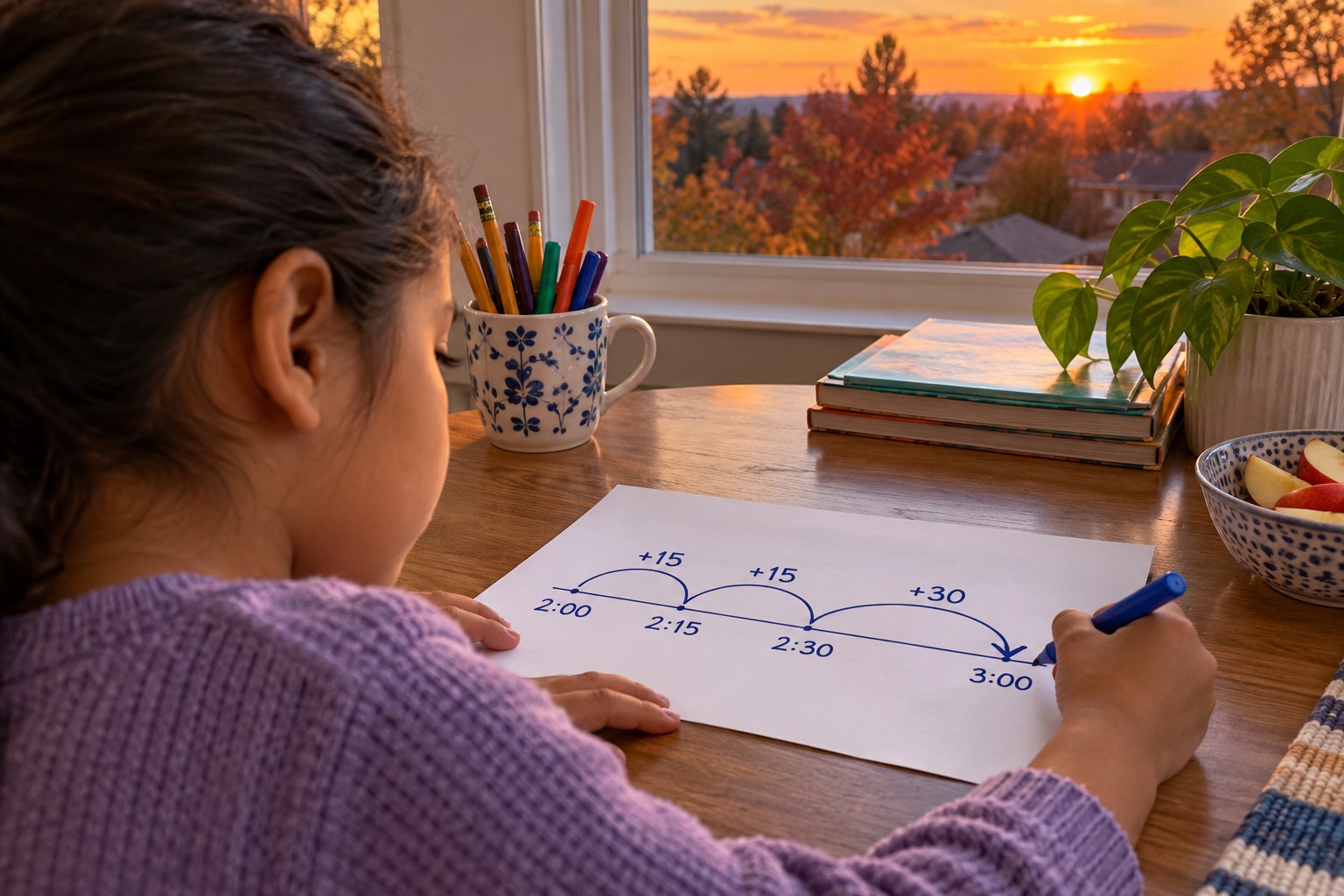
(8 min) For September 22, draw a number line from 6:46 AM to 6:58 PM. Your child jumps to 7:00 AM (14 minutes), then to 12:00 noon (5 hours), then to 6:00 PM (6 hours), then to 6:58 PM (58 minutes), and adds the jumps: 12 hours 12 minutes.
3Step 3
Find each day length
(12 min) Your child uses the same jump method to find the day length for each remaining date and writes it in the last column. Check each one together with the answer key.
4Step 4
How much daylight did we lose?
(9 min) Your child converts each day length to minutes (hours times 60 plus minutes) and subtracts to find the minutes lost between each pair of dates. Highlight the biggest loss and find the total lost from the equinox to the solstice.
5Step 5
Why it happens
(5 min) Read 'About fall daylight' together. Then use a flashlight and a ball to show how Earth's tilt makes the Northern Hemisphere get less sunlight each fall day.
Conclusion
Ask: when did daylight shrink the fastest? Watch the sunset tonight and check whether it matches the table for your town.
Make your own lesson plan in minutes
Describe a topic and Resource Portal AI writes the objectives, materials and steps for your group.
Try Resource Portal AI