Spring Equinox Shadow Tracking
Overview
Track a shadow stick on the first day of spring.
Description
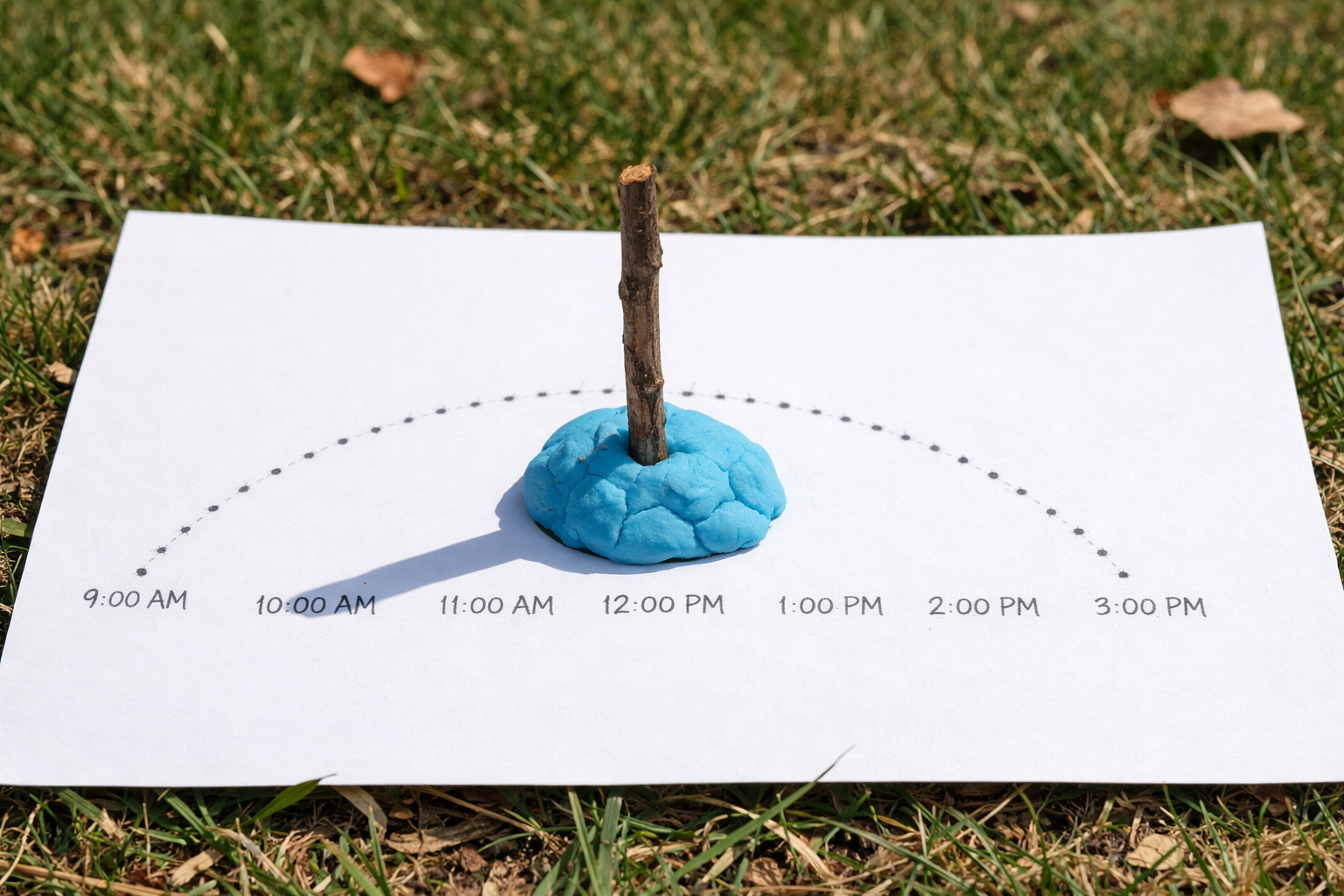
Your child sets up a shadow stick on the spring equinox (or any sunny March day), marks and measures the shadow every 10 minutes, and records how it moves and changes length.
Objective
Your child will measure and record a shadow's length and direction over time and explain that the sun's apparent motion causes the change.
Standards
Materials
| Item | Quantity |
|---|---|
| Straight stick, pencil or chopstick | 1 |
| Lump of play dough or clay (or a pot of soil) | 1 golf-ball-size lump |
| Large sheet of paper or cardboard | 1 |
| Ruler | 1 |
| Pencil and small stones to weigh the paper | 1 pencil, 4 stones |
| Paper for the data table | 1 sheet |
| Clock, watch or timer | 1 |
Vocabulary
Preparation
- Pick a spot that stays sunny for at least an hour, and start before noon.
- Draw a data table on the paper with columns for Time, Shadow length (inches) and Direction.
Introduction
Say: today the sun shines straight on Earth's middle, so almost everywhere has about 12 hours of day and 12 hours of night. Let's watch the sun move without ever looking at it!
Does your shadow stay in one place all day?
Where does the sun rise? Where does it set?
Steps
Conclusion
Ask: if we kept going until sunset, what would happen to the shadow? Do it again on the summer solstice in June and compare the shadow lengths at the same time of day.
Make your own lesson plan in minutes
Describe a topic and Resource Portal AI writes the objectives, materials and steps for your group.
Try Resource Portal AI