Trace Evidence Fiber Lab: Match the Mystery Thread
Overview
Compare household fibers and match a mystery thread.
Description
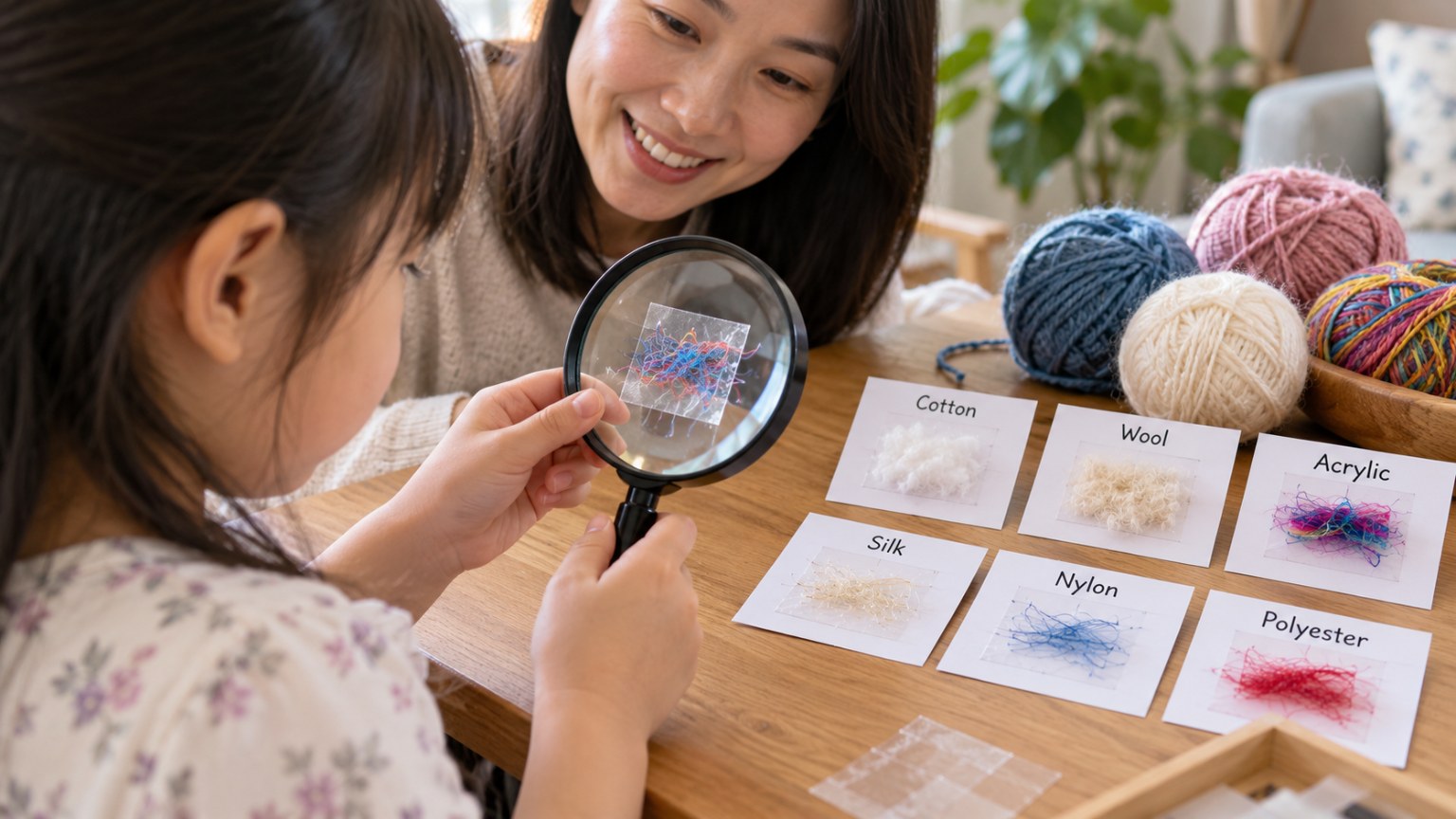
Your child collects fiber samples from yarn, cotton, fleece and other household fabrics with tape lifts, studies them with a magnifier or phone camera zoom, builds a fiber reference chart, and matches a mystery fiber found on a chair to its source.
Objective
Your child will collect and compare fibers by color, thickness, shine, crimp and twist, record observations in a reference chart, and use evidence to identify the source of a mystery fiber.
Materials
| Item | Quantity |
|---|---|
| Clear tape | 1 roll |
| Index cards or white paper | 8 |
| Magnifying glass or a phone camera with zoom | 1 |
| Fabric samples: cotton ball or T-shirt, wool or acrylic yarn, fleece blanket, a polyester pillow filling, a towel | 4-6 kinds |
| Dark paper for light-colored fibers | 1 sheet |
| Tweezers | 1 pair |
| Pencil | 1 per child |
Vocabulary
Preparation
- Choose 4 to 6 fabrics from around the home. Without your child seeing, pull a few fibers from one of them and stick them on a card labeled MYSTERY FIBER: FOUND ON THE KITCHEN CHAIR.
- Label one index card for each fabric with its name and where it came from.
Introduction
Show the mystery fiber card and say: a tiny thread was found on the kitchen chair where someone left their muddy backpack. It's almost invisible, but it can tell us a lot. Let's become fiber examiners.
Where might tiny threads come from in our house?
How can something so small be useful evidence?
Steps
Conclusion
Ask: what property was most useful for telling fibers apart? Real fiber examiners use powerful microscopes, but they start with the same careful comparisons.
Make your own lesson plan in minutes
Describe a topic and Resource Portal AI writes the objectives, materials and steps for your group.
Try Resource Portal AI