Lesson planIbn al-Haytham's Pinhole Viewer: Why the World Looks Upside Down
Science45 minutesGrades: 3rd, 4th, 5th
Overview
Build a pinhole viewer and see the world flip upside down.
Description
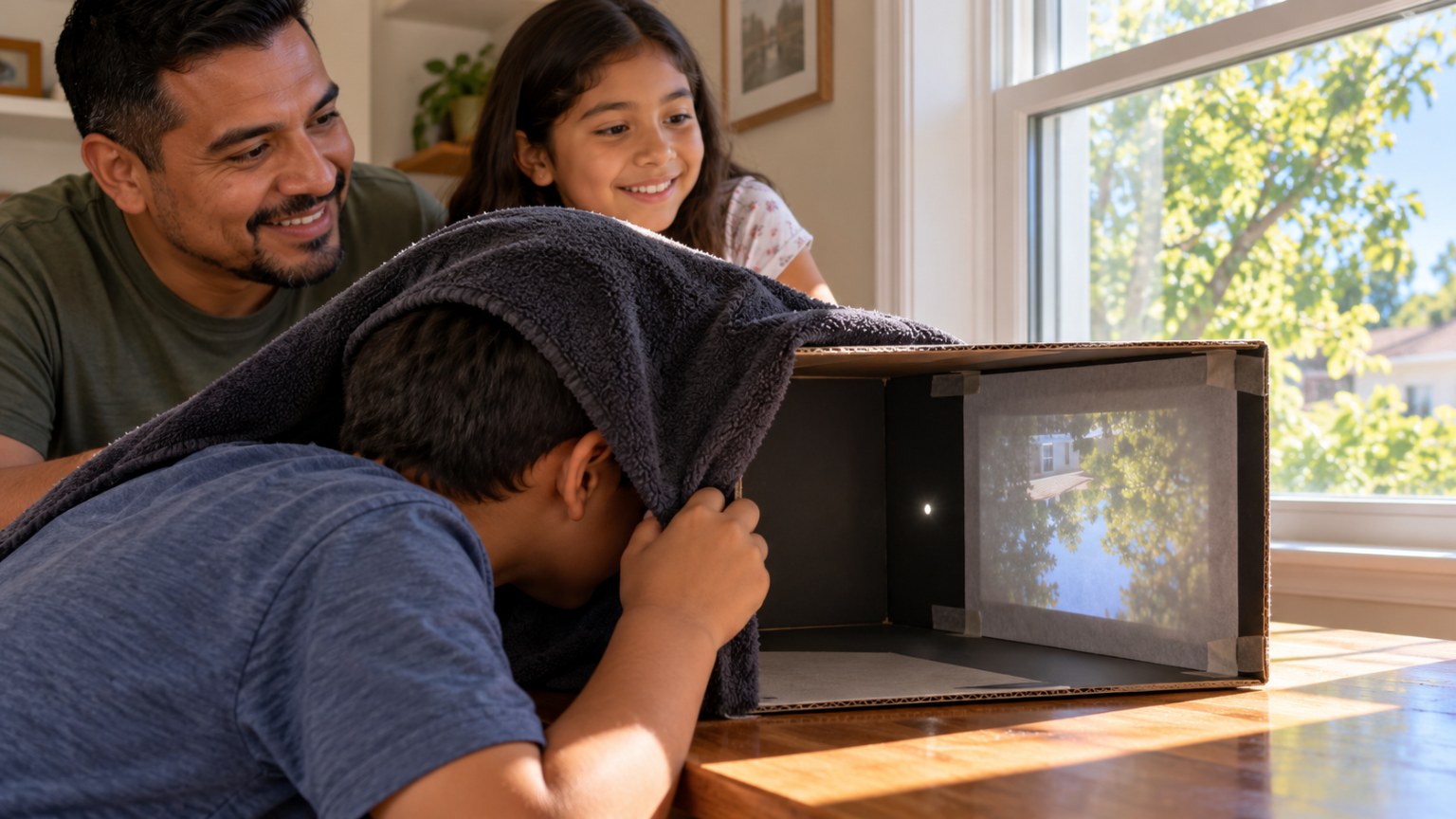
Your child reads about Ibn al-Haytham, the scientist from about 1,000 years ago who studied light in a dark room, builds a shoebox pinhole viewer, sees an upside-down image of a bright window, and explains why it happens.
Objective
Your child will build a pinhole viewer, observe that the image is upside down and reversed, and explain in order how straight-line light makes it happen, using details from the text.
Standards
RI.3.3ELA · Grade 3 · Reading: Informational Text Describe the relationship between a series of historical events, scientific ideas or concepts, or steps in technical procedures in a text, using language that pertains to time, sequence, and cause/effect.
RI.4.3ELA · Grade 4 · Reading: Informational Text Explain events, procedures, ideas, or concepts in a historical, scientific, or technical text, including what happened and why, based on specific information in the text.
RI.5.3ELA · Grade 5 · Reading: Informational Text Explain the relationships or interactions between two or more individuals, events, ideas, or concepts in a historical, scientific, or technical text based on specific information in the text.
Materials
| Item | Quantity |
|---|
| Shoebox with a lid (or any small box) | 1 |
| Aluminum foil | a 3-inch square |
| Wax paper or tracing paper | a piece big enough to span the box |
| Pushpin or thumbtack (adult helps) | 1 |
| Tape, scissors and a ruler | 1 each |
| Dark towel or blanket | 1 |
| Paper and pencil | 1 each |
Vocabulary
Optics
The science of light and how we see.
Camera obscura
Latin for 'dark room': a dark space where light through a small hole makes a picture.
Pinhole
A tiny hole that lets in only a thin beam of light.
Inverted
Turned upside down.
Preparation
- The adult cuts a 1-inch square hole in the center of one short end of the shoebox and a hole about 2 inches wide in the other short end to look through.
- Tape the foil over the 1-inch hole and poke one clean pinhole in the center. Tape a piece of wax paper across the inside of the box about halfway along, as a screen.
Introduction
Make the room dim and stand by a bright window. Ask: if I poke a tiny hole in a dark box, what will we see inside? About 1,000 years ago, a scientist in Cairo did experiments like this to learn how light works.
How do you think light gets into our eyes?
Does light travel in curves or straight lines?
Steps
1Step 1
Read about Ibn al-Haytham
(8 min) Read 'About Ibn al-Haytham' together. Ask your child to underline the two big ideas: light travels in straight lines, and we see because light comes into our eyes. Talk about why doing experiments, not just guessing, was important to him.
2Step 2
Finish the viewer
(8 min) Check that the pinhole is clean and round and the wax paper screen is smooth and tight. Put the lid on and tape any gaps so no extra light leaks in.
3Step 3
Look and observe
(10 min) Point the pinhole end at a bright window, a lamp or a sunny outdoor scene (never directly at the sun). Your child puts their face to the viewing hole with a towel over their head and the box, and looks at the wax paper screen. They describe what they see and draw it.
4Step 4
Test a change
(7 min) Have someone wave a hand or walk past the window from left to right. Which way does it move on the screen? Then make the pinhole a little bigger and compare how bright and sharp the image is.
5Step 5
Explain in order
(8 min) Your child draws a diagram with straight lines from the top and bottom of a tree, crossing at the pinhole and landing on the screen. They write 3-4 sentences in order explaining why the image is upside down, using the words straight line, pinhole and screen.
Conclusion
Ask: how did Ibn al-Haytham learn about light? Your eye works the same way: light passes through a small opening, the pupil, and makes an upside-down image that your brain flips.
Make your own lesson plan in minutes
Describe a topic and Resource Portal AI writes the objectives, materials and steps for your group.
Try Resource Portal AI