Lesson planSummer Kiddie Pool Math: Cylinder Volume and Hose Fill Time
Math40 minutesGrades: 6th, 7th, 8th
Overview
Find a pool's volume in gallons and predict its fill time.
Description
Before filling the backyard pool on a hot day, your teen measures it, finds its volume as a cylinder, converts to gallons, times the hose to find its flow rate, and predicts how long filling will take.
Objective
Your teen will use the cylinder volume formula to solve a real problem, convert cubic inches to gallons, and use a measured unit rate to predict fill time.
Standards
7.RP.2bMath · Grade 7 · Ratios & Proportional Relationships Identify the constant of proportionality (unit rate) in tables, graphs, equations, diagrams, and verbal descriptions of proportional relationships.
8.G.9Math · Grade 8 · Geometry Know the formulas for the volumes of cones, cylinders, and spheres and use them to solve real-world and mathematical problems.
Materials
| Item | Quantity |
|---|
| Round kiddie pool, large round tub or bucket | 1 |
| Tape measure or yardstick | 1 |
| Garden hose | 1 |
| 1-gallon jug or bucket marked at 1 gallon | 1 |
| Stopwatch or phone | 1 |
| Calculator, paper and pencil | 1 each |
Vocabulary
Cylinder
A 3-D shape with two parallel circular bases; volume = pi x radius squared x height.
Radius
Half the diameter; the distance from the center of a circle to its edge.
Flow rate
How much water comes out per unit of time, like gallons per minute.
Constant of proportionality
The unit rate in a proportional relationship, the k in y = kx.
Preparation
- If you do not have a round pool, use any round tub or bucket, or use the example numbers in 'Worked example.'
- Plan to use the measured water afterward to water plants or trees so none is wasted.
Introduction
Ask your teen to guess how many gallons the pool holds and how long the hose will take to fill it. Write the guesses down to check later.
Why might a family want to know how much water a pool uses?
What measurements do you need to find the volume of a cylinder?
Steps
1Step 1
Measure the pool
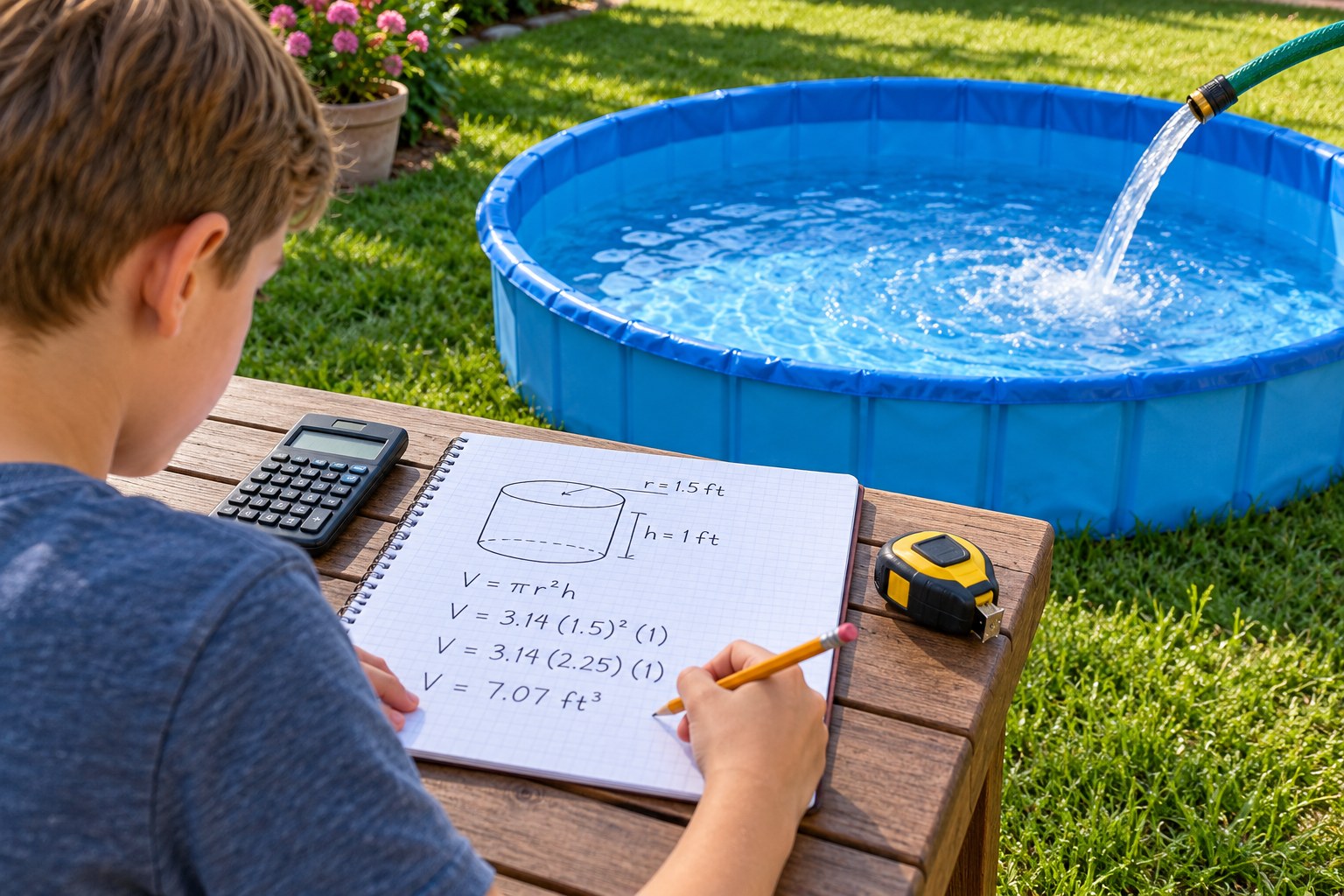
(8 min) Your teen measures the inside diameter of the pool across its widest point and the fill depth they want, such as the line a few inches below the rim. They halve the diameter to get the radius.
2Step 2
Find the volume
(10 min) Using V = pi x r squared x h with measurements in inches, your teen finds the volume in cubic inches and divides by 231 to convert to gallons. Compare the answer with the earlier guess.
3Step 3
Time the hose
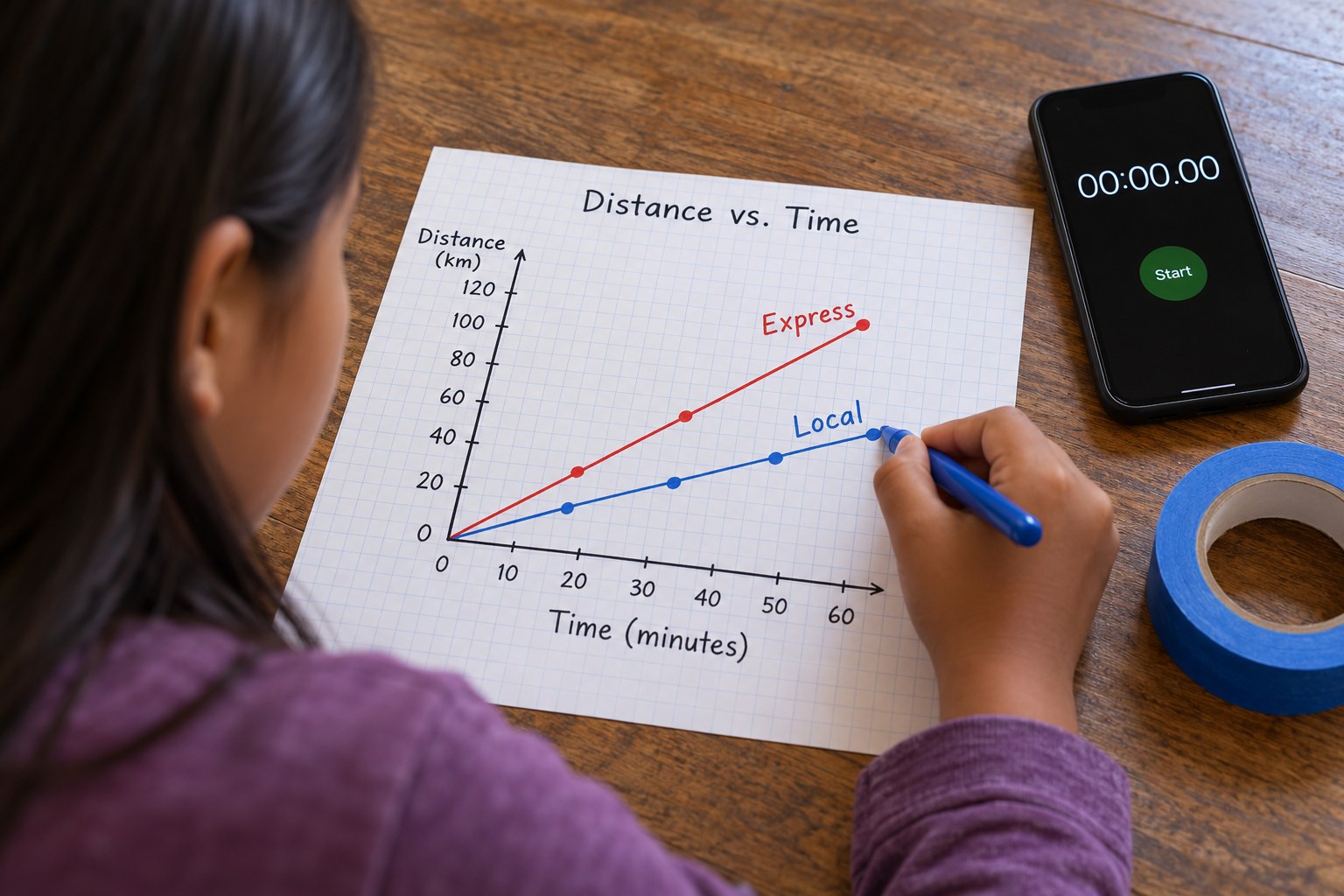
(8 min) Turn the hose on at the setting you will use and time how many seconds it takes to fill the 1-gallon jug, three times. Your teen averages the times and finds the flow rate in gallons per minute, then makes a table of minutes and gallons and writes the equation g = k x m.
4Step 4
Predict the fill time
(10 min) Your teen divides the pool's gallons by the flow rate to predict minutes to fill, and finds when it would be full if you start now. If you are filling the pool, start the hose and check the prediction at the end.
5Step 5
Plan for the water
(4 min) Talk about what happens to the water afterward. Your teen estimates how many 2-gallon watering cans the pool could fill for the garden when it is emptied.
Conclusion
Ask: how close was your prediction? What could make the real fill time different, like changing water pressure or the pool's sloped sides?
Make your own lesson plan in minutes
Describe a topic and Resource Portal AI writes the objectives, materials and steps for your group.
Try Resource Portal AI