Lesson planLaying Flock Math: Eggs per Hen, Feed per Dozen and Proportional Rates
Math45 minutesGrades: 6th, 7th
Overview
Unit rates and proportional equations for a flock of laying hens.
Description
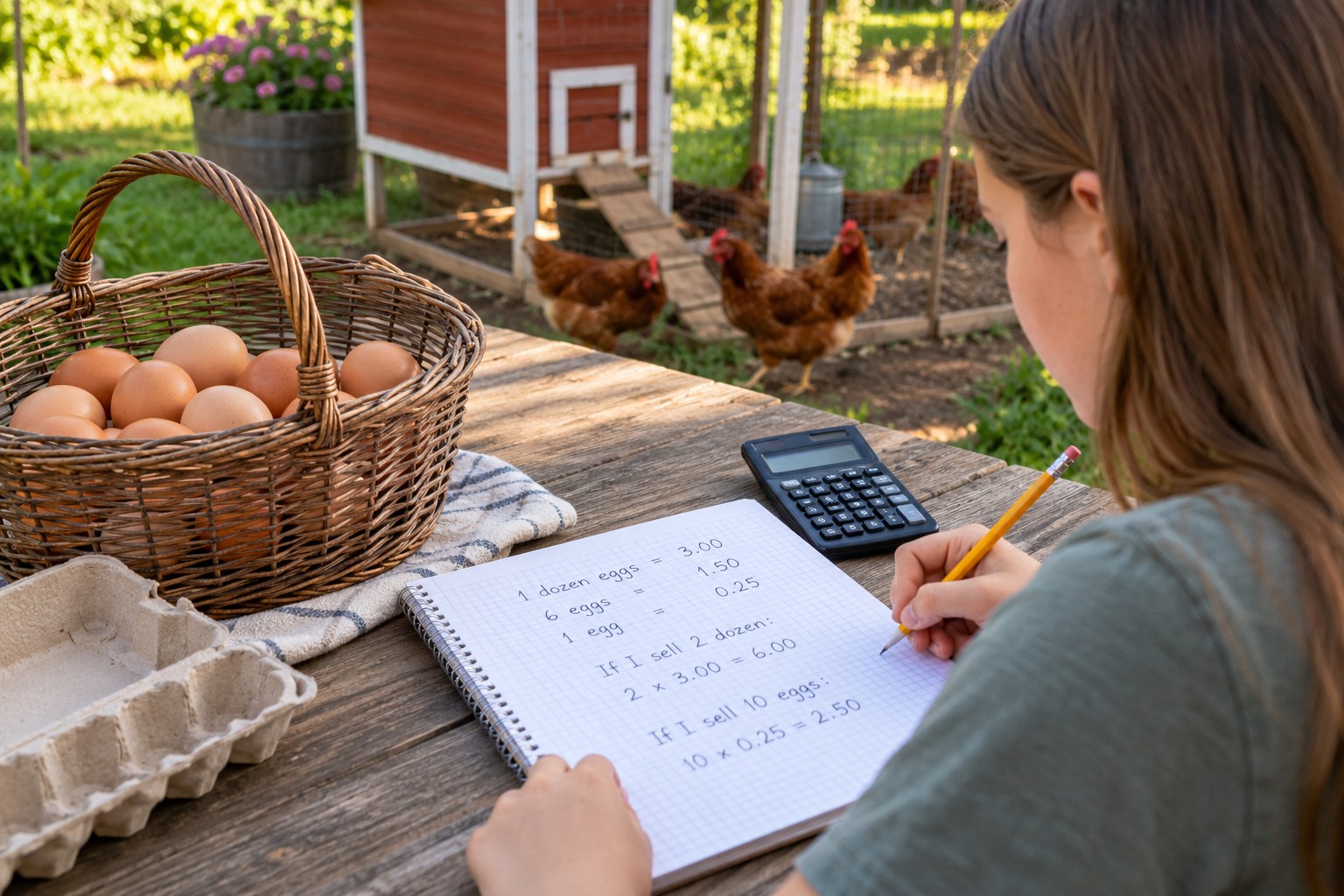
Your teen runs the numbers on a laying flock: eggs per hen per week, pounds of feed per dozen eggs and feed cost per dozen. They build a table and equation for flock size versus eggs, identify the constant of proportionality, then scale up to a 1,000-hen farm and discuss why real egg production is not perfectly proportional.
Objective
Your teen will compute unit rates from flock data, represent the relationship between hens and eggs with a table and an equation, identify the constant of proportionality, and judge when a proportional model breaks down.
Standards
6.RP.3bMath · Grade 6 · Ratios & Proportional Relationships Solve unit rate problems including those involving unit pricing and constant speed.
7.RP.2bMath · Grade 7 · Ratios & Proportional Relationships Identify the constant of proportionality (unit rate) in tables, graphs, equations, diagrams, and verbal descriptions of proportional relationships.
7.RP.2cMath · Grade 7 · Ratios & Proportional Relationships Represent proportional relationships by equations.
Materials
| Item | Quantity |
|---|
| Flock Data card (in Additional Sections) | 1 per teen |
| Graph paper and pencil | 2 sheets |
| Calculator | 1 |
| Carton of eggs (to look at the dozen) | 1 |
| Optional: a recent grocery receipt or online price for a dozen eggs | 1 |
Vocabulary
Unit rate
A rate with 1 in the denominator, like eggs per 1 hen or dollars per 1 pound.
Constant of proportionality
The fixed number k in y = kx that links two proportional quantities.
Layer feed
Chicken feed with extra calcium for hens that are laying eggs.
Point of lay
The age (around 18 to 22 weeks) when a young hen starts laying eggs.
Preparation
- Copy the Flock Data card. Set the egg carton on the table.
- Look up the current price of a dozen eggs at your store (optional).
Introduction
Open the egg carton and ask, 'If your family kept six hens, would the eggs be cheaper than the store's? What would you need to know to find out?'
What numbers would a farmer track to know if a flock is worth the cost?
If you double the number of hens, do you always double the eggs?
Steps
1Step 1
Rates from the data
(10 min) Using the Flock Data card, your teen finds eggs per hen per week, eggs per hen per day, and pounds of feed the flock eats per week. They show each as a unit rate with labels.
2Step 2
Feed per dozen
(8 min) Your teen converts weekly eggs to dozens, then finds pounds of feed per dozen and feed cost per dozen. Compare the feed cost alone to the store price and list costs the feed number leaves out (coop, waterer, bedding, vet care, time).
3Step 3
Table and equation
(10 min) Your teen makes a table of hens (2, 4, 6, 10, 20) and weekly eggs at the flock's rate, graphs the points and writes an equation E = kh. They name k and explain what it means in words.
4Step 4
Scale up
(8 min) Your teen uses the commercial rate on the card (about 0.8 eggs per hen per day) to write an equation for a 1,000-hen barn and find daily eggs and dozens. They compare the two k values and explain why commercial hens lay more often.
5Step 5
When the model breaks
(6 min) Your teen reads the notes about winter daylight and hen age and explains why the real hens-to-eggs graph is not a perfect straight line all year. Discuss what a farmer would track to keep the model honest.
Conclusion
Farmers use unit rates every day to decide whether a flock pays for itself. Your teen found the constant of proportionality, used it to scale up, and saw where real biology bends the math.
Make your own lesson plan in minutes
Describe a topic and Resource Portal AI writes the objectives, materials and steps for your group.
Try Resource Portal AI