Lesson planChip Log and Dead Reckoning: Navigate a Pirate-Era Voyage by Speed and Time
STEAM45 minutesGrades: 6th, 7th, 8th
Overview
Measure speed in knots and plot a voyage by dead reckoning.
Description
Your teen builds a scaled-down chip log, the knotted line sailors used to measure a ship's speed in knots, measures a walker's speed with it, then uses unit rates to plot a three-day voyage by dead reckoning on graph paper.
Objective
Your teen will explain how a chip log measured speed, calculate unit rates in knots and feet per second, and use speed × time to plot a ship's position on a scaled chart.
Standards
6.RP.3bMath · Grade 6 · Ratios & Proportional Relationships Solve unit rate problems including those involving unit pricing and constant speed.
7.RP.2bMath · Grade 7 · Ratios & Proportional Relationships Identify the constant of proportionality (unit rate) in tables, graphs, equations, diagrams, and verbal descriptions of proportional relationships.
Materials
| Item | Quantity |
|---|
| String or yarn at least 60 feet long, on a stick or spool | 1 |
| Paper plate or piece of cardboard as the 'chip' | 1 |
| Measuring tape, marker or colored tape to mark the line | 1 each |
| Phone stopwatch | 1 |
| Graph paper, ruler and protractor | 1 each |
| Open outdoor space about 60 feet long (yard, park path or sidewalk) | 1 |
Vocabulary
Knot (speed)
One nautical mile per hour, about 1.15 miles per hour.
Nautical mile
About 6,076 feet, based on one minute of latitude on Earth.
Chip log
A weighted wooden board on a knotted line, thrown off the stern to measure a ship's speed.
Dead reckoning
Finding your position from your starting point, speed, direction and time traveled.
Heading
The compass direction a ship is pointed.
Preparation
- Work out the scale: real sailors used knots about 47 feet 3 inches apart and a 28-second sandglass. This lesson uses 1/4 scale: marks every 11 feet 10 inches and a 7-second timer.
- Tie the string to the paper plate chip. Starting 5 feet from the chip (slack, called stray line), mark the string every 11 feet 10 inches with the marker or tape, 5 marks in all.
Introduction
Ask: 'Before GPS, how could a ship in the middle of the ocean, with no landmarks, know how fast it was going?' Show the knotted line and say that sailors literally counted knots.
Why is speed called knots on boats and planes today?
If you know your speed and how long you traveled, what else can you figure out?
Steps
1Step 1
How the chip log worked
(7 min) Read the 'About pirates' and 'Chip log math' sections together. Your teen checks the real knot spacing: 6,076 feet per hour times 28/3,600 of an hour is about 47.3 feet, so each knot passing in 28 seconds means 1 nautical mile per hour.
2Step 2
Measure a walker's speed
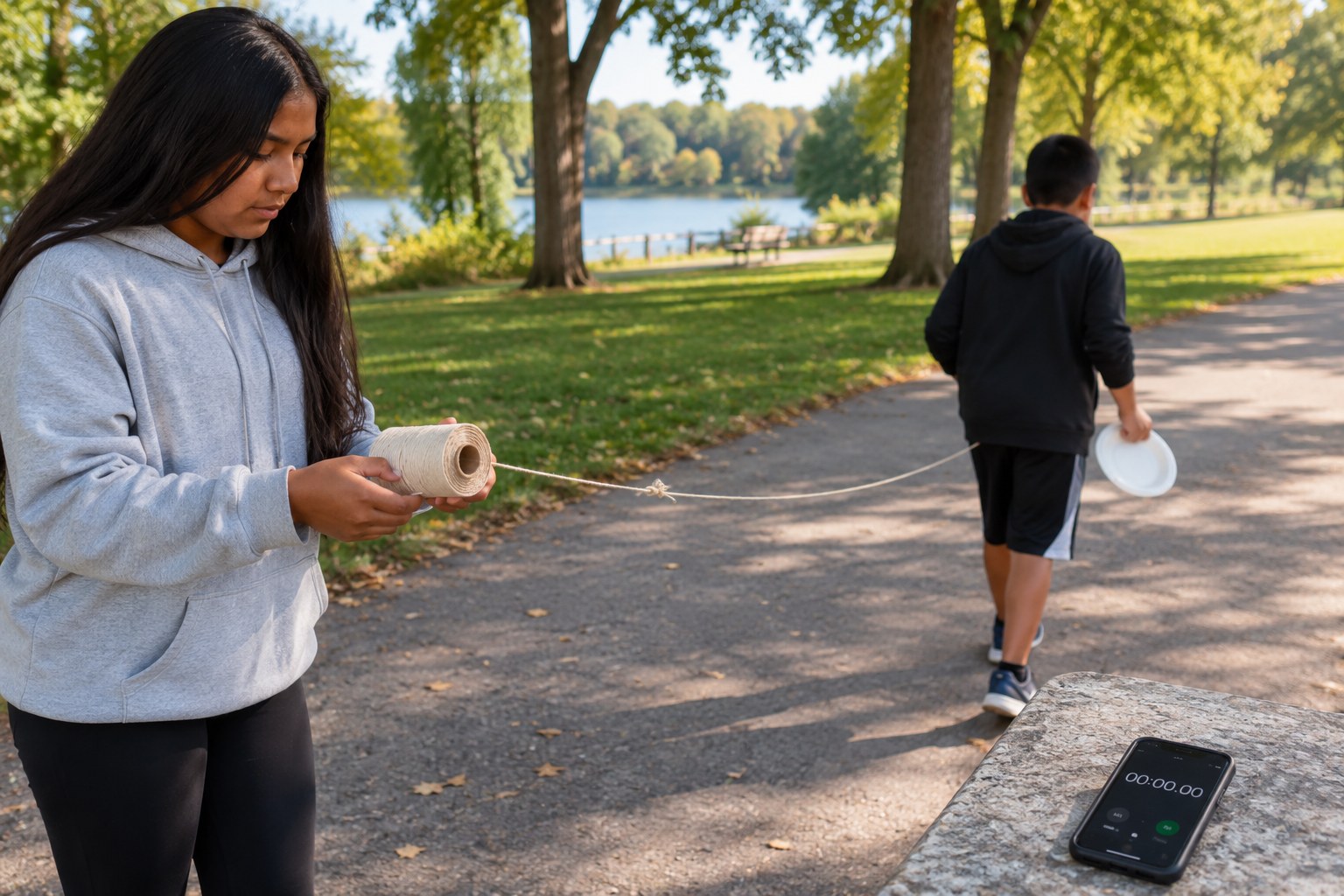
(10 min) Outdoors, your teen holds the spool while a helper holds the chip and walks away at a steady pace. Start the 7-second timer when the first mark leaves the spool hand, call stop at 7 seconds, and count the marks that passed (estimate fractions). Repeat for a slow walk, fast walk and jog, and record each.
3Step 3
Unit rates
(8 min) Your teen converts each result into feet per second (marks × 11.83 feet ÷ 7 seconds) and into miles per hour (1 knot ≈ 1.15 mph). They organize the results in a table and identify the constant of proportionality between knots and feet per second (about 1.69).
4Step 4
Plot the voyage
(14 min) Using the voyage log in Additional Sections, your teen calculates the distance sailed each day (speed × hours) and plots the course on graph paper with a scale of 1 square = 10 nautical miles, drawing each heading with the protractor. They mark the estimated position where the ship should sight land.
5Step 5
Error check
(5 min) Discuss why dead reckoning drifted off over long voyages: currents, wind pushing sideways, and timing errors. Your teen estimates how far off the ship would be after 3 days if the speed were measured 1 knot too high.
Conclusion
Ask: 'What is the unit rate in your voyage log, and how did you use it?' Every number on the chart came from the same idea: distance = rate × time.
Make your own lesson plan in minutes
Describe a topic and Resource Portal AI writes the objectives, materials and steps for your group.
Try Resource Portal AI