Lesson planKitchen Science Spoon Detectives: Teaspoon, Tablespoon and Cup
Math30 minutesGrades: K, 1st
Overview
Find out which kitchen measure holds more, then use them in a recipe.
Description
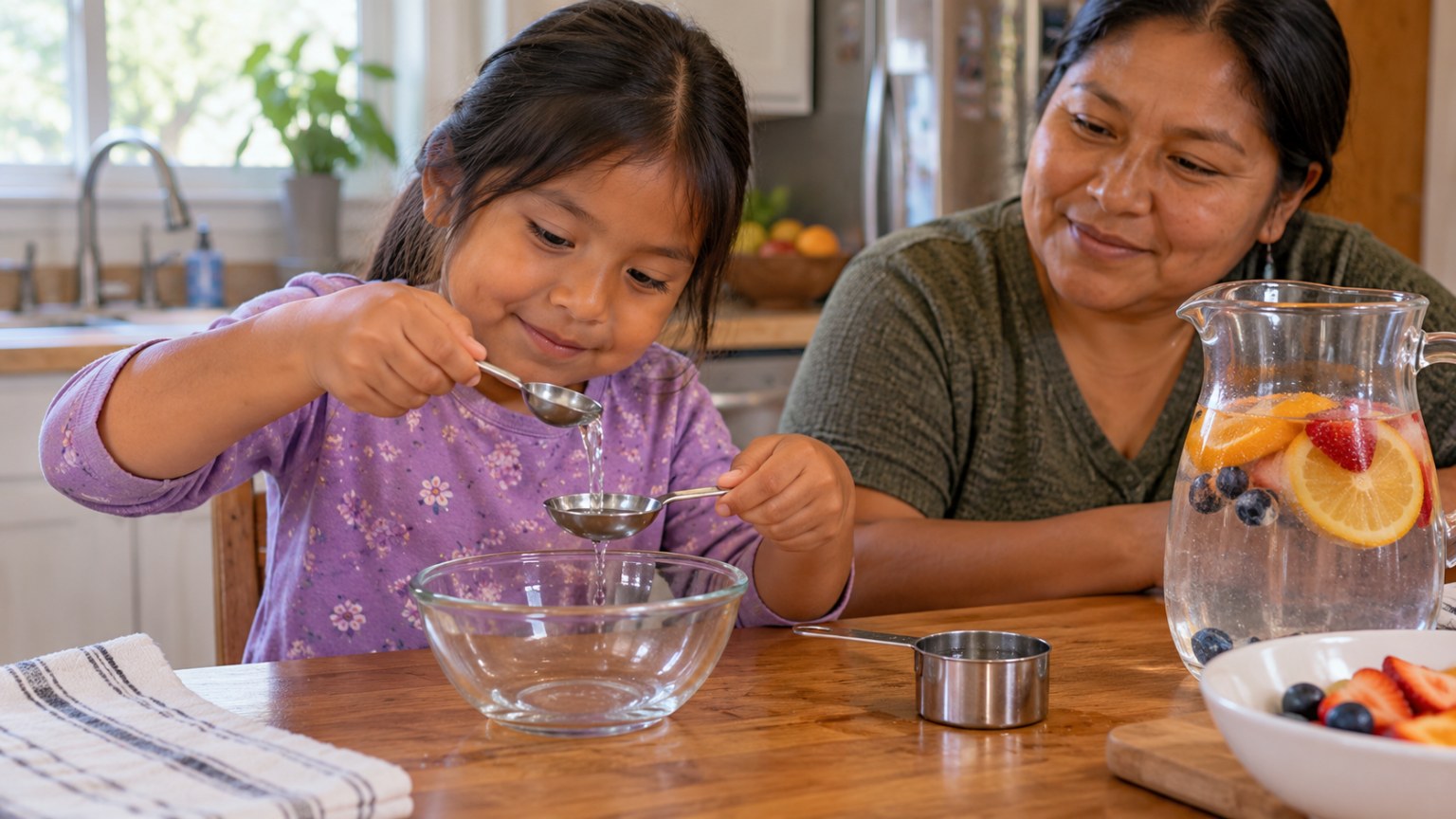
Your child compares a teaspoon, a tablespoon and a 1/4 cup by how much water they hold, fills one with the other to find out "how many," and then follows a measuring recipe to mix a fruit-flavored water for the family.
Objective
Your child will describe how much a container holds, compare two measures to tell which holds more, and count how many smaller scoops fill a larger measure.
Standards
K.MD.1Math · Grade K · Measurement & Data Describe measurable attributes of objects, such as length or weight. Describe several measurable attributes of a single object.
K.MD.2Math · Grade K · Measurement & Data Directly compare two objects with a measurable attribute in common, to see which object has "more of"/"less of" the attribute, and describe the difference.
Materials
| Item | Quantity |
|---|
| Measuring teaspoon, tablespoon and 1/4 measuring cup | 1 each |
| Bowl of water on a tray or in a sink | 1 |
| Small clear cups | 2 |
| Pitcher of cold water | 1 |
| Lemon or orange slices, or a few berries | 4-5 |
| Paper and crayons for recording | 1 each |
Vocabulary
Holds more
Can fit a bigger amount inside.
Teaspoon
A small measuring spoon.
Tablespoon
A bigger measuring spoon; 3 teaspoons fill it.
Measure
To find out how much or how big.
Preparation
- Set the measuring spoons, the 1/4 cup and a bowl of water on a tray, or work at the sink.
- Wash the fruit. An adult slices the lemon or orange ahead of time.
Introduction
Hold the teaspoon and the tablespoon side by side. Ask: "If these were soup bowls for a mouse, which mouse would get more soup?"
How can we find out which spoon holds more without guessing?
How many little spoonfuls do you think fit in the big spoon?
Steps
1Step 1
Look and guess
(4 min) Your child lines up the teaspoon, tablespoon and 1/4 cup from smallest to largest. They point to the one they think holds the most water and the one that holds the least.
2Step 2
Pour and compare
(6 min) Your child fills the teaspoon and pours it into one clear cup, then fills the tablespoon and pours it into the other cup. Hold the cups side by side, and your child says which cup has more water and which spoon holds more.
3Step 3
How many teaspoons?
(6 min) Your child fills the tablespoon with teaspoons of water, counting each one, and draws a dot on paper for each scoop. It takes 3; try twice to check.
4Step 4
How many tablespoons?
(6 min) Now your child fills the 1/4 cup with tablespoons of water, counting and drawing a dot for each. It takes 4; compare the number of dots and talk about which measure holds the most.
5Step 5
Measure a recipe
(6 min) Your child makes fruit water: they measure 4 quarter-cups of cold water into a pitcher (1 cup), add 4 fruit slices or berries, and stir. Pour and share a taste with the family.
Conclusion
Ask: "Which holds more, a teaspoon or a tablespoon? How do you know?" Look for these measures next time you cook together.
Make your own lesson plan in minutes
Describe a topic and Resource Portal AI writes the objectives, materials and steps for your group.
Try Resource Portal AI