Sports Day Bowling Collisions: Heavy Ball vs. Light Ball
Overview
Roll heavy and light balls into a cup pin and measure the crash.
Description
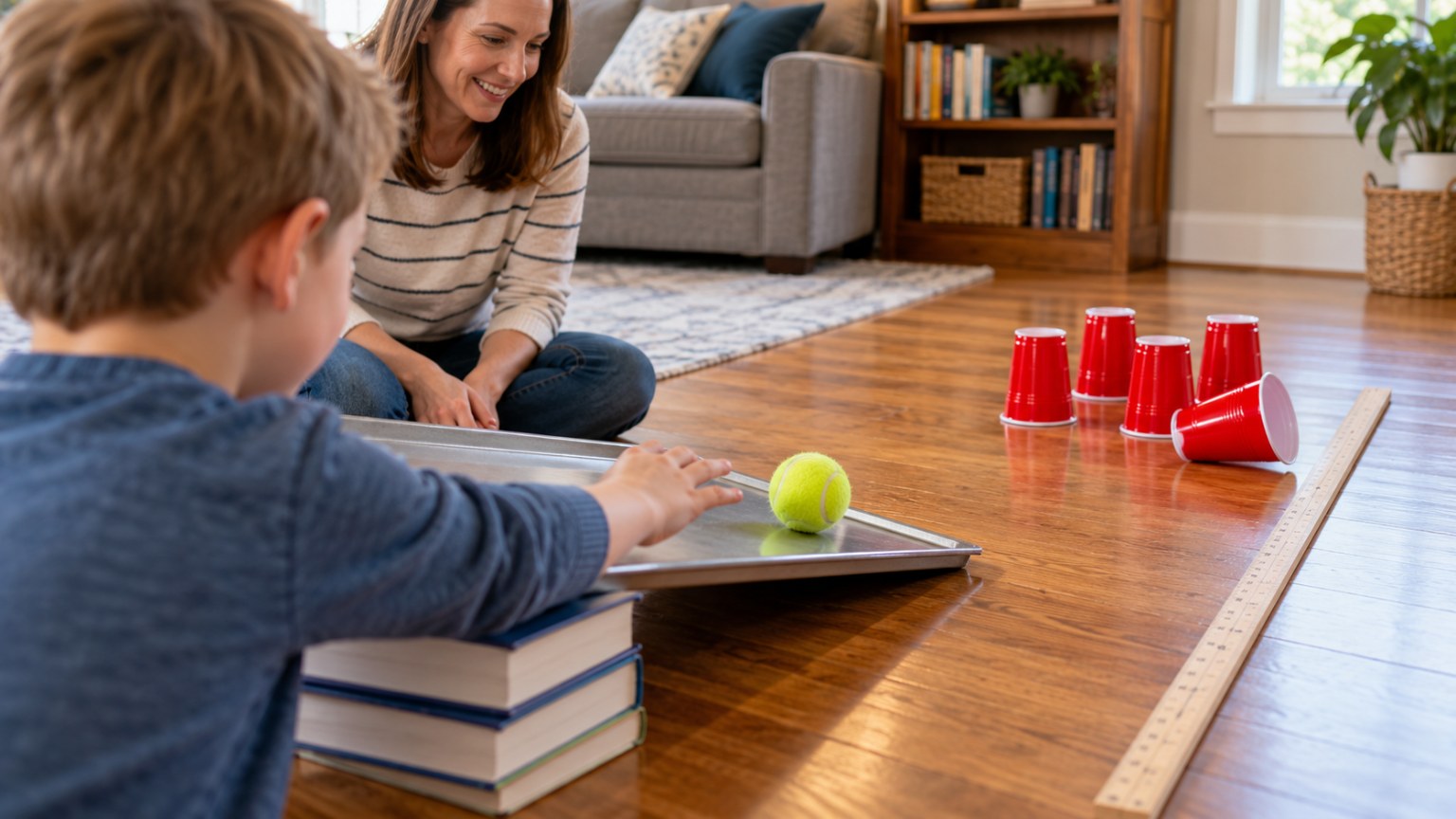
Your child sets up a sports-day bowling lane with a ramp, rolls a heavy ball and a light ball of about the same size into a plastic-cup 'pin,' measures how far the cup slides each time, and explains what the results show about mass, speed and energy in a collision.
Objective
Your child will run a fair test of how a ball's mass and speed change what happens in a collision, measure results in centimeters, and explain them using the idea of energy transfer.
Materials
| Item | Quantity |
|---|---|
| Two balls of about the same size but different weight (tennis ball and a ping-pong ball or foam ball, or a baseball and a whiffle ball) | 2 |
| Stiff board, baking sheet or large hardcover book for a ramp | 1 |
| Books to prop up the ramp | 3-4 |
| Plastic cup (the pin) | 1 |
| Meter stick or tape measure with centimeters | 1 |
| Painter's tape, paper and pencil | 1 roll, 1 sheet, 1 pencil |
Vocabulary
Preparation
- Prop one end of the ramp on 2 books on a smooth floor. Tape a start line at the top of the ramp and an X on the floor 30 centimeters past the bottom of the ramp for the cup.
- Make a chart with columns for ball, ramp height, Try 1, Try 2, Try 3 and Average slide (cm).
Introduction
Roll the ping-pong ball into the cup, then the tennis ball. Ask: 'Same ramp, same cup. Why did one crash knock the pin so much farther?'
At a sports day bowling station, which ball would you choose and why?
What could make a ball hit harder besides being heavier?
Steps
Conclusion
Ask: why do real bowling balls have so much mass? How could a sports day bowling station make the game fair for players of all ages?
Make your own lesson plan in minutes
Describe a topic and Resource Portal AI writes the objectives, materials and steps for your group.
Try Resource Portal AI