Lesson planWeight on Other Worlds: The Space Gravity Constant of Proportionality
Math45 minutesGrades: 7th
Overview
Find what things would weigh on the Moon, Mars and Jupiter.
Description
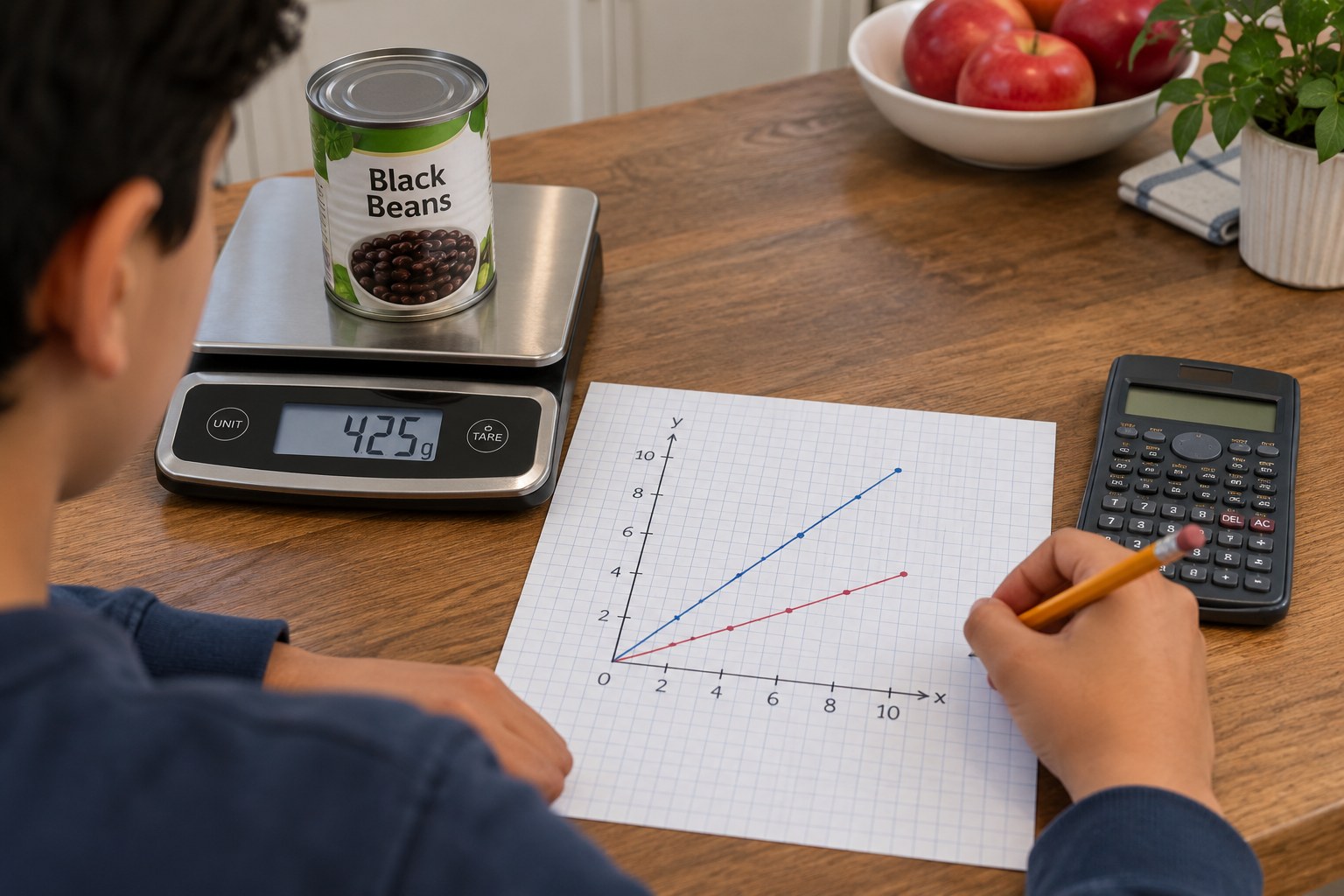
Your teen weighs household objects on a kitchen or bathroom scale, uses each world's gravity factor as a constant of proportionality to find what they would weigh on the Moon, Mars and Jupiter, then graphs Earth weight against Mars weight to prove the relationship is proportional.
Objective
Your teen will identify the constant of proportionality between Earth weight and weight on another world, use it in tables, equations and a graph, and explain the difference between mass and weight.
Standards
7.RP.2aMath · Grade 7 · Ratios & Proportional Relationships Decide whether two quantities are in a proportional relationship, e.g., by testing for equivalent ratios in a table or graphing on a coordinate plane and observing whether the graph is a straight line through the origin.
7.RP.2bMath · Grade 7 · Ratios & Proportional Relationships Identify the constant of proportionality (unit rate) in tables, graphs, equations, diagrams, and verbal descriptions of proportional relationships.
Materials
| Item | Quantity |
|---|
| Kitchen scale or bathroom scale | 1 |
| 5-6 household objects of different weights (a can of beans, a book, a bag of flour, a shoe, a full backpack) | 5-6 |
| Graph paper and a ruler | 2 sheets and 1 |
| Calculator | 1 |
| Gravity factor card (see section below) | 1 |
Vocabulary
Mass
The amount of matter in an object; it stays the same everywhere in the universe.
Weight
The force of gravity pulling on an object's mass; it changes depending on the world you're on.
Constant of proportionality
The number k in y = kx; the fixed ratio of y to x in a proportional relationship.
Proportional relationship
A relationship where y/x is the same for every pair, and the graph is a straight line through the origin.
Surface gravity
The strength of gravity at the surface of a planet or moon, often compared to Earth's.
Preparation
- Gather the objects and the scale. Make a table with columns: Object, Earth weight, Moon weight, Mars weight, Jupiter weight.
- Copy the gravity factors onto a card: Moon 0.17, Mars 0.38, Jupiter 2.53.
Introduction
Ask: if an astronaut's backpack weighs 30 pounds on Earth, would it weigh the same on Mars? Would its mass change? Today you'll find out exactly how much it would weigh on three different worlds.
Why could astronauts on the Moon carry heavy equipment so easily?
If one world's gravity is twice another's, what happens to an object's weight?
Steps
1Step 1
Weigh on Earth
(8 min) Your teen weighs each object and records its Earth weight in the table (use pounds or grams, but keep the same unit for all). For heavy objects on a bathroom scale, they can weigh themselves holding the object and subtract.
2Step 2
Apply the constants
(10 min) Your teen multiplies each Earth weight by the Moon, Mars and Jupiter factors to complete the table. Ask them to write each relationship as an equation, such as M = 0.38E for Mars, and to say in words what 0.38 means.
3Step 3
Test for proportionality
(8 min) Your teen divides each Mars weight by its Earth weight and checks that every ratio is the same. Then they ask: if an object weighed 0 on Earth, what would it weigh on Mars?
4Step 4
Graph two worlds
(12 min) On graph paper, your teen plots Earth weight on the x-axis and Mars weight on the y-axis for every object, then does the same for Jupiter in a different color. They describe the two lines, find the point (1, k) on each, and explain why the steeper line belongs to Jupiter.
5Step 5
Reverse problems
(5 min) Your teen solves reverse problems: a rover weighs 870 pounds on Mars; what does it weigh on Earth? Your teen explains how dividing by k works and checks the answer with the table.
Conclusion
Ask: what stays the same about an object on every world, and what changes? Mass stays the same; weight is proportional to the world's surface gravity, which is why the graph is a straight line through the origin.
Make your own lesson plan in minutes
Describe a topic and Resource Portal AI writes the objectives, materials and steps for your group.
Try Resource Portal AI