Lesson planElectromagnet Coil Count: Graph Wire Wraps vs. Paper Clips Lifted
Math50 minutesGrades: 7th, 8th
Overview
Turn on a magnet with a battery, then graph its strength.
Description
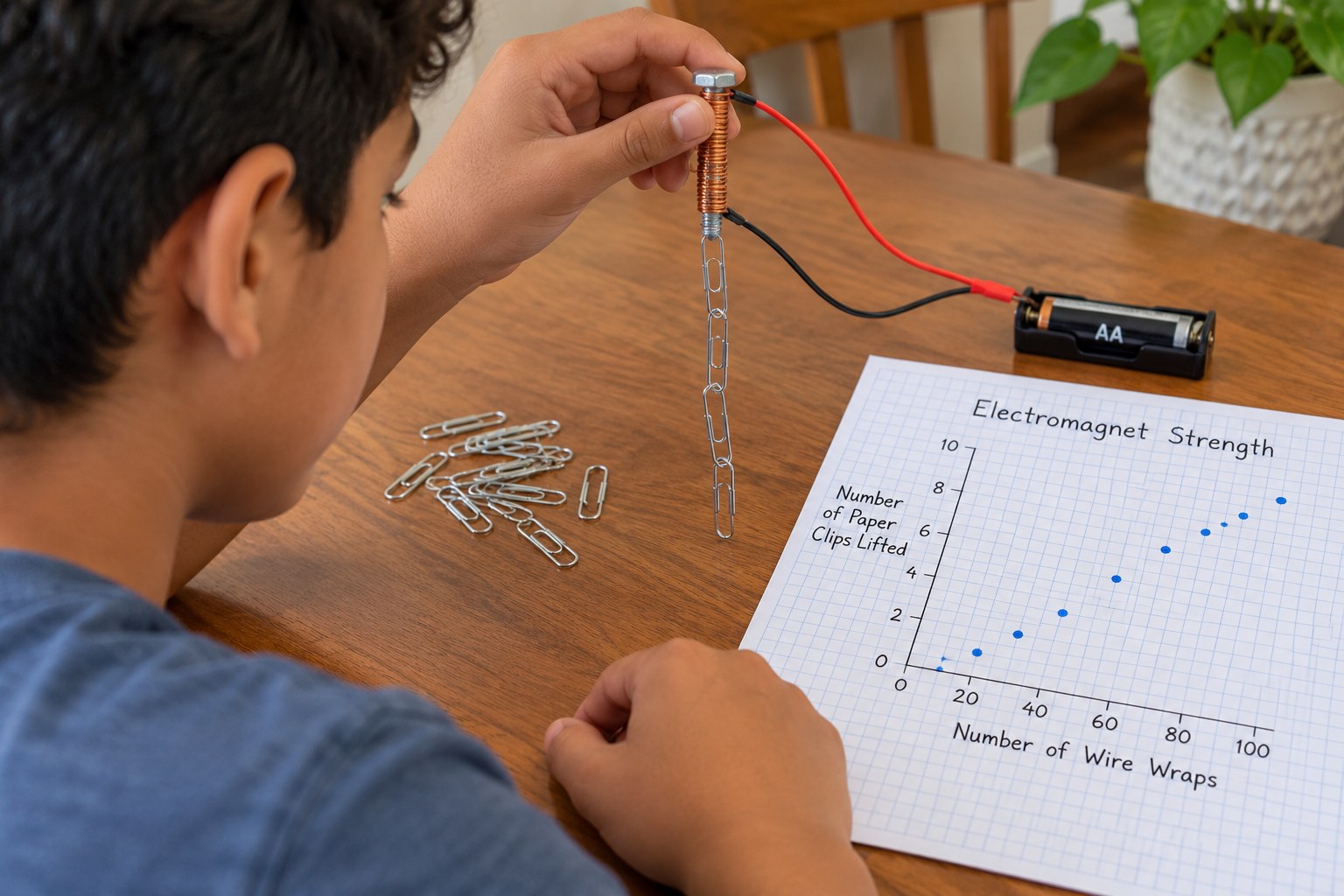
Your teen builds an electromagnet from a steel bolt, insulated wire and one AA battery, counts the paper clips it lifts with 10, 20, 30 and 40 wraps, then makes a scatter plot and decides whether the relationship is proportional.
Objective
Your teen will collect bivariate data from an electromagnet experiment, construct and interpret a scatter plot, and test whether the data show a proportional relationship.
Standards
7.RP.2aMath · Grade 7 · Ratios & Proportional Relationships Decide whether two quantities are in a proportional relationship, e.g., by testing for equivalent ratios in a table or graphing on a coordinate plane and observing whether the graph is a straight line through the origin.
8.SP.1Math · Grade 8 · Statistics & Probability Construct and interpret scatter plots for bivariate measurement data to investigate patterns of association between two quantities. Describe patterns such as clustering, outliers, positive or negative association, linear association, and nonlinear association.
Materials
| Item | Quantity |
|---|
| Large steel bolt or iron nail, about 3 inches long (not stainless steel) | 1 |
| Thin insulated copper wire (22-24 gauge) or enamel magnet wire | about 6 feet |
| AA battery | 1 |
| AA battery holder (or tape and a rubber band) | 1 |
| Small steel paper clips | about 30 |
| Sandpaper or scissors to strip wire ends (adult helps) | 1 |
| Graph paper, ruler and pencil | 1 each |
Vocabulary
Electromagnet
A magnet made by sending electric current through a coil of wire; it turns off when the current stops.
Coil
Wire wrapped in loops around a core.
Scatter plot
A graph of paired data points used to look for a relationship between two variables.
Proportional relationship
A relationship where y = kx; the graph is a straight line through the origin.
Association
A pattern in a scatter plot, such as positive, negative or none.
Preparation
- Adult: strip about 1 inch of insulation (or sand off the enamel) from both ends of the wire. Mark the wire with tape at the halfway point so the leftover wire doesn't tangle.
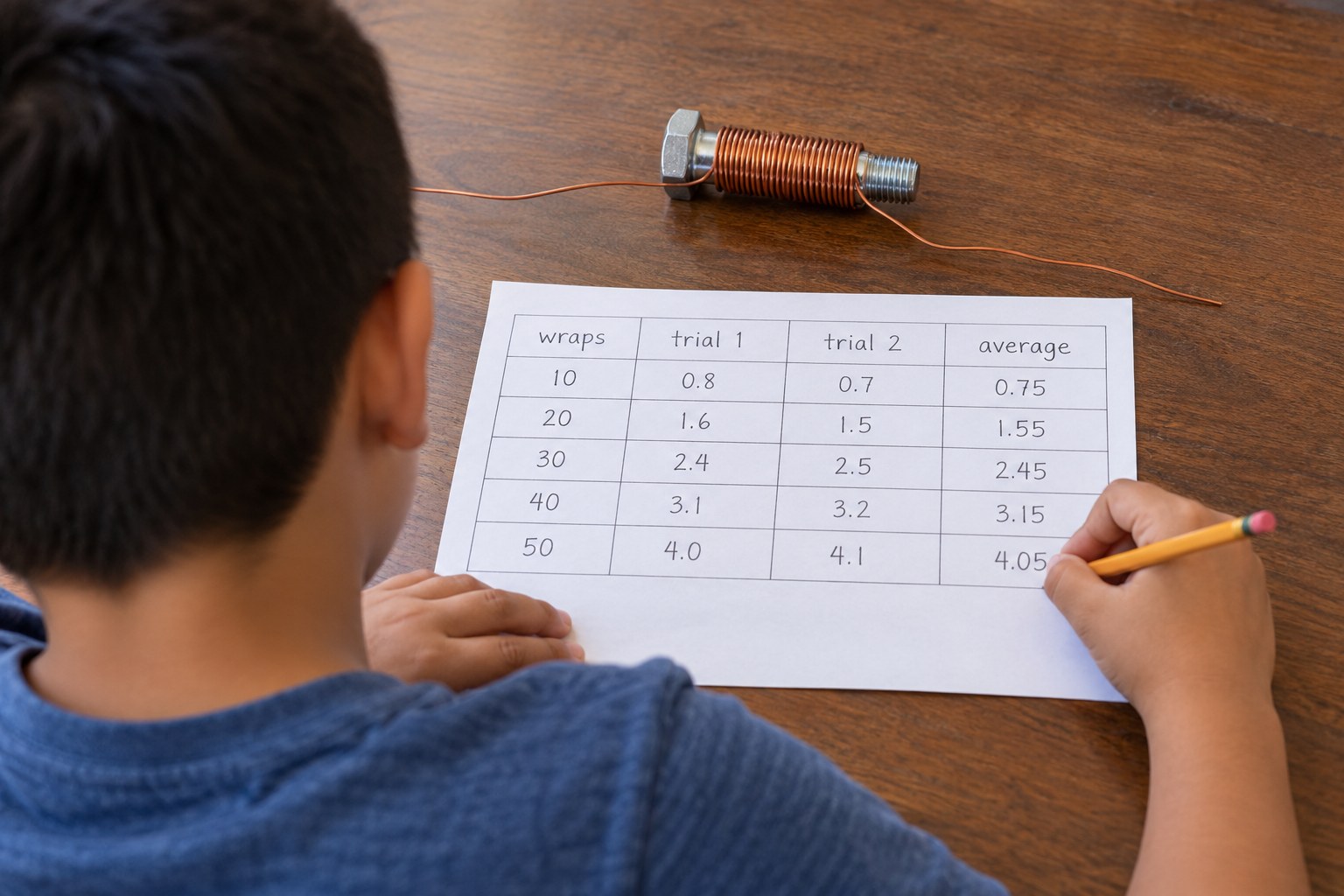
- Draw a data table with columns for Wraps, Trial 1, Trial 2 and Average clips. Set up a safe work spot away from water. Use only an AA battery: no wall outlets, no coin or button batteries.
Introduction
Touch the bolt to a pile of paper clips: nothing. Then connect the battery to a coil around it and lift a chain of clips. Disconnect and watch them fall. Ask, 'What changed?'
What variables could change how strong an electromagnet is?
If you double the wraps, do you think you'll double the clips?
Steps
1Step 1
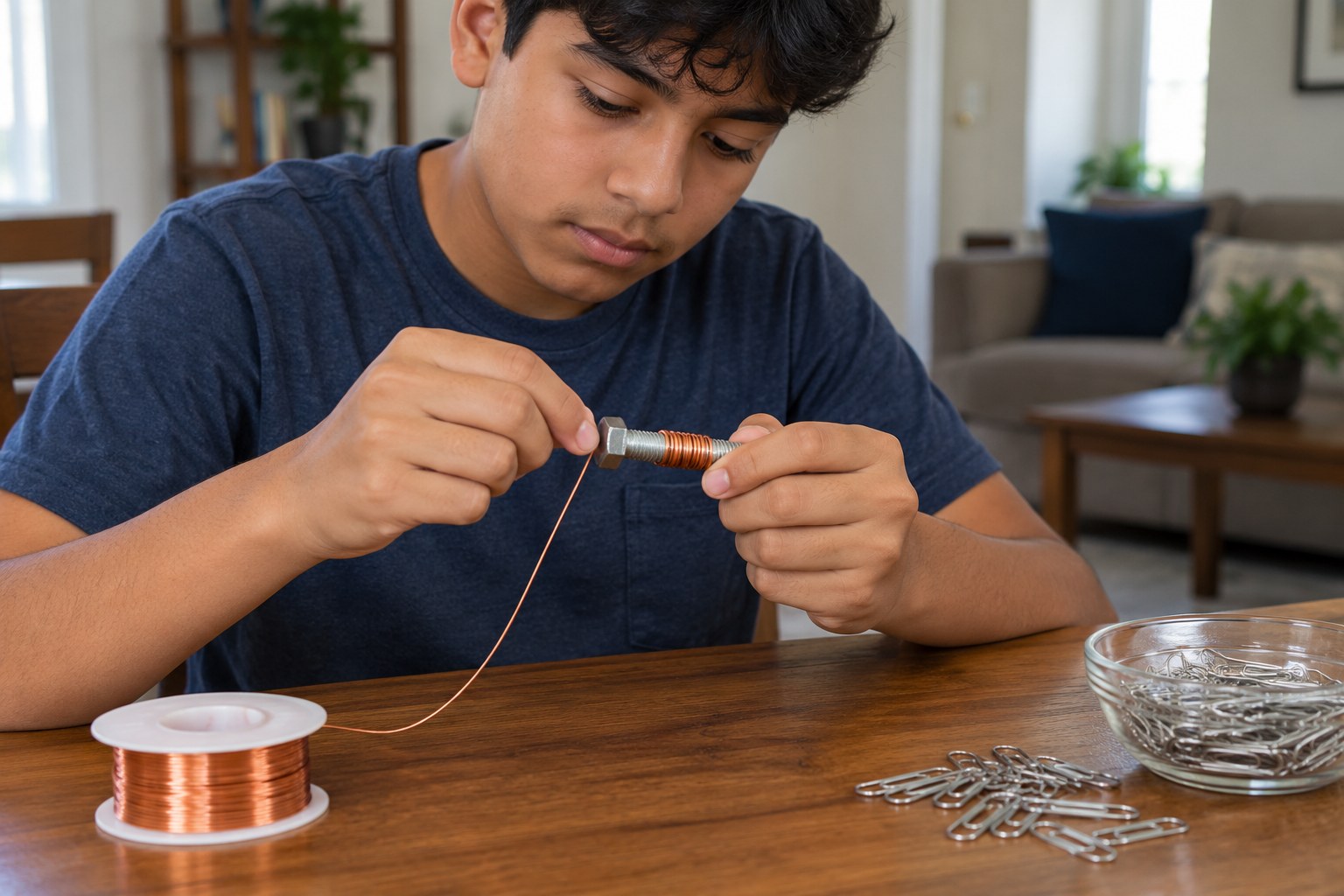
Wrap 10 coils
(8 min) Your teen leaves a 6-inch tail of wire, then wraps exactly 10 tight coils around the bolt, all in the same direction, and tapes them in place. They predict how many clips each number of wraps will lift and write the prediction down.
2Step 2
Test and record
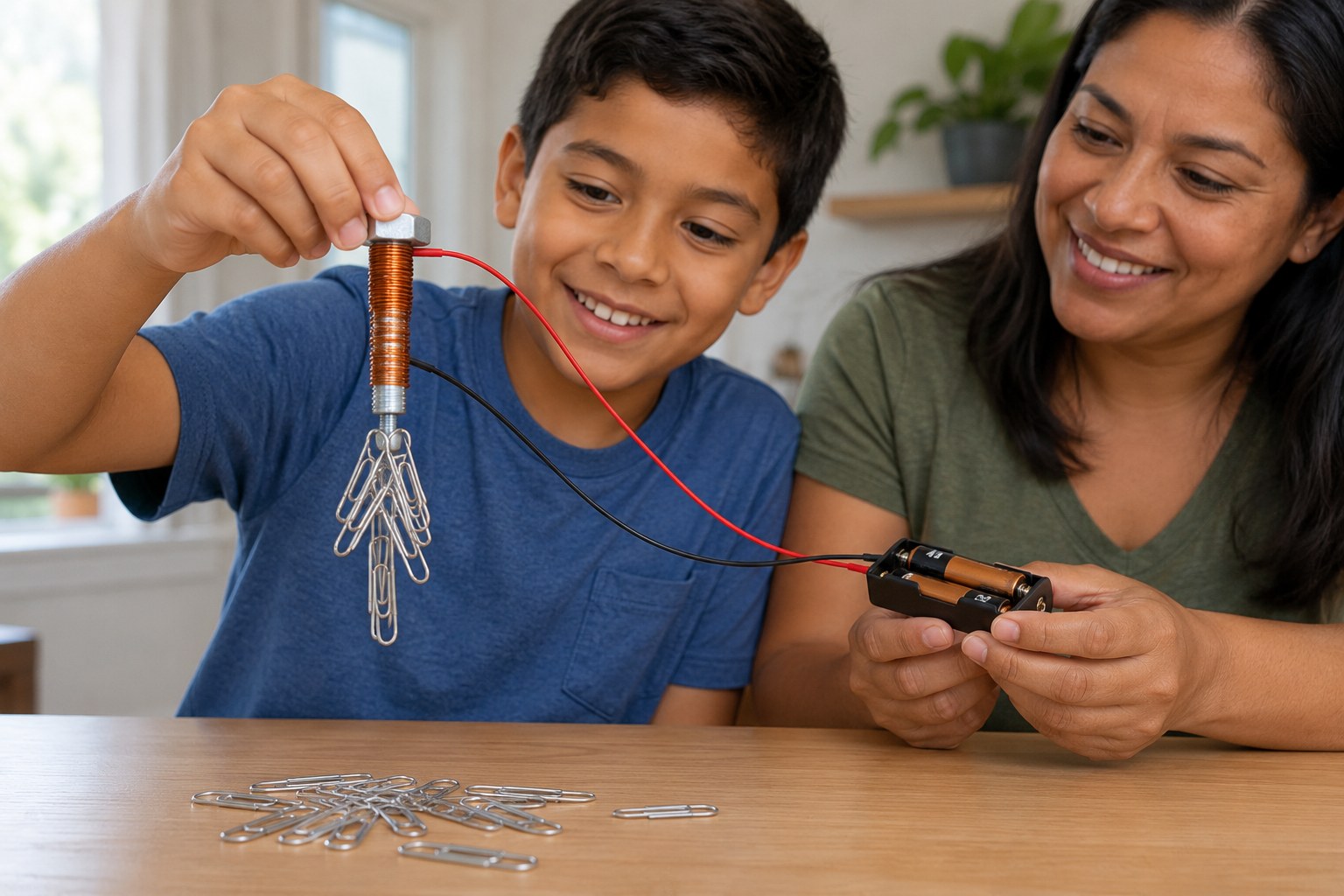
(10 min) Touch the stripped wire ends to the battery ends (in the holder) for no more than 10 seconds, dip the bolt tip into the clips, lift and count. Run 2 trials, disconnect between trials and record both counts and the average.
3Step 3
Add wraps
(12 min) Your teen adds wraps to make 20, 30 and 40 total, testing 2 trials at each and letting the battery and wire cool for 30 seconds between tests. They note any surprises, like clips that stay stuck after the power is off.
4Step 4
Make the scatter plot
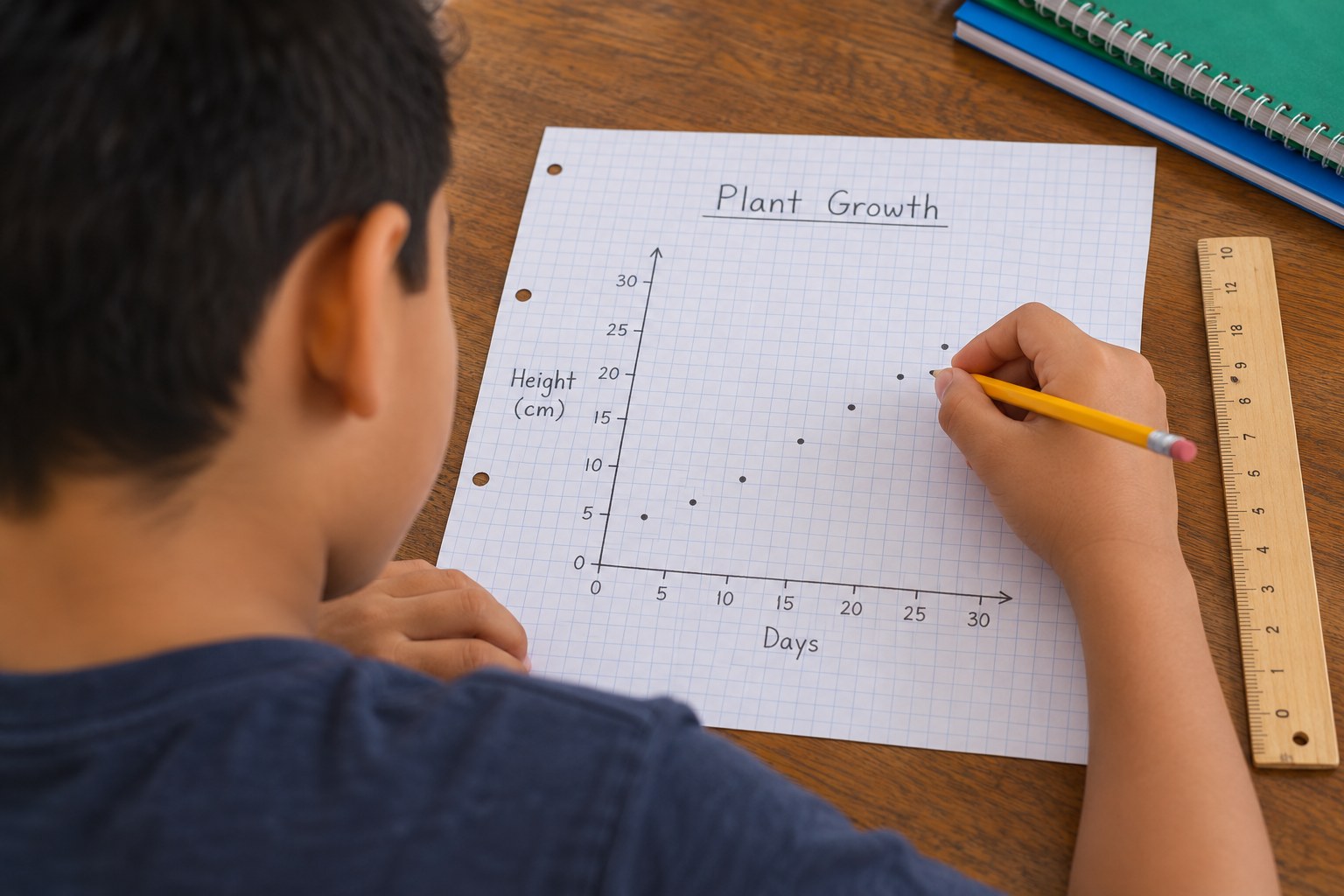
(10 min) Your teen plots wraps on the x-axis and average clips on the y-axis, using a consistent scale. They describe the association (positive, negative or none, linear or not) and circle any outliers.
5Step 5
Proportional or not?
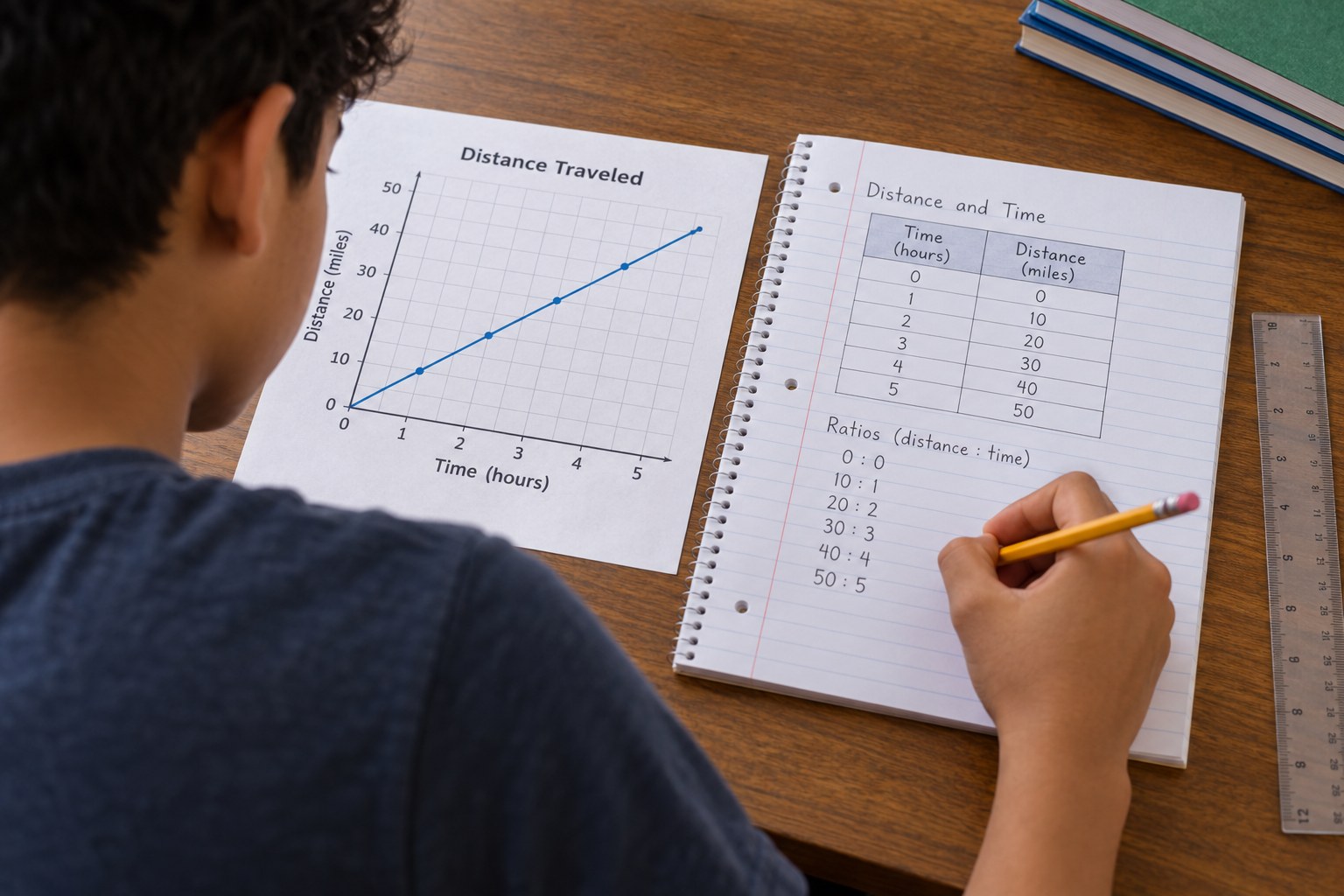
(8 min) Your teen divides clips by wraps for each row to see whether the ratio is constant, and checks whether a line through the points would pass through (0, 0). They write 3 sentences: the pattern, whether it is proportional, and one reason the data are not perfect.
Conclusion
Your teen found that more wraps generally made a stronger electromagnet, a positive association. Real data usually aren't perfectly proportional because of battery drain, loose wraps and counting limits, which is why scientists run trials and average.
Make your own lesson plan in minutes
Describe a topic and Resource Portal AI writes the objectives, materials and steps for your group.
Try Resource Portal AI