Full lesson previewCinco de Mayo Talavera Tile Geometry: Angles and Area
Math45 minutesGrades: 7th, 8th
Overview
Design a Puebla-style tile and solve for angles and area.
Description
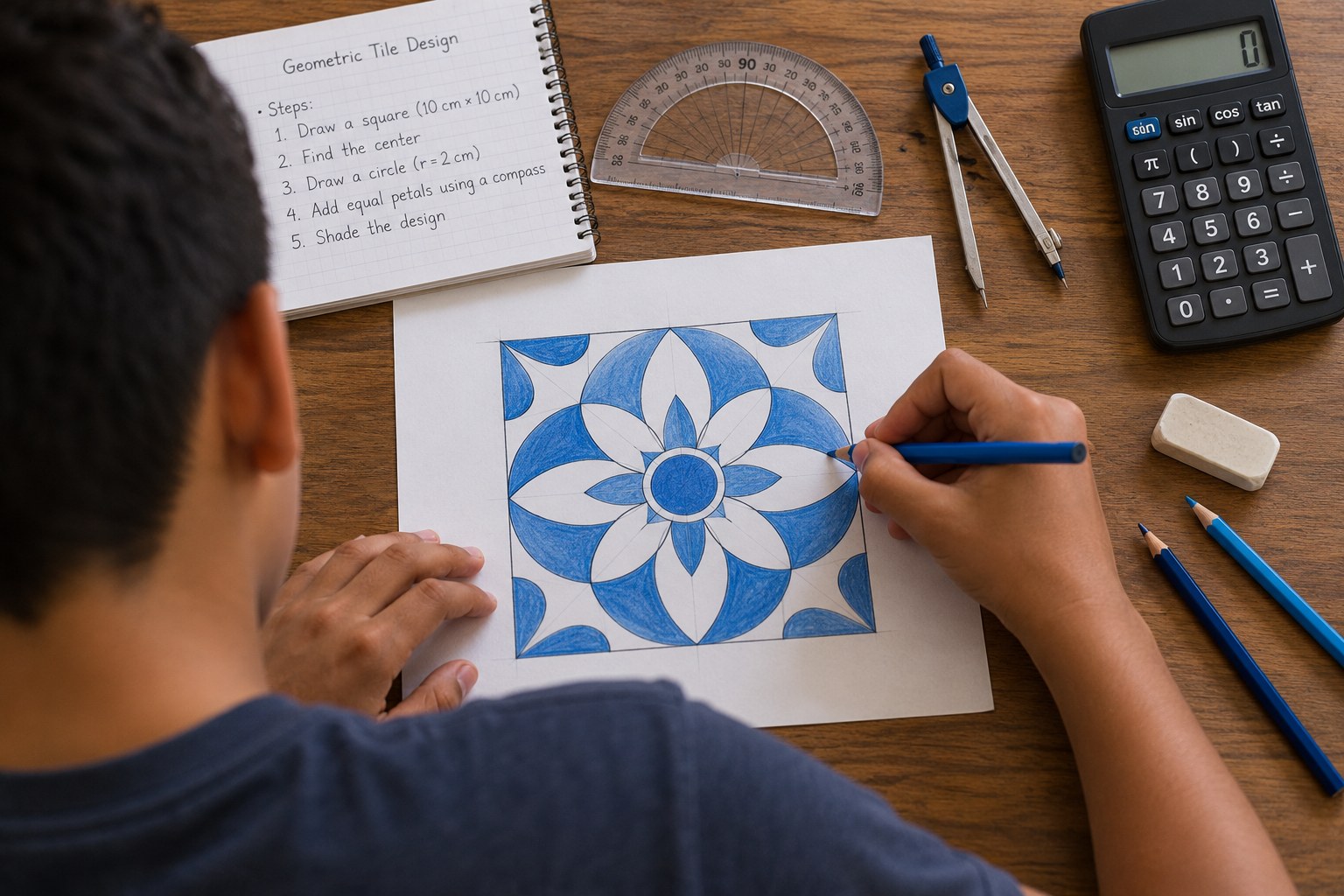
Your teen designs a Talavera-inspired tile from Puebla on a 6-inch square, using intersecting lines and a circular medallion, then uses angle relationships to find unknown angles and calculates the area of the circle and the fraction of the tile it covers.
Objective
Your teen will use supplementary, complementary, vertical and adjacent angles to write and solve equations for unknown angles, and use the circle area formula to solve a design problem.
Standards
7.G.4Math · Grade 7 · Geometry Know the formulas for the area and circumference of a circle and use them to solve problems; give an informal derivation of the relationship between the circumference and area of a circle.
7.G.5Math · Grade 7 · Geometry Use facts about supplementary, complementary, vertical, and adjacent angles in a multi-step problem to write and solve simple equations for an unknown angle in a figure.
Materials
| Item | Quantity |
|---|
| Square paper or cardstock cut to 6 x 6 inches | 2 per teen |
| Ruler, protractor and compass (or a round lid to trace) | 1 each |
| Pencil, blue fine-tip marker and colored pencils | 1 set |
| Calculator | 1 |
| Pictures of Talavera tiles (from a book or online) | a few |
Vocabulary
Talavera
Hand-painted, tin-glazed pottery and tile from Puebla and Tlaxcala, Mexico.
Vertical angles
The opposite angles formed when two lines cross; they are equal.
Supplementary angles
Two angles whose measures add to 180 degrees.
Complementary angles
Two angles whose measures add to 90 degrees.
Medallion
A circular design at the center of a tile.
Preparation
- Cut the paper into 6-inch squares and gather the tools.
- Look up a few photos of Talavera tiles with star or flower medallions.
Introduction
Show a Talavera tile photo and ask: how many different angles can you spot in this design? Explain that Puebla, the city of the Cinco de Mayo battle, is famous for this tile.
Why do tile designs need precise angles?
How could you find how much of a tile is covered by a circle?
Steps
1Step 1
Study Talavera
(5 min) Read the 'About Talavera' section and look at photos. Your teen notes how designs use diagonals, circles and repeating star or petal shapes that must meet neatly at the edges.
2Step 2
Draw the framework
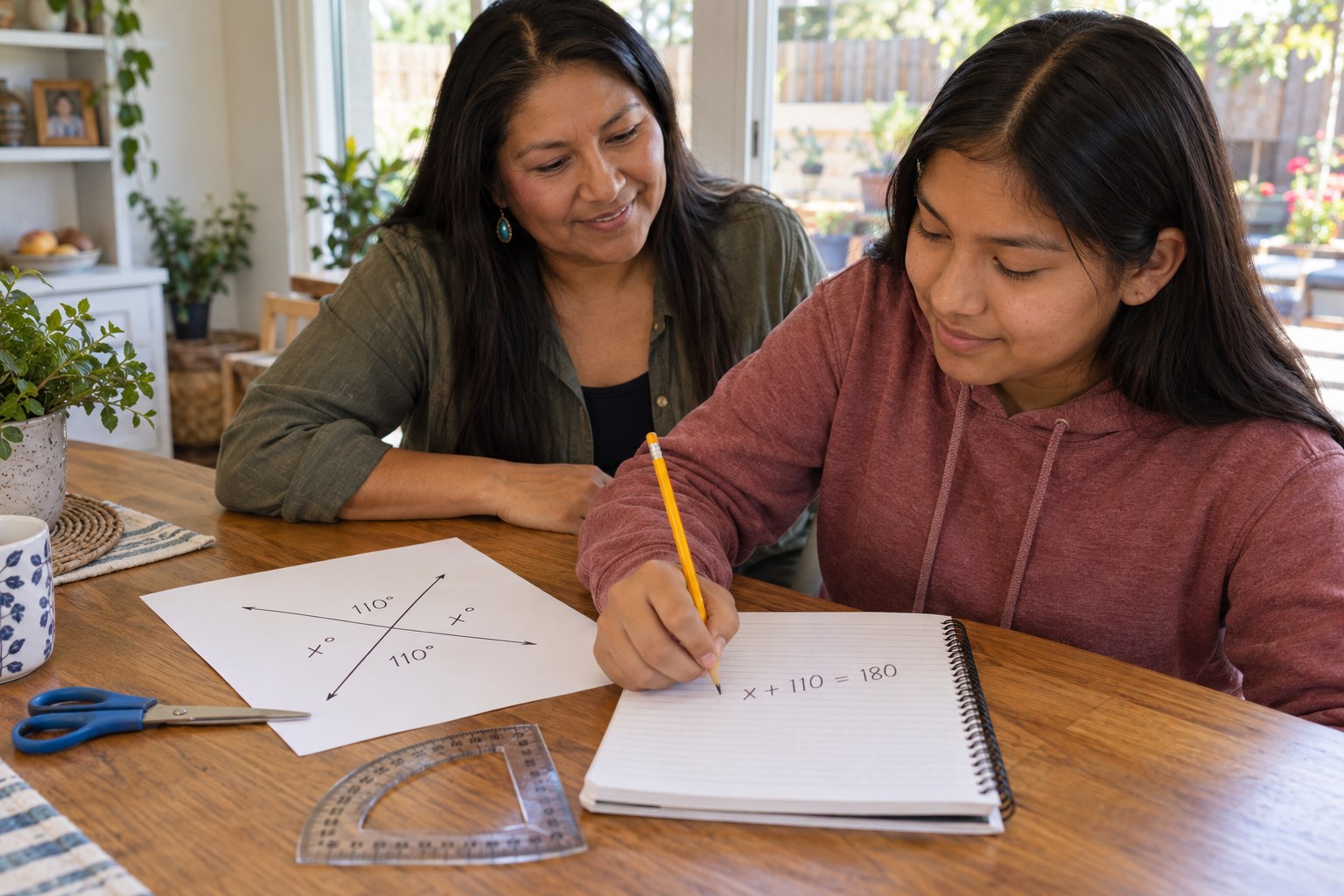
(8 min) On the 6-inch square, your teen draws both diagonals and both midlines so they cross at the center. Then they add one more line through the center at 30 degrees above the horizontal midline.
3Step 3
Solve the angles
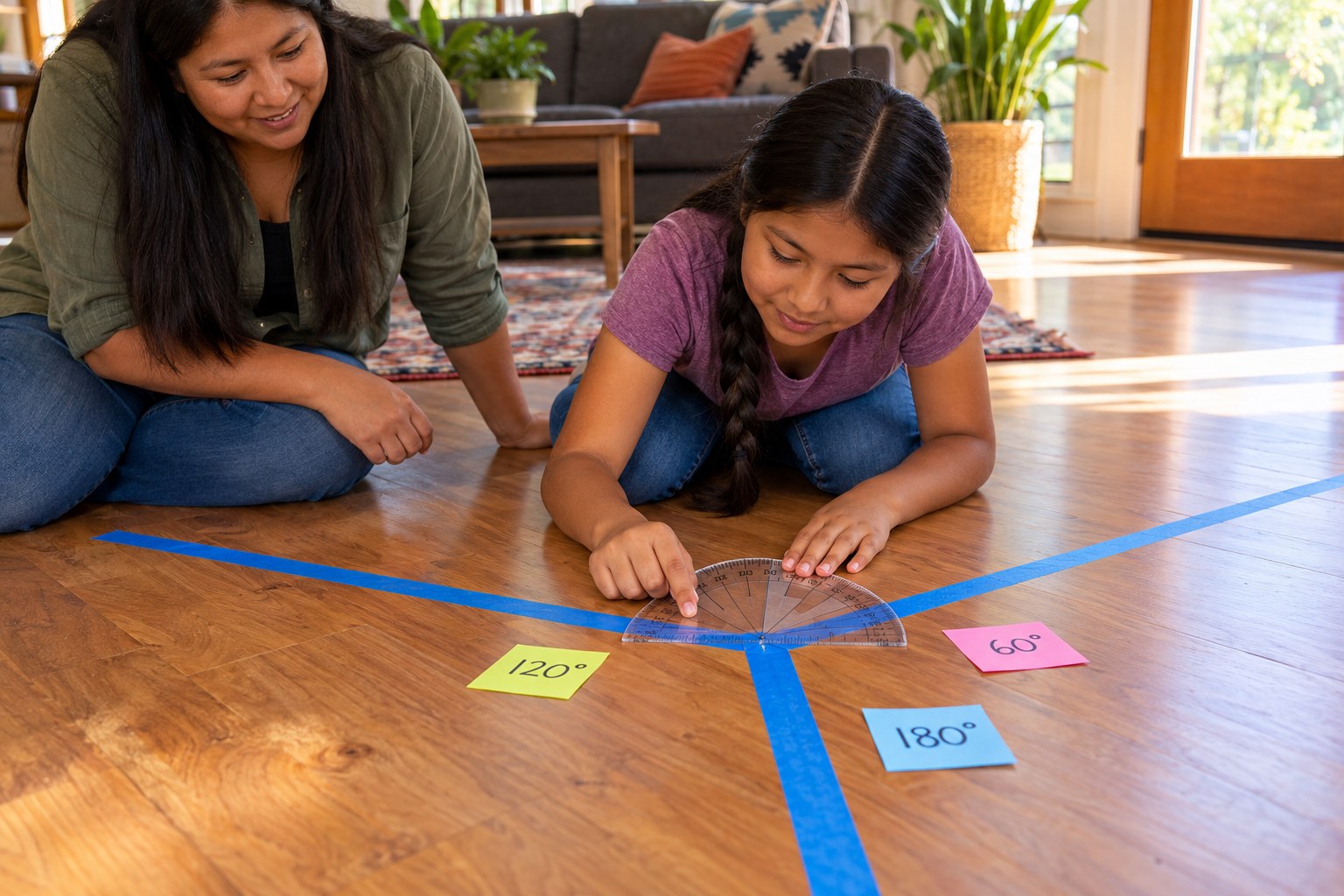
(12 min) Your teen labels the angles around the center and uses angle relationships to find each one without the protractor, writing an equation for each, such as x + 30 = 45. Then they measure with the protractor to check.
4Step 4
Add the medallion
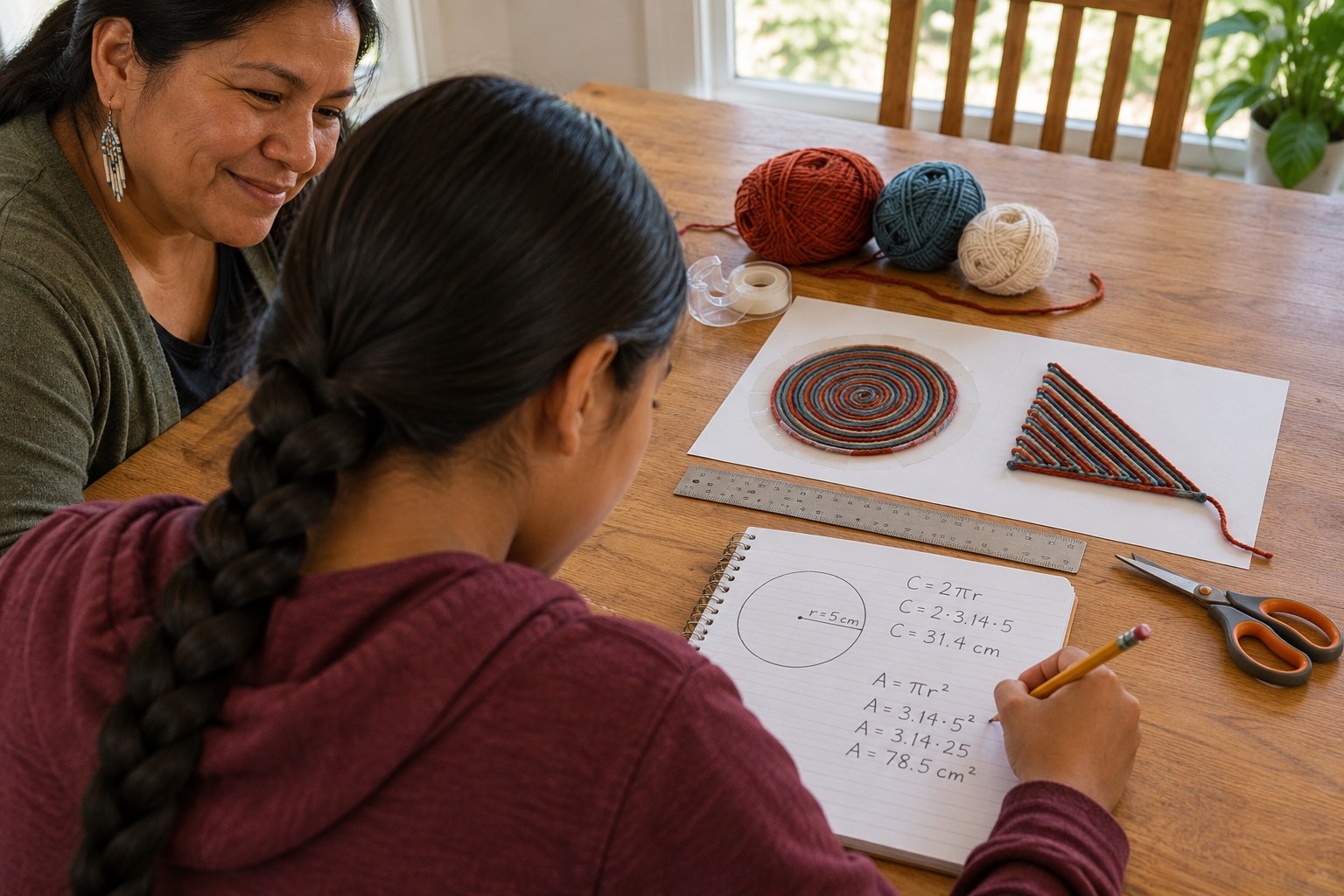
(10 min) Your teen draws a circle with radius 2 inches at the center and calculates its area and circumference. They find what percent of the 36-square-inch tile the medallion covers.
5Step 5
Paint the design
(8 min) Your teen fills the design with blue lines, petals and dots, keeping it symmetric. Place two copies side by side to see how the pattern continues across tiles.
Conclusion
Ask: which angle relationship did you use most? Talavera artisans use careful geometry so patterns line up across walls of many tiles.
Make your own lesson plan in minutes
Describe a topic and Resource Portal AI writes the objectives, materials and steps for your group.
Try Resource Portal AI