Hidden Leaf Colors: Fall Chromatography in a Jar
Overview
Reveal the yellow hiding inside green leaves.
Description
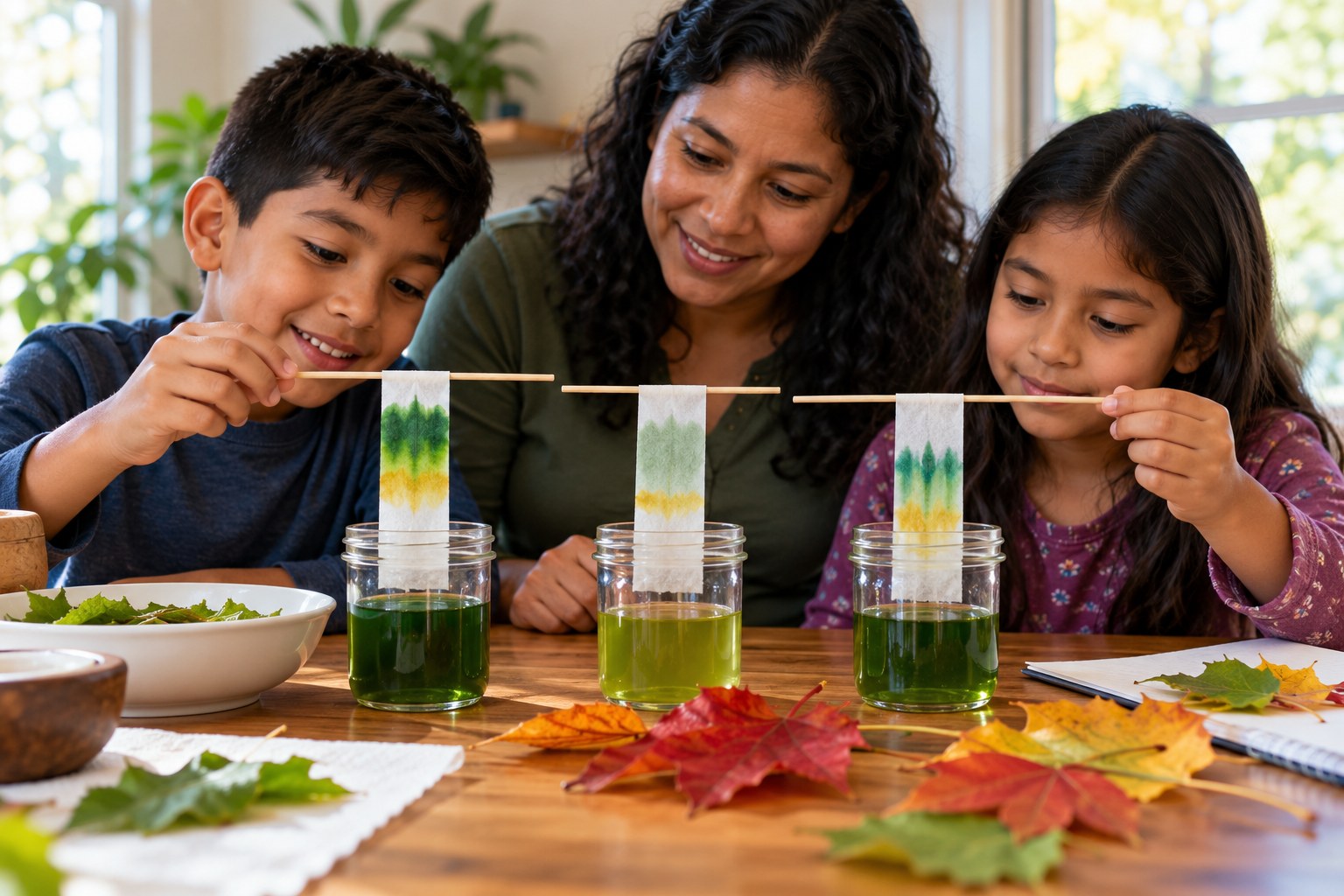
Your child reads a short science text about why leaves change color in fall, then separates the pigments in green leaves with rubbing alcohol and coffee-filter strips to find the yellow and orange colors that were hiding all along.
Objective
Your child will separate leaf pigments using paper chromatography and explain, using details from a science text, what happens to chlorophyll and the other pigments in fall and why.
Standards
Materials
| Item | Quantity |
|---|---|
| Fresh green leaves from 2-3 kinds of trees or plants (spinach works well too) | about 1/2 cup torn pieces per kind |
| Small glass jars or clear cups | 1 per kind of leaf |
| Rubbing alcohol, 70% or 91% (adult pours) | about 1/4 cup per jar |
| White coffee filters cut into 1-inch-wide strips | 1 strip per jar plus extras |
| Metal spoon for mashing | 1 |
| Pencils and tape to hang the strips | 1 per jar |
| Baking dish with warm tap water | 1 |
| Plastic wrap or foil | 1 small piece per jar |
Vocabulary
Preparation
- Collect fresh leaves that are still mostly green, plus one that is starting to turn if you can find it. Label a jar for each kind.
- Rubbing alcohol is flammable and poisonous to drink: an adult pours it, work in a room with an open window, keep it away from any flame or stove, and keep the bottle capped.
- Fill a baking dish with warm tap water (not boiling).
Introduction
Hold up a green leaf and a yellow fall leaf. Ask: where did the yellow come from? Did the tree paint the leaf, or was the yellow there all along? Today you will find out with a real science test.
What do you think makes leaves green?
Why might a tree stop keeping its leaves green in fall?
Steps
Conclusion
Ask your child to explain to someone else why a maple or ginkgo turns yellow in fall, using the words chlorophyll and carotenoids. Repeat the test in a few weeks with leaves that have started to turn.
Make your own lesson plan in minutes
Describe a topic and Resource Portal AI writes the objectives, materials and steps for your group.
Try Resource Portal AI