Full lesson previewWings That Move: Testing Active Aero With a Fan and a Kitchen Scale
STEAM60 minutesGrades: 12th
Overview
Measure downforce at five wing angles with a fan and a scale.
Description
Your teen learns how Formula 1's 2026 rules gave cars movable front and rear wing elements that switch between a high-downforce Corner Mode and a low-drag Straight Mode. They build a cardboard wing on a pivot, set it on a kitchen scale in front of a box fan, measure the downforce at five angles, fit a line to the data and use residuals to see where the model breaks down.
Objective
Your teen will design a fair test of wing angle and downforce, fit a linear function to the data, use it to predict, and judge the fit with residuals.
Standards
S-ID.6aMath · Grade HS · High School: Statistics & Probability — Interpreting Categorical & Quantitative Data Fit a function to the data; use functions fitted to data to solve problems in the context of the data.
Materials
| Item | Quantity |
|---|
| Box fan | 1 |
| Digital kitchen scale (grams) | 1 |
| Piece of stiff cardboard, about 15 × 25 cm | 1 |
| Pencil or wooden skewer for the pivot | 1 |
| Small cardboard box or block as a stand | 1 |
| Masking tape | 1 roll |
| Protractor | 1 |
| Sheet of graph paper | 1 |
| Notebook and pencil | 1 each |
Vocabulary
Downforce
A downward aerodynamic force that pushes a car onto the track, giving the tires more grip in corners.
Drag
The aerodynamic force that resists a car's forward motion and limits top speed.
Angle of attack
The angle between a wing and the oncoming air; a steeper angle usually makes more downforce and more drag, until the flow breaks away.
Active aerodynamics
Wing parts that move while driving; in F1's 2026 rules, Corner Mode closes the wing elements for downforce and Straight Mode opens them to cut drag.
Preparation
- Tape the small box or block to the kitchen scale so it is stable, and make sure the fan is on a separate surface so its vibration does not touch the scale.
- Cut the cardboard into a wing about 15 × 25 cm and poke the pencil or skewer through two holes in the stand so the wing can tilt and be taped at each angle.
Introduction
Ask your teen: a race car's wing works like an upside-down airplane wing. If a plane's wing lifts it up, what does an upside-down wing do to a car, and why would a team ever want to open it on a straight?
What do you gain and lose by adding more wing angle?
What needs to stay the same in every trial for the test to be fair?
Steps
1Step 1
Learn Corner Mode and Straight Mode
(8 min) Your teen reads the active-aero note in Additional Sections and sketches in the notebook how a wing deflects air upward to push the car down. They write a prediction of how downforce will change from 0° to 20°.
2Step 2
Build the test rig
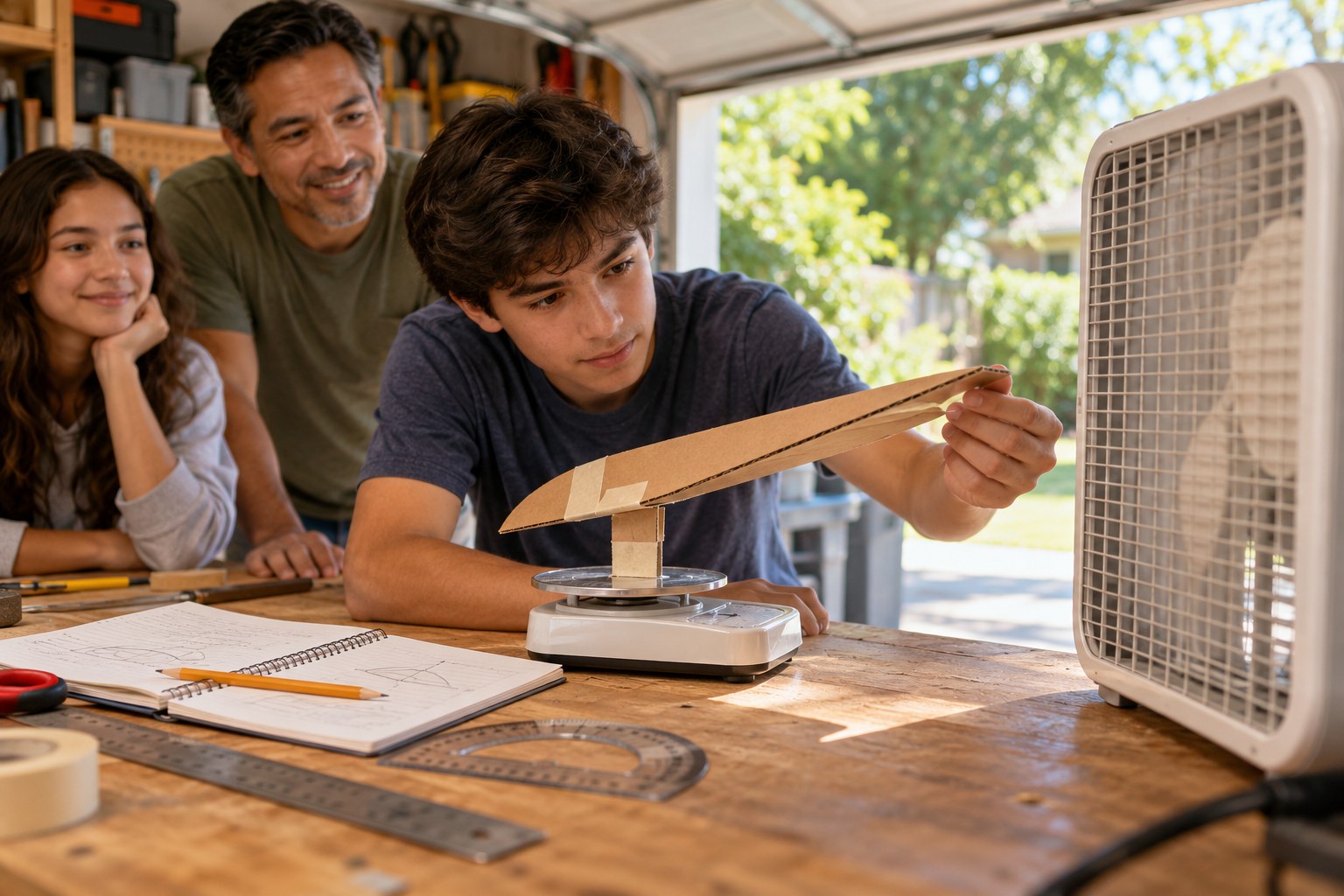
(12 min) Your teen tapes the cardboard wing to the pencil or skewer pivot on the stand so its front edge is lower than its back edge, the shape that makes downforce. They set the box fan about 30 cm away, level with the wing, use the protractor to set 0°, and zero the kitchen scale with the fan off.
3Step 3
Measure five angles
(15 min) With the fan on high, your teen records the scale reading in grams at 0°, 5°, 10°, 15° and 20°, taping the wing at each angle with the masking tape and waiting 10 seconds for the number to settle. They repeat each angle twice and record the average in the notebook.
4Step 4
Graph and fit a line
(12 min) On the graph paper your teen plots average downforce against angle and fits a line by eye or with a calculator. They write the equation and use it to predict the reading at 12°.
5Step 5
Check the model and explain the trade-off
(13 min) Your teen works the sample-data problems in Additional Sections, finds the residuals and looks for a curve in them. They write a paragraph on why a wing gains less downforce at steep angles and why F1 opens the wing on straights, then check their work with the answer key.
Conclusion
Ask your teen: 'Why not just run the biggest wing all the time?' Every bit of downforce costs drag, which is exactly why movable wings matter.
Make your own lesson plan in minutes
Describe a topic and Resource Portal AI writes the objectives, materials and steps for your group.
Try Resource Portal AI