Full lesson previewDraw Your Own Chibi: Proportions With a Head-Count Grid
Arts & Crafts50 minutesGrades: 9th
Overview
Same character, three heights: learn the head-count grid behind chibi.
Description
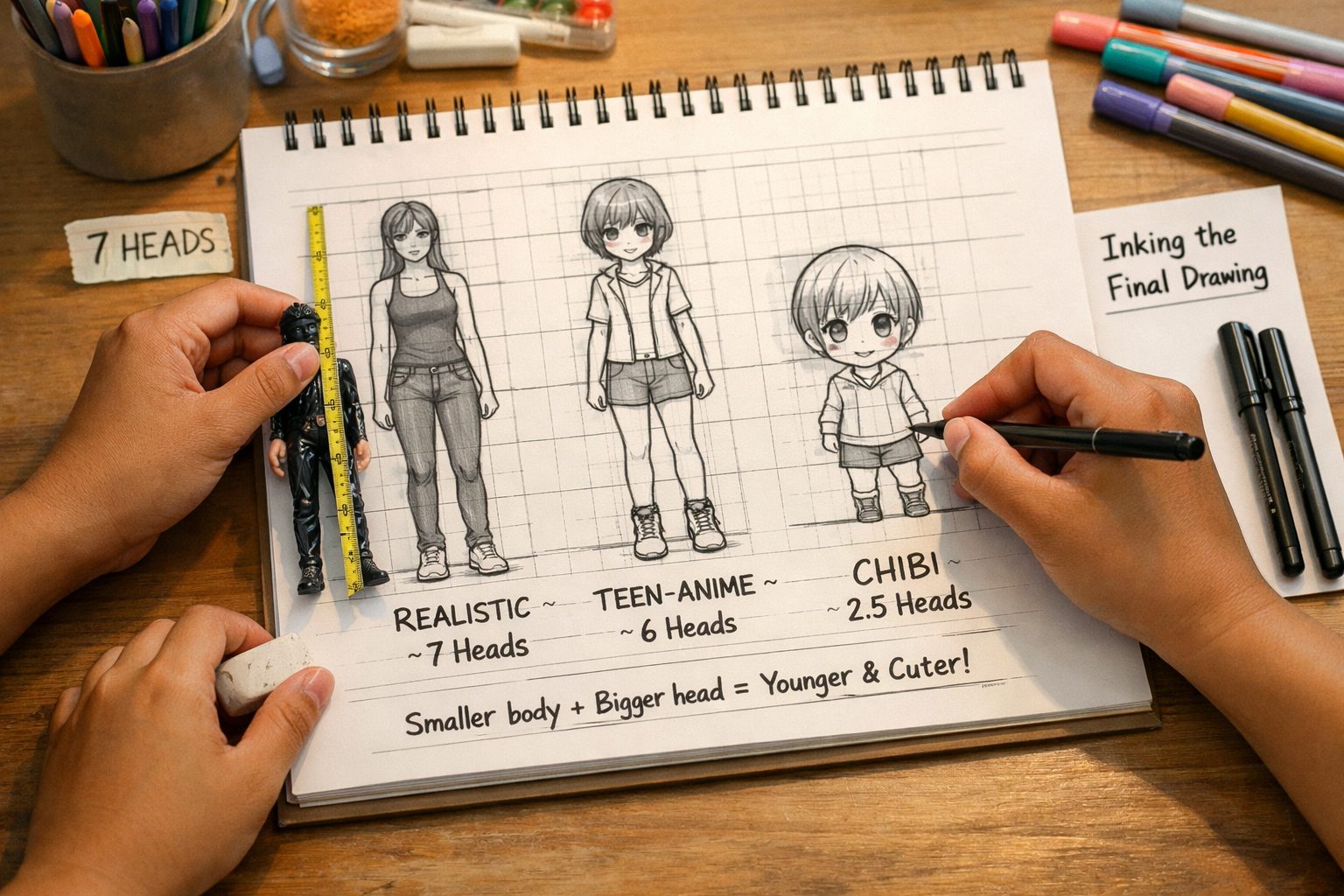
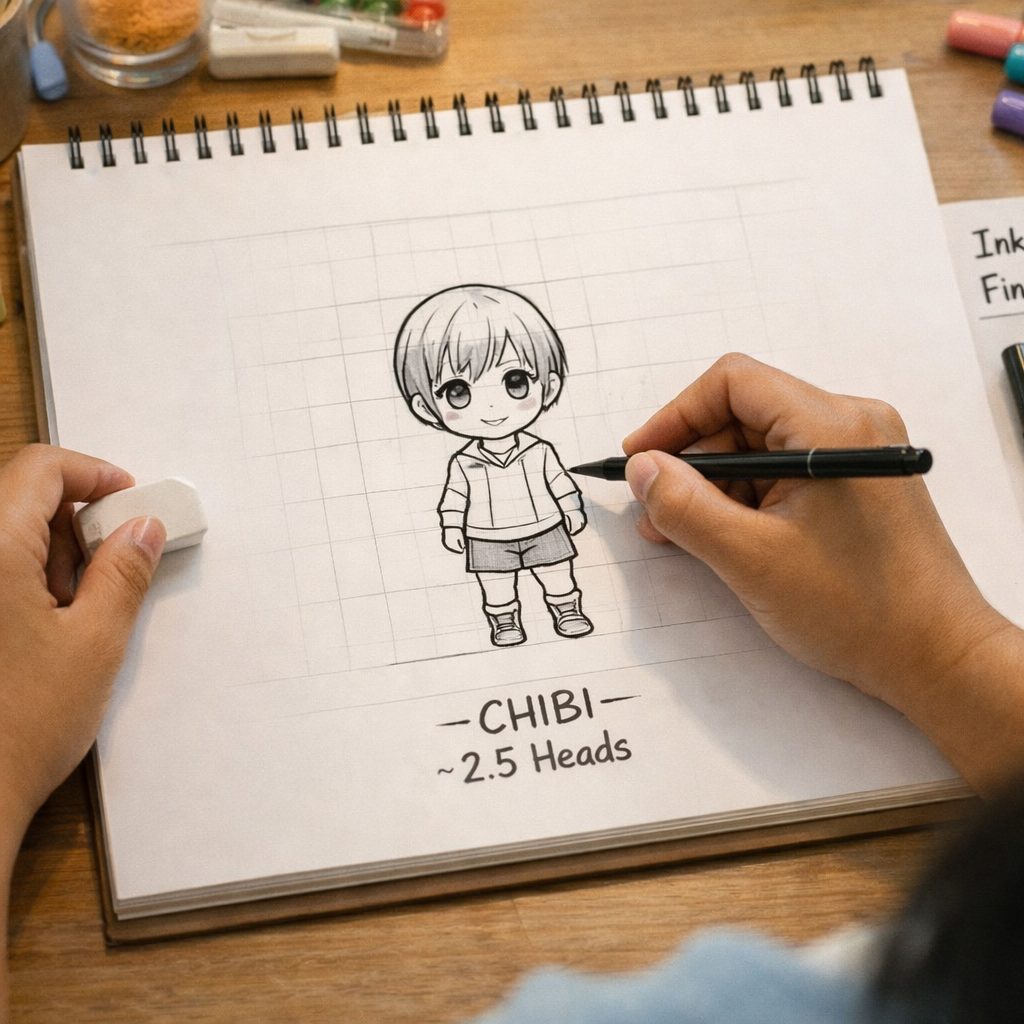
Your teen measures a real standing figure in 'heads,' then draws one original character three ways on a ruled pencil grid: realistic at about 7 heads tall, teen-anime at about 6, and chibi at about 2.5. They refine faces and hands for each version, ink the strongest one with fine-tip pens, and explain how shrinking the body and enlarging the head changes age, mood and cuteness.
Objective
Your teen will measure figure proportions in head units, block three versions of one original character at about 7, 6 and 2.5 heads tall, and explain how proportion changes how old, serious or cute a character reads.
Materials
| Item | Quantity |
|---|
| Sheets of plain or grid paper | 3 |
| Ruler | 1 |
| HB pencil | 1 |
| Kneaded eraser | 1 |
| Fine-tip black pens (one thin, one medium) | 2 |
| Phone with a full-length photo of a standing person (a family photo works) | 1 |
Vocabulary
Head unit
The height of a figure's head from chin to crown, used as a ruler to measure the rest of the body.
Proportion
The size of each body part compared with the others and with the whole figure.
Chibi
A style that draws characters very short, often 2 to 3 heads tall, with a big head and simplified body to look young and cute.
Landmark
A key point on the body, such as the chin, shoulders, waist, hips or knees, that you mark before drawing details.
Preparation
- Find or take one full-length photo of a family member standing straight, feet visible.
- Clear a table with good light and set out the 3 sheets of paper, ruler, HB pencil and kneaded eraser.
Introduction
Hold up any phone photo of a person standing. Ask: if you had to measure this person using only their own head as a ruler, how many heads tall would they be? Then ask how many heads tall a cute mascot or a tiny chibi sticker character looks.
Why do you think a big head on a small body reads as young or cute?
What has to stay the same so a character is still recognizable when you shrink them?
Steps
1Step 1
Measure in heads
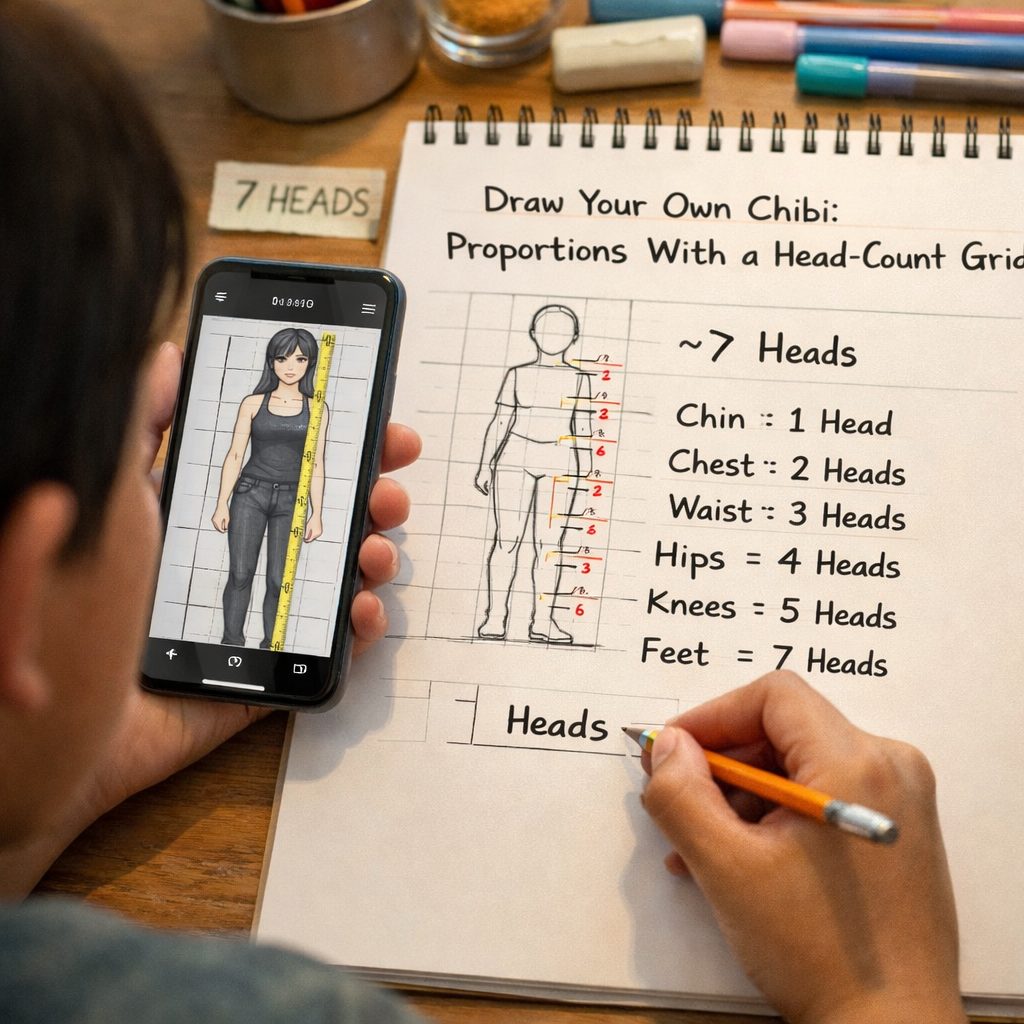
(8 min) Your teen opens the phone photo, uses the ruler on the screen or a printout to measure the head from chin to crown, then counts how many head lengths fit from the top of the head to the feet. They write the result on the first sheet of paper (most adults land around 7 to 7.5) and note where the chin, chest, waist, hips and knees fall in head units.
2Step 2
Rule three head-count grids
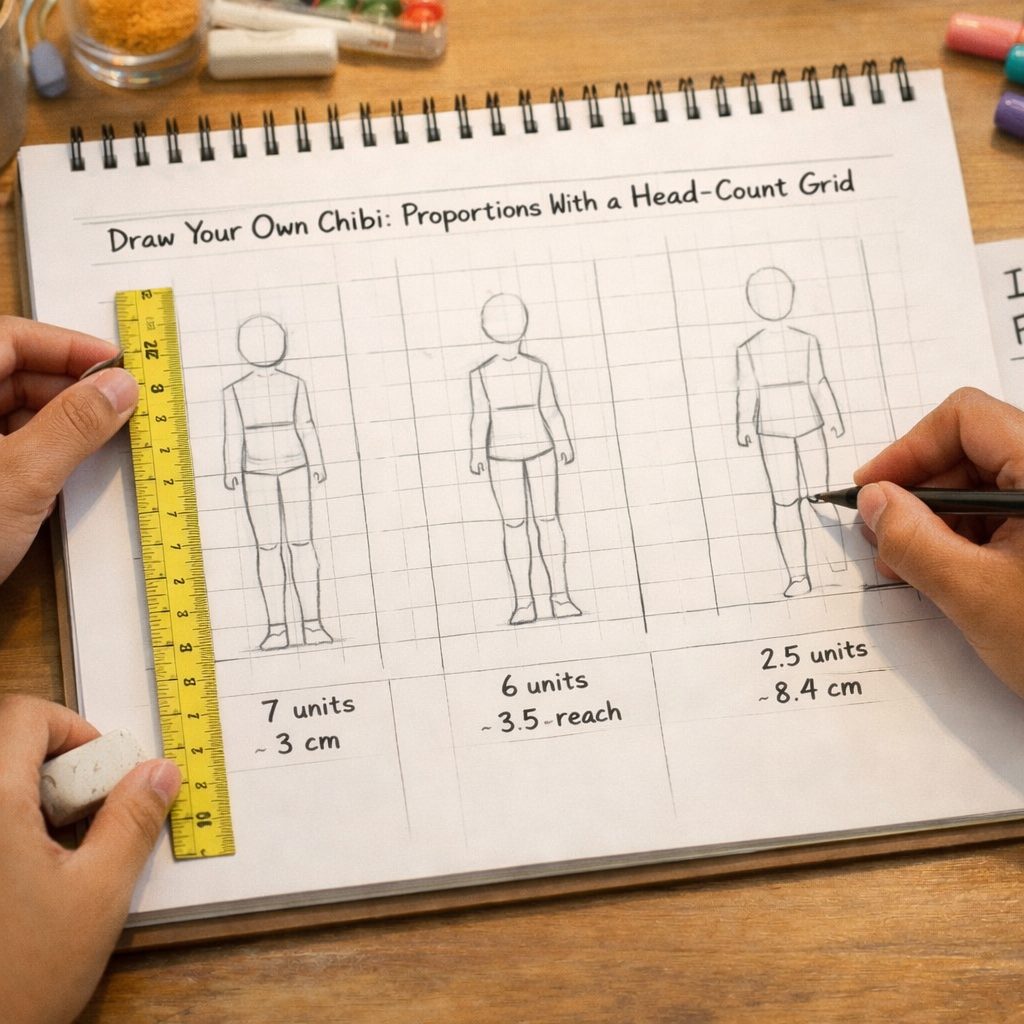
(12 min) On the second sheet of paper your teen uses the ruler and HB pencil to draw three columns of the same total height, 21 cm. They divide the first into 7 units of 3 cm, the second into 6 units of 3.5 cm, and the third into 2.5 units of 8.4 cm, then block a light stick figure with shoulder, hip and knee landmarks in each column.
3Step 3
Design one character, three ways
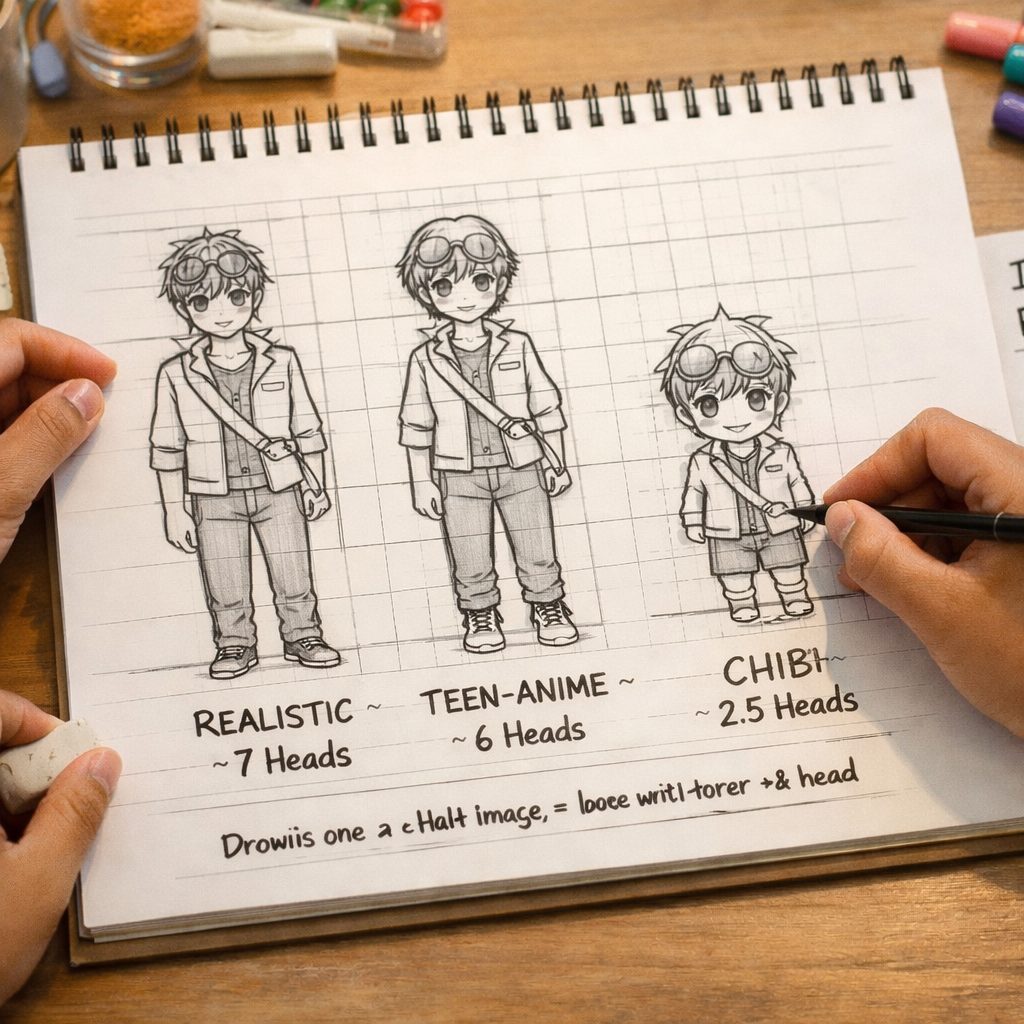
(12 min) Your teen invents an original character with three recognizable features, such as a hair shape, a jacket and one accessory, and draws that same character over all three grids in pencil. They check that every version keeps the three features even as the chibi's legs shrink to about one head and the torso to about half a head.
4Step 4
Refine faces and hands
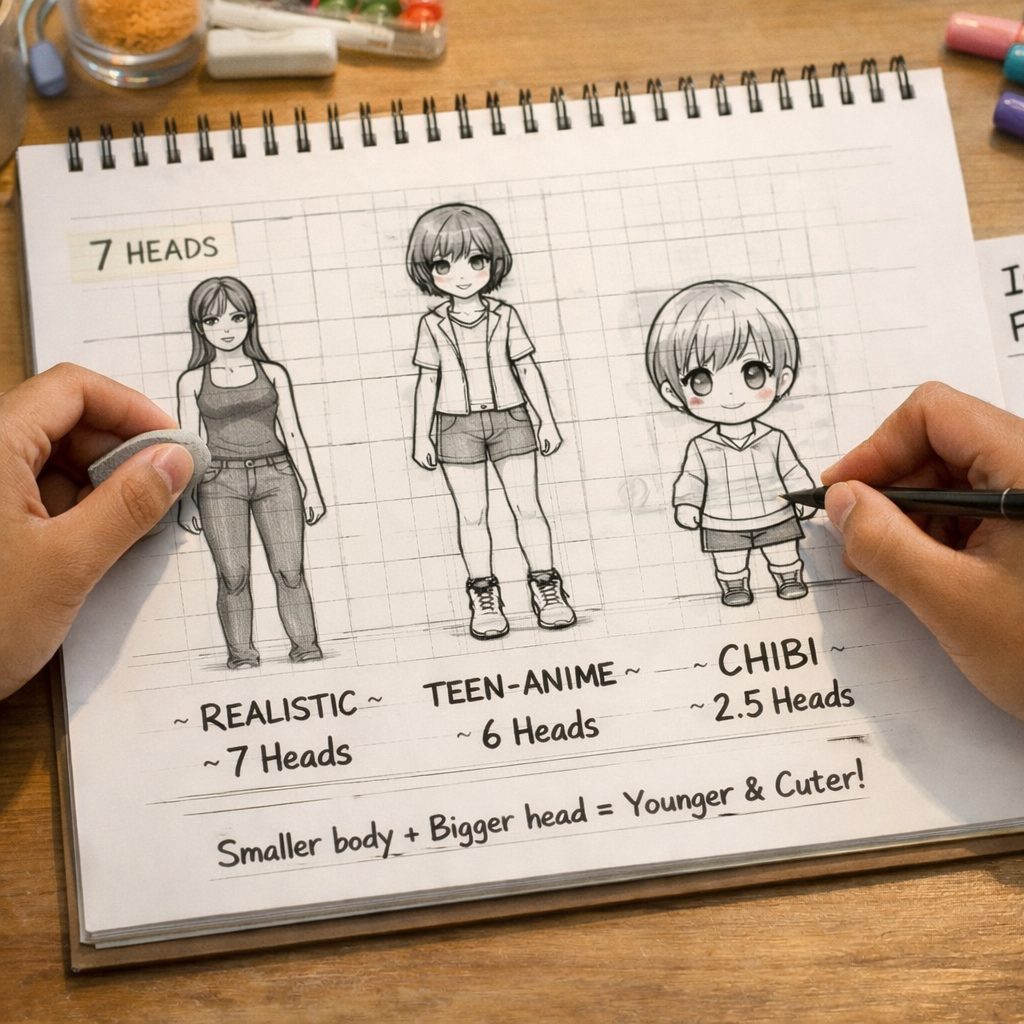
(10 min) Your teen refines each face: on the realistic figure the eyes sit about halfway down the head, while on the chibi they drop lower and grow much larger. They simplify the chibi's hands into small mitten shapes, keep fingers on the realistic figure, and use the kneaded eraser to lift extra grid lines.
5Step 5
Ink the best one
(8 min) Your teen chooses their favorite version and inks it on the third sheet of paper or over the pencil, using the medium fine-tip pen for outlines and the thin pen for faces and details. After the ink dries for a minute they erase the pencil and tell you, in two sentences, how the proportion changed the character's age and mood.
Conclusion
Ask your teen which version felt most like the character and why. Proportion is a choice artists make on purpose, and now they can make it on purpose too.
Make your own lesson plan in minutes
Describe a topic and Resource Portal AI writes the objectives, materials and steps for your group.
Try Resource Portal AI