Lesson planShoe Print Detectives: Measure to the Quarter Inch and Make a Line Plot
Math40 minutesGrades: 3rd, 4th, 5th
Overview
Measure shoe prints and use a line plot to solve the case.
Description
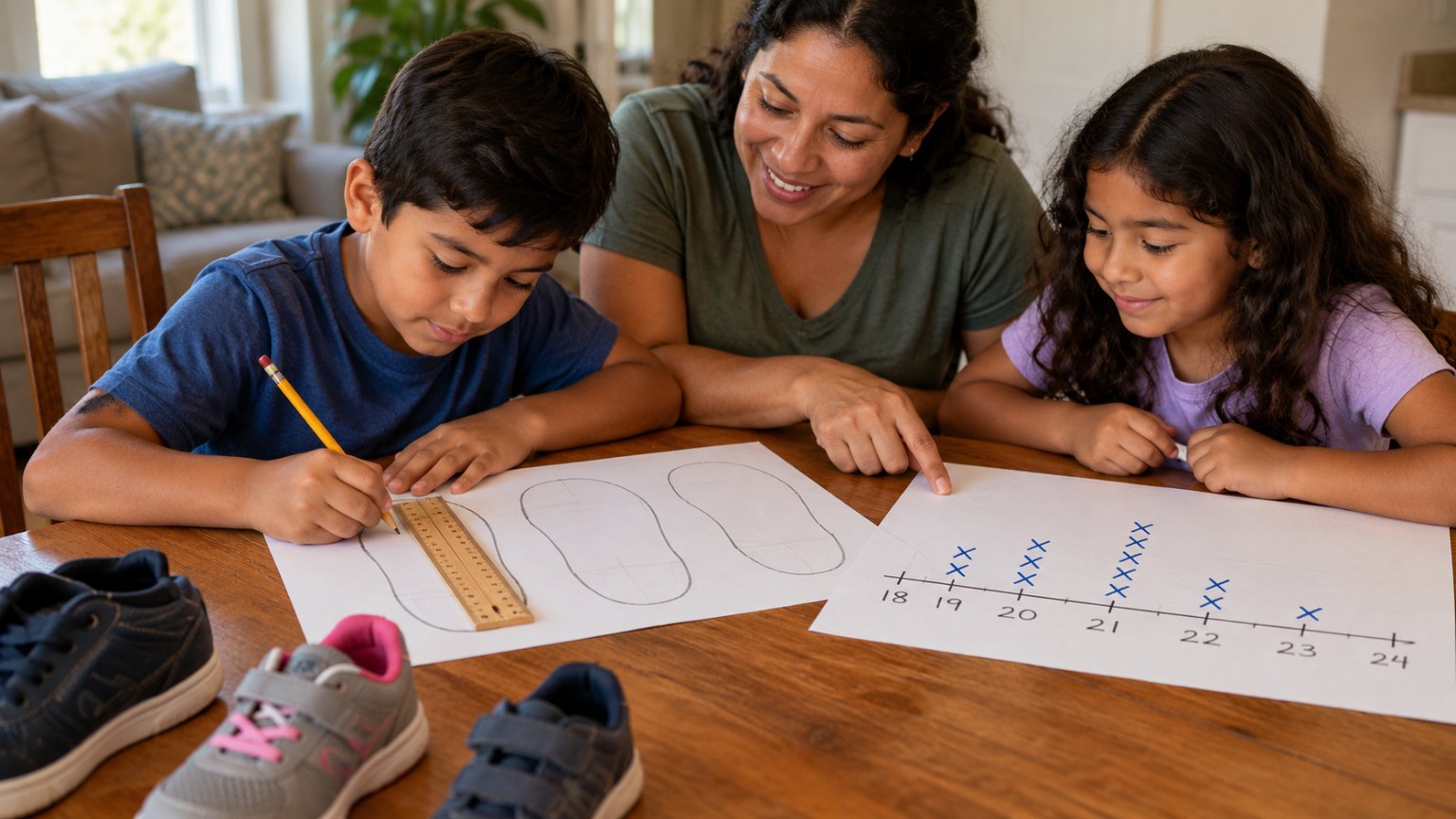
Your child traces the shoes of everyone in the house (or class), measures each print to the nearest quarter inch, builds a line plot of the data, and uses it to figure out whose shoe left a mystery print by the back door.
Objective
Your child will measure shoe-print lengths to the nearest quarter (or eighth) inch, display the data on a line plot, and use the data to match a mystery print and answer comparison questions.
Standards
3.MD.4Math · Grade 3 · Measurement & Data Generate measurement data by measuring lengths using rulers marked with halves and fourths of an inch. Show the data by making a line plot, where the horizontal scale is marked off in appropriate units— whole numbers, halves, or quarters.
4.MD.4Math · Grade 4 · Measurement & Data Make a line plot to display a data set of measurements in fractions of a unit (1/2, 1/4, 1/8). Solve problems involving addition and subtraction of fractions by using information presented in line plots.
5.MD.2Math · Grade 5 · Measurement & Data Make a line plot to display a data set of measurements in fractions of a unit (1/2, 1/4, 1/8). Use operations on fractions for this grade to solve problems involving information presented in line plots.
Materials
| Item | Quantity |
|---|
| Paper (printer paper or newspaper) | 1 sheet per shoe |
| Pencils and a marker | 2-3 |
| Ruler marked in quarter and eighth inches | 1 per child |
| Shoes from 5-8 people (or a pile of family shoes) | 5-8 |
| Paper for the line plot | 1 sheet |
| Sticky notes or index cards for labels | 8 |
Vocabulary
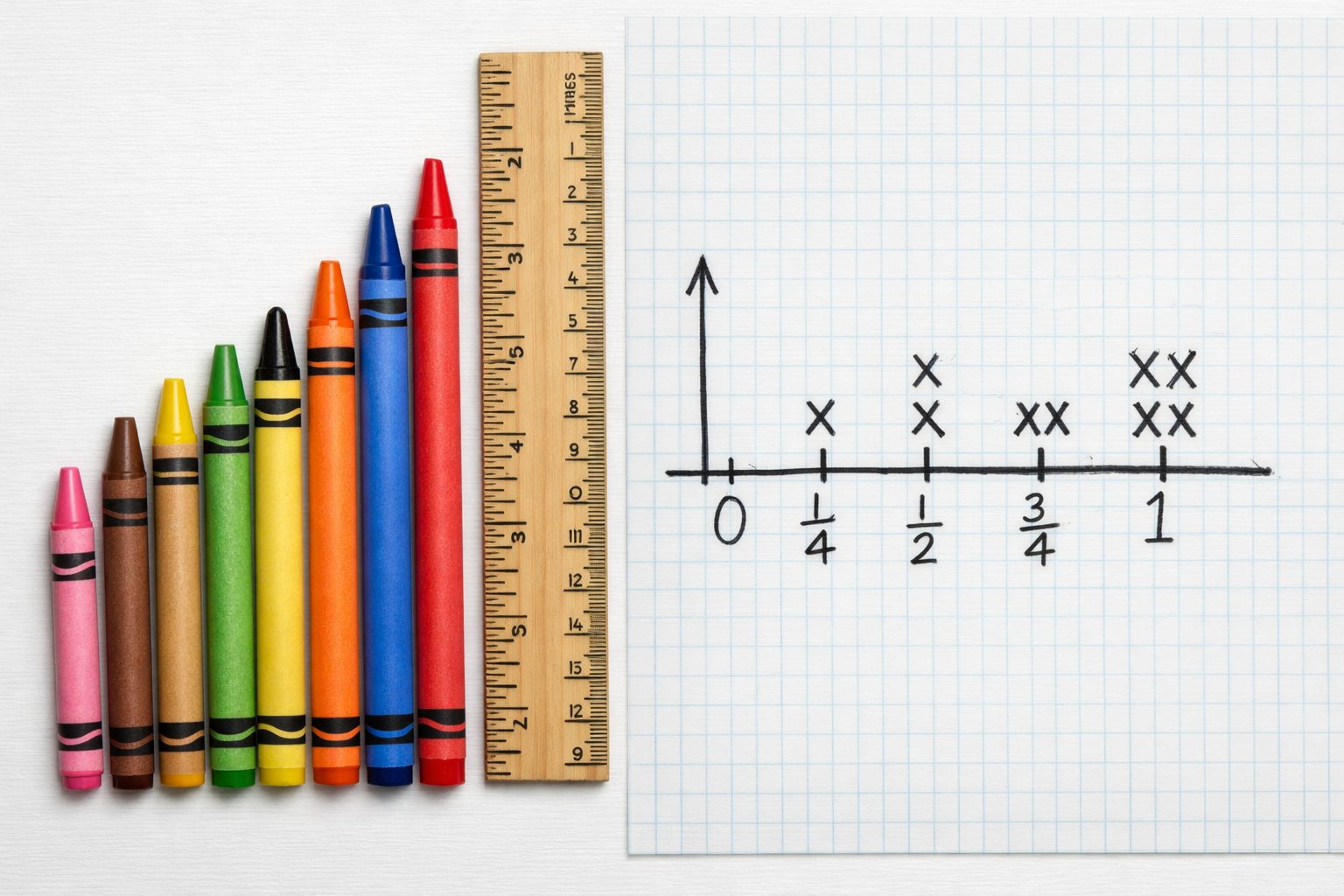
Line plot
A number line with X marks above it that shows how often each value appears.
Nearest quarter inch
Rounding a measurement to the closest 1/4-inch mark on a ruler.
Data
Information collected to answer a question.
Suspect
A person or thing that might be connected to a mystery, before the facts are known.
Preparation
- Secretly trace one family shoe on a sheet of paper and label it MYSTERY PRINT FOUND BY THE BACK DOOR.
- Collect 5 to 8 shoes of different sizes. Write the owner's name on a sticky note for each shoe.
Introduction
Show the mystery print and say: someone tracked mud in by the back door and left only this print. Every shoe in the house is a suspect. How can math help us crack the case?
Why might measuring be better than just looking?
What could make two shoe prints look the same size?
Steps
1Step 1
Trace the suspects
(8 min) Your child sets each shoe on its own sheet of paper and traces around the sole with a pencil held straight up. They label each tracing with the owner's name.
2Step 2
Measure each print
(10 min) Your child measures each tracing from the very back of the heel to the tip of the toe, to the nearest quarter inch (fourth and fifth graders can use eighths). Record each length in a table, then measure the mystery print the same way.
3Step 3
Build the line plot
(10 min) Draw a number line that covers the smallest to the largest length, marked in quarter (or eighth) inches. Your child puts an X above the line for each suspect's print and labels the X with initials.
4Step 4
Crack the case
(7 min) Your child finds where the mystery print would go on the line plot and names the match. If two shoes have the same length, compare the shape and width of the tracings as a second clue.
5Step 5
Answer the data questions
(5 min) Your child uses the line plot to answer the questions in this lesson, such as the difference between the longest and shortest prints. Fourth and fifth graders add and subtract the fractions to answer.
Conclusion
Ask: which clue solved the case, the length or the shape? Explain that real investigators measure shoe prints and photograph them next to a ruler.
Make your own lesson plan in minutes
Describe a topic and Resource Portal AI writes the objectives, materials and steps for your group.
Try Resource Portal AI