How a Dinosaur Becomes a Fossil: Rock Layer Model
Overview
Bury "fossils" in rock layers and read the layers like a paleontologist.
Description
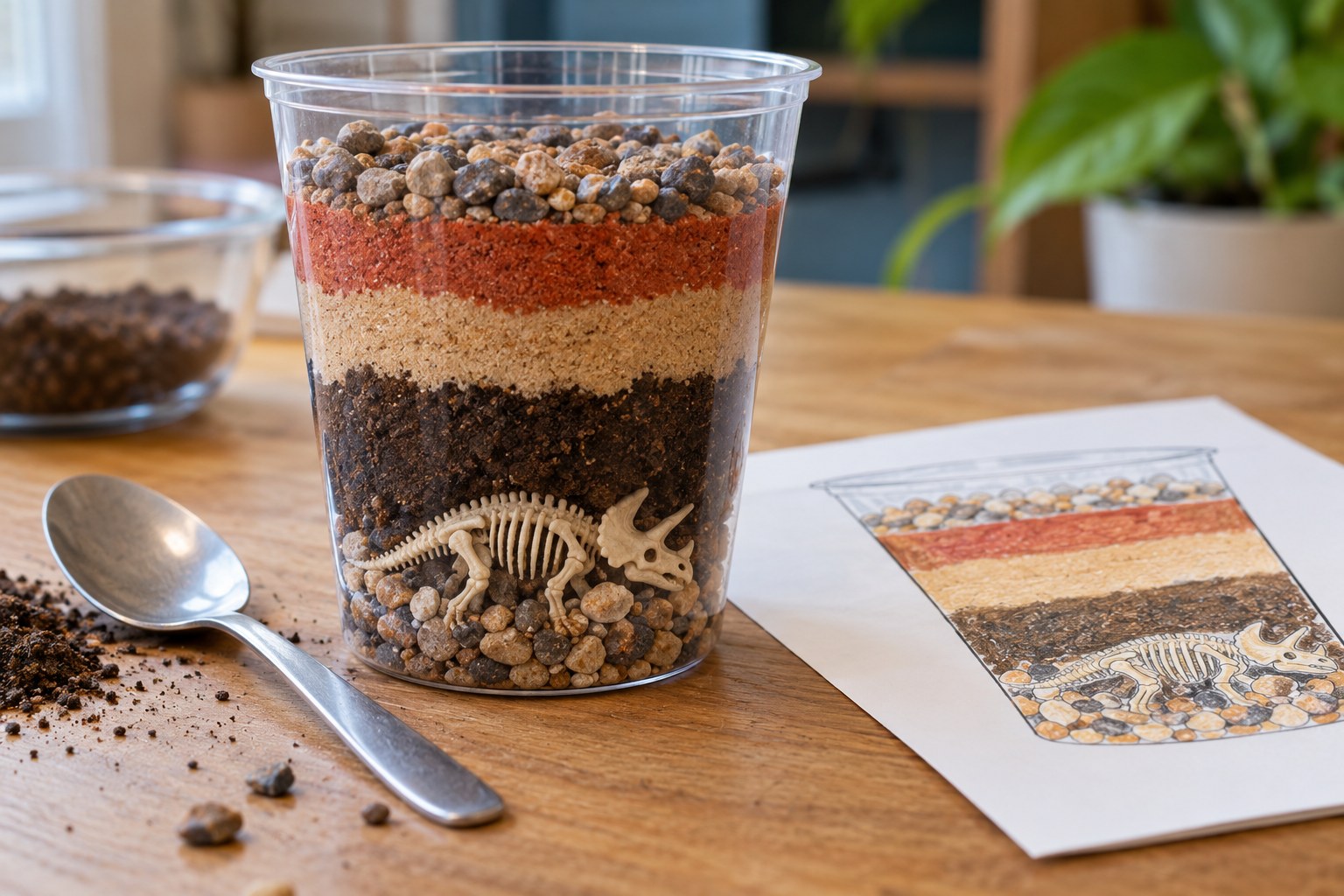
Your child builds layers of sand, soil and gravel in a clear jar or cup, burying a different "fossil" in each layer, then acts as a paleontologist to read the layers from oldest to youngest and explains each stage of how a dinosaur bone turns to stone.
Objective
Your child will model how sediment buries remains, explain the main steps of fossilization, and use the principle that lower layers are usually older to put fossils in order.
Materials
| Item | Quantity |
|---|---|
| Clear plastic cup, jar or bottle with the top cut off | 1 per child |
| Sand, garden soil, small gravel and flour or cornmeal (for different-colored layers) | about 1/2 cup each |
| Small "fossils": dry pasta bones, shells, a leaf, a small toy dinosaur | 4-5 per cup |
| Spoon and small cup of water | 1 each |
| Paper and colored pencils | 1 set per child |
Vocabulary
Preparation
- Set the sediments in separate bowls with spoons. Lay down newspaper or work outside.
- Read the "Fossil story cards" section so you can narrate each layer.
Introduction
Hold up a chicken bone or picture of a dinosaur skeleton and ask: "Most animals that die are eaten or rot away. So how did this dinosaur bone survive 70 million years?"
Why do you think fossils are often found near ancient rivers and lakes?
If you stacked books one at a time, which book would be at the bottom?
Steps
Conclusion
Ask: what has to happen quickly for a fossil to form? Being buried fast by sediment protects remains, which is why fossils are rare and so valuable to science.
Make your own lesson plan in minutes
Describe a topic and Resource Portal AI writes the objectives, materials and steps for your group.
Try Resource Portal AI