Lesson plan

Washington Monument Scale Tower Challenge
STEAM45 minutesGrades: 4th, 5th
Washington Monument Scale Tower Challenge

Overview

Calculate a scale and build a Washington Monument that stands up to wind.

Description

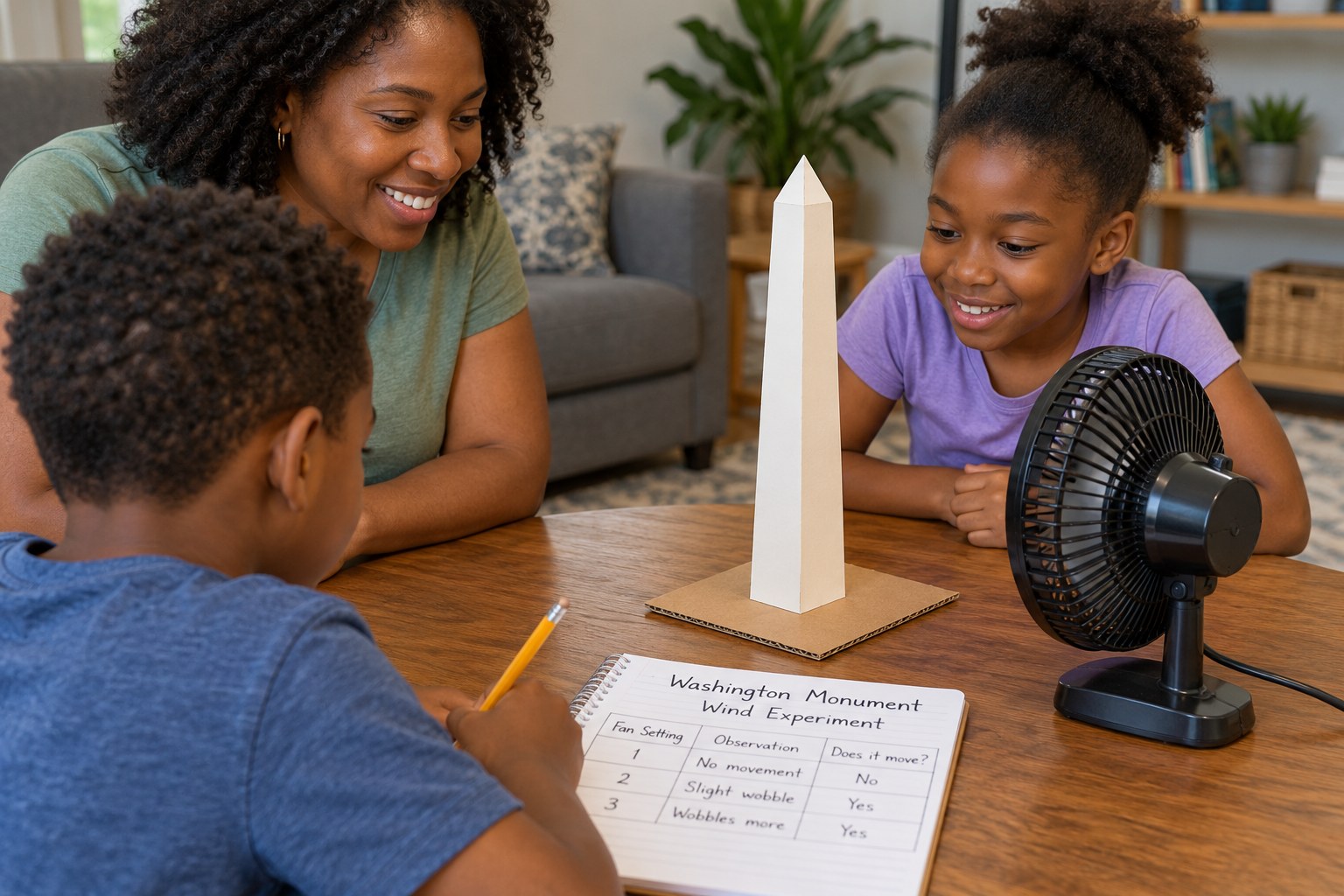
Your child learns how the Washington Monument was built, uses a scale of 1 inch = 25 feet to calculate the height of a model, then engineers a free-standing obelisk from cardstock that must stand tall and survive a 'wind test' from a fan.

Objective

Your child will convert real measurements to a scale model using multiplication and division, then design, build and test a stable tower.

Standards

4.MD.2Math · Grade 4 · Measurement & Data
Use the four operations to solve word problems involving distances, intervals of time, liquid volumes, masses of objects, and money, including problems involving simple fractions or decimals, and problems that require expressing measurements given in a larger unit in terms of a smaller unit. Represent measurement quantities using diagrams such as number line diagrams that feature a measurement scale.

Materials

ItemQuantity
Cardstock or file folders3-4 sheets
Ruler and pencil1 each
Tape and scissors1 each
Small cardboard square for a base (about 6 inches)1
Coins or pebbles for weighta handful
Fan or a piece of cardboard for fanning1

Vocabulary

Obelisk
A tall, four-sided stone pillar that narrows to a pyramid-shaped point.
Scale
The rule that matches a model's size to the real object, such as 1 inch = 25 feet.
Stable
Hard to tip over.
Base
The bottom part of a structure that holds it up.

Preparation

Introduction

Show a photo of the Washington Monument and say: 'This is about as tall as a 50-story building, and it's made of stone with no steel frame. How could we build a model that won't fall over?'
Why do you think the monument is wider at the bottom?
What does it mean to build something to scale?

Steps

1Step 1
Learn about the monument
(5 min) Read the 'About the Washington Monument' section together. Point out the change in stone color partway up, from when building stopped for many years.
2Step 2
Do the scale math
(10 min) Using 1 inch = 25 feet, your child divides the real height (about 555 feet) by 25 to find the model height and the real base width (about 55 feet) by 25 to find the model base. They also convert the real height to inches (555 x 12) to see how big the real monument is in a smaller unit.
3Step 3
Design and build
(15 min) Your child sketches a plan, then cuts and folds cardstock into a tall four-sided tower about 22 inches high that narrows toward the top, with a small pyramid cap. They tape it to the cardboard base, adding coins inside the bottom for weight if needed.
4Step 4
Wind test
(8 min) Stand the tower on the table and turn the fan on low from 3 feet away for 10 seconds. If it tips or bends, your child changes one thing, such as a wider base, more weight or a folded inner brace, and tests again.
5Step 5
Measure and reflect
(5 min) Measure the final height and check how close it is to the scale target. Your child explains which change made the tower most stable and why.

Conclusion

Ask: why did the real builders make the base so wide and heavy? How did your model's changes help it stay up?

Make your own lesson plan in minutes

Describe a topic and Resource Portal AI writes the objectives, materials and steps for your group.

Try Resource Portal AI