Lesson planKwanzaa Ujamaa Family Market Money Math
Math40 minutesGrades: 3rd, 4th, 5th
Overview
Run a pretend Ujamaa market and solve money problems.
Description
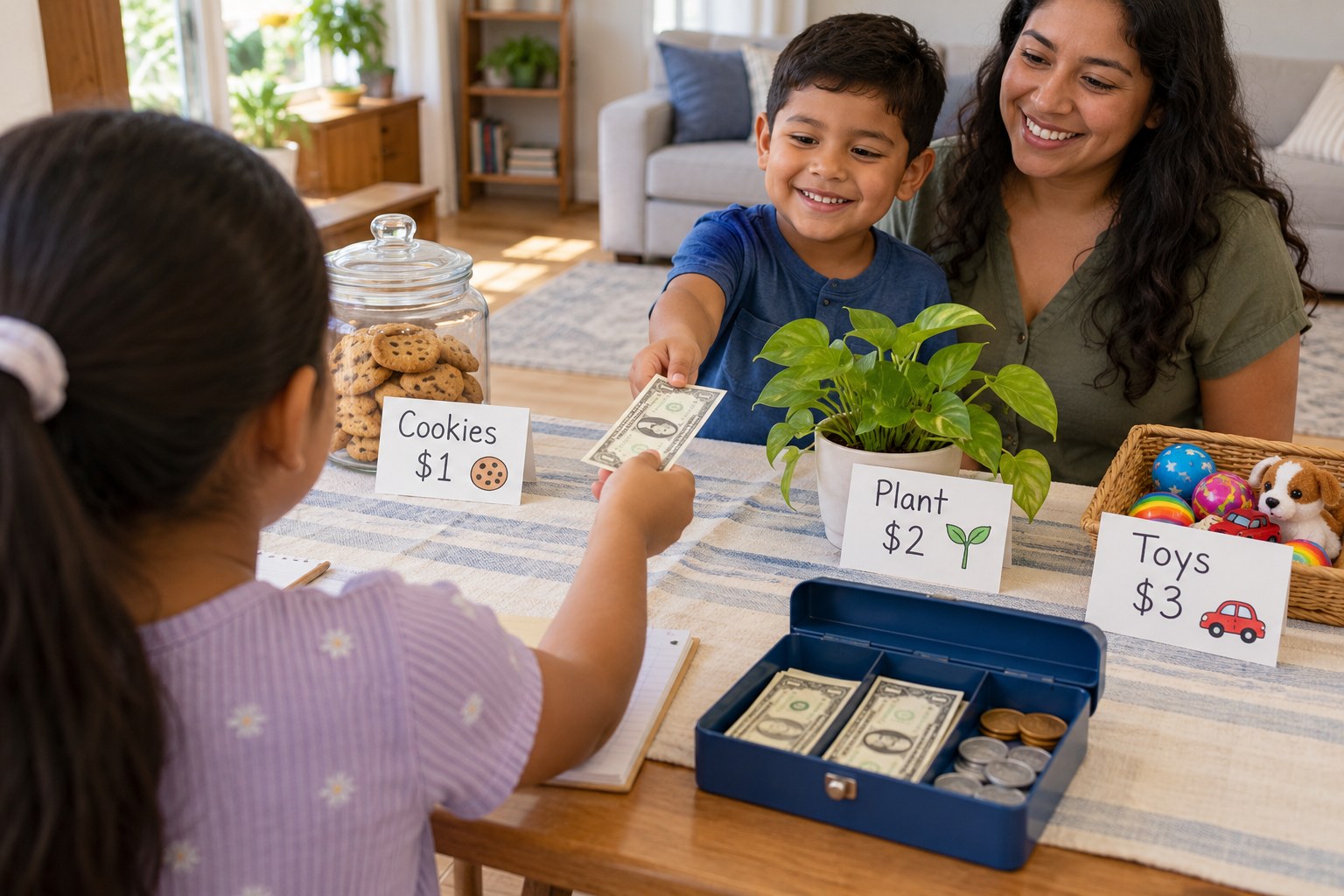
Your child learns that Ujamaa, the fourth principle of Kwanzaa, means cooperative economics, sets up a pretend market of handmade goods with price tags, and solves two-step money problems as shopkeeper and shopper.
Objective
Your child will add and subtract money amounts with decimals, make change from a budget, and solve two-step word problems about a family market.
Standards
3.OA.8Math · Grade 3 · Operations & Algebraic Thinking Solve two-step word problems using the four operations. Represent these problems using equations with a letter standing for the unknown quantity. Assess the reasonableness of answers using mental computation and estimation strategies including rounding.
4.MD.2Math · Grade 4 · Measurement & Data Use the four operations to solve word problems involving distances, intervals of time, liquid volumes, masses of objects, and money, including problems involving simple fractions or decimals, and problems that require expressing measurements given in a larger unit in terms of a smaller unit. Represent measurement quantities using diagrams such as number line diagrams that feature a measurement scale.
Materials
| Item | Quantity |
|---|
| Household items to 'sell' (books, a scarf, a plant, a jar of cookies, a drawing) | 6-8 |
| Index cards or sticky notes for price tags | 8 |
| Play money, or paper bills and coins made from scrap paper | $20 per shopper |
| Paper and pencil, calculator for checking | 1 each per child |
| Small box or bowl as a cash box | 1 |
Vocabulary
Ujamaa
Cooperative economics: building and supporting businesses in your own community.
Budget
The amount of money you have to spend.
Change
The money you get back when you pay more than the price.
Two-step problem
A word problem that needs two calculations to solve.
Preparation
- Choose 6-8 items to sell and set them on a table like a market stall.
- Make play money if needed: for each shopper, one $10 bill, two $5 bills and a few quarters and dimes.
Introduction
Ask: when we buy from a neighbor's bakery or a local barber shop, where does the money go? Today you'll run a market where the money stays in the community.
What small businesses do we visit in our neighborhood?
How do you find out how much change you should get?
Steps
1Step 1
Learn about Ujamaa
(6 min) Read 'About Kwanzaa' together and talk about Ujamaa, the fourth principle. Explain that it encourages families to build their own businesses and support businesses in their community so that wealth is shared.
2Step 2
Price the goods
(8 min) Your child writes a price tag for each item using dollars and cents, such as $3.75 for cookies and $6.50 for a scarf. Make at least two prices end in 25, 50 or 75 cents.
3Step 3
Open the market
(12 min) Each shopper has $20 and must buy at least 3 items. The shopper writes the total and the change on paper, and the shopkeeper checks it with the play money before handing over change. Switch roles after two sales.
4Step 4
Two-step problems
(10 min) Your child solves the market word problems below, writing a number sentence for each step. Check answers with the calculator and the answer key.
5Step 5
Reflect
(4 min) Ask: how much did the market earn in all? If the family put that money back into the community, what could it support? Connect the answer to Ujamaa.
Conclusion
Ask: what was the hardest change to figure out? Next time you shop at a local business, estimate the total before you get to the register.
Make your own lesson plan in minutes
Describe a topic and Resource Portal AI writes the objectives, materials and steps for your group.
Try Resource Portal AI