Lesson planGreat Wall of China by the Numbers: Scientific Notation Estimates
Math45 minutesGrades: 7th, 8th
Overview
Use powers of ten to size up the Great Wall.
Description
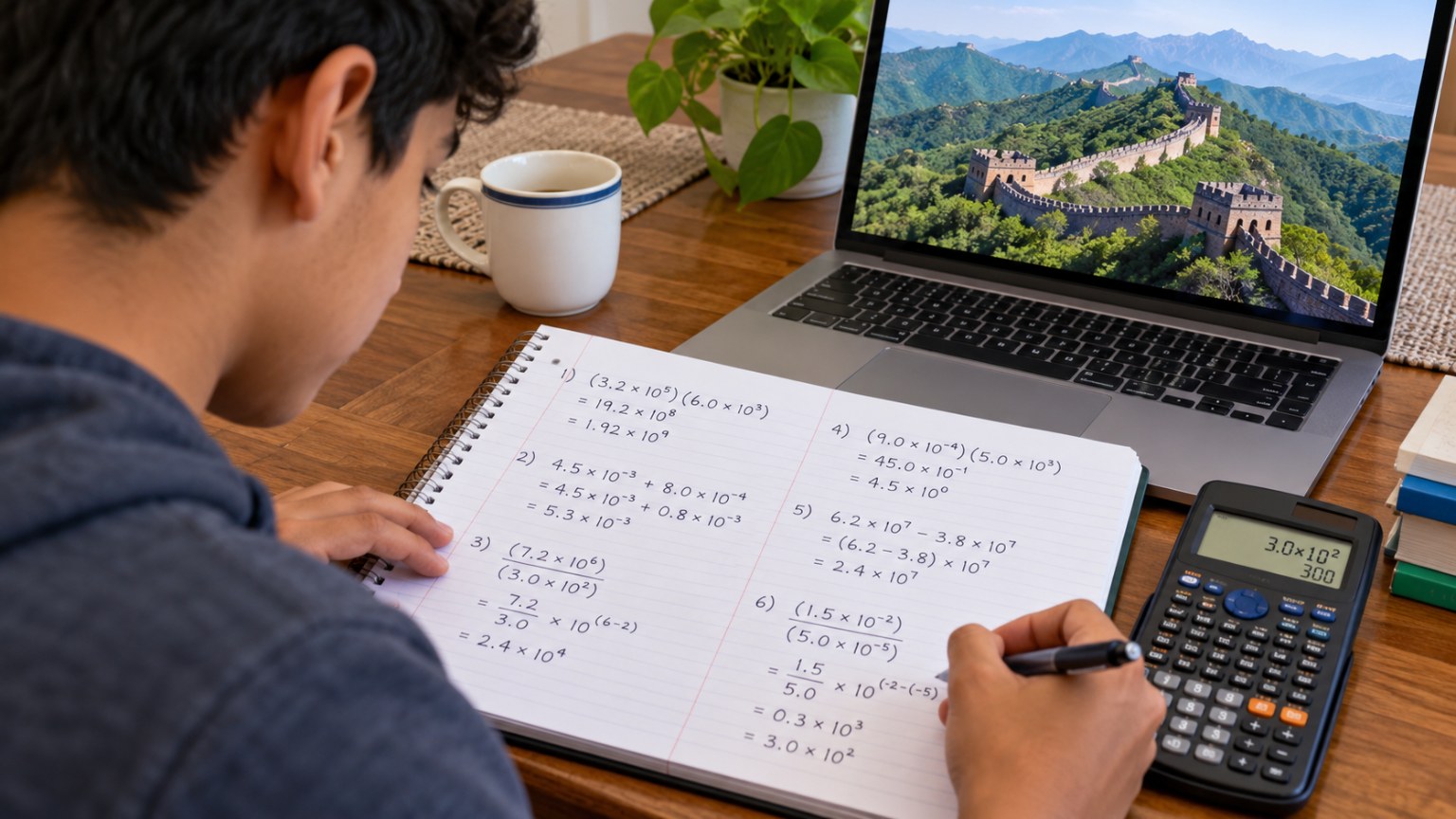
Your teen uses scientific notation to work with the Great Wall of China's enormous numbers: converting its 21,196-kilometer length to meters, comparing it with Earth's circumference, estimating how many bricks one kilometer of wall could hold, and testing the "visible from space" myth with a hair-width model.
Objective
Your teen will write very large and very small quantities in scientific notation, multiply and divide them, and use the results to make and check estimates about the Great Wall.
Standards
8.EE.3Math · Grade 8 · Expressions & Equations Use numbers expressed in the form of a single digit times an integer power of 10 to estimate very large or very small quantities, and to express how many times as much one is than the other.
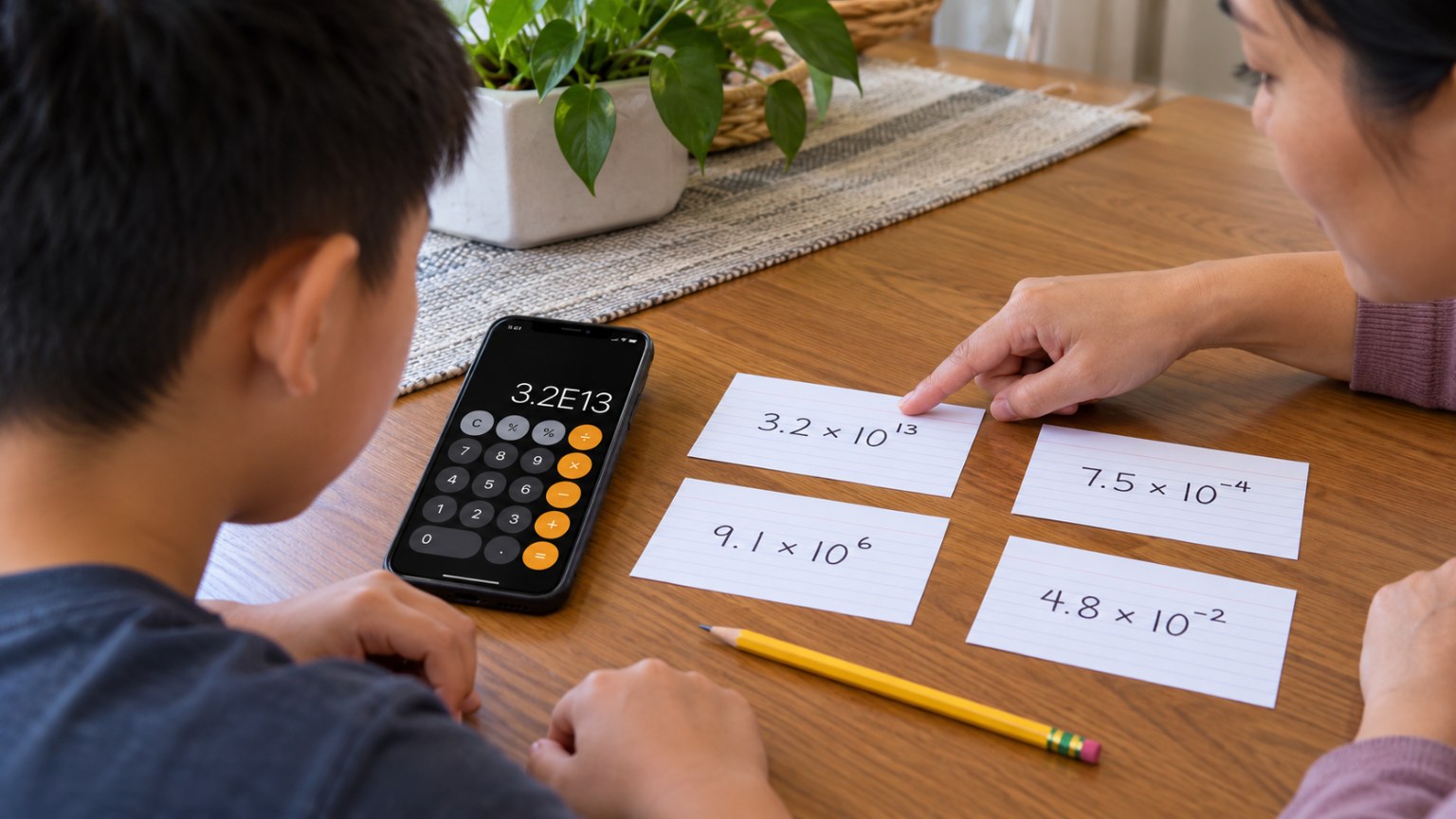
8.EE.4Math · Grade 8 · Expressions & Equations Perform operations with numbers expressed in scientific notation, including problems where both decimal and scientific notation are used. Use scientific notation and choose units of appropriate size for measurements of very large or very small quantities (e.g., use millimeters per year for seafloor spreading). Interpret scientific notation that has been generated by technology.
Materials
| Item | Quantity |
|---|
| Calculator with an EE or x10^ key (a phone calculator in scientific mode works) | 1 |
| Paper, pencil and the problem set from this lesson | 1 each |
| A real brick or a shoebox to measure (optional) | 1 |
| A strand of hair or a piece of thread | 1 |
| Tape measure | 1 |
Vocabulary
Scientific notation
A way to write a number as a number from 1 to less than 10 times a power of 10, such as 2.1 x 10^4.
Order of magnitude
The power of ten closest to a number; used to compare sizes quickly.
Rammed earth
Soil packed tightly between wooden boards, used in early sections of the wall.
Ming dynasty
The Chinese dynasty (1368-1644) that built most of the brick wall tourists visit today.
Preparation
- Copy the problem set from the additional section onto paper, leaving space to work.
- Find a strand of hair and a tape measure for the visibility test.
Introduction
Ask: "Which is bigger: the total length of every section of the Great Wall of China, or halfway around the Earth?" Have your teen commit to a guess before doing any math.
Why do scientists and engineers use scientific notation instead of writing out all the zeros?
Where have you heard the claim that the Great Wall can be seen from space?
Steps
1Step 1
Background and guesses
(6 min) Your teen reads the About section and writes 3 guesses: how the wall compares with Earth's circumference, how many bricks are in 1 km of wall, and whether it can be seen from orbit. Keep the guesses to check later.
2Step 2
Length in powers of ten
(9 min) Your teen writes 21,196 km in scientific notation (2.1196 x 10^4 km), converts it to meters (2.1196 x 10^7 m), then divides by Earth's circumference (4.0075 x 10^4 km). They interpret the answer as a fraction of a trip around the planet.
3Step 3
Brick estimate
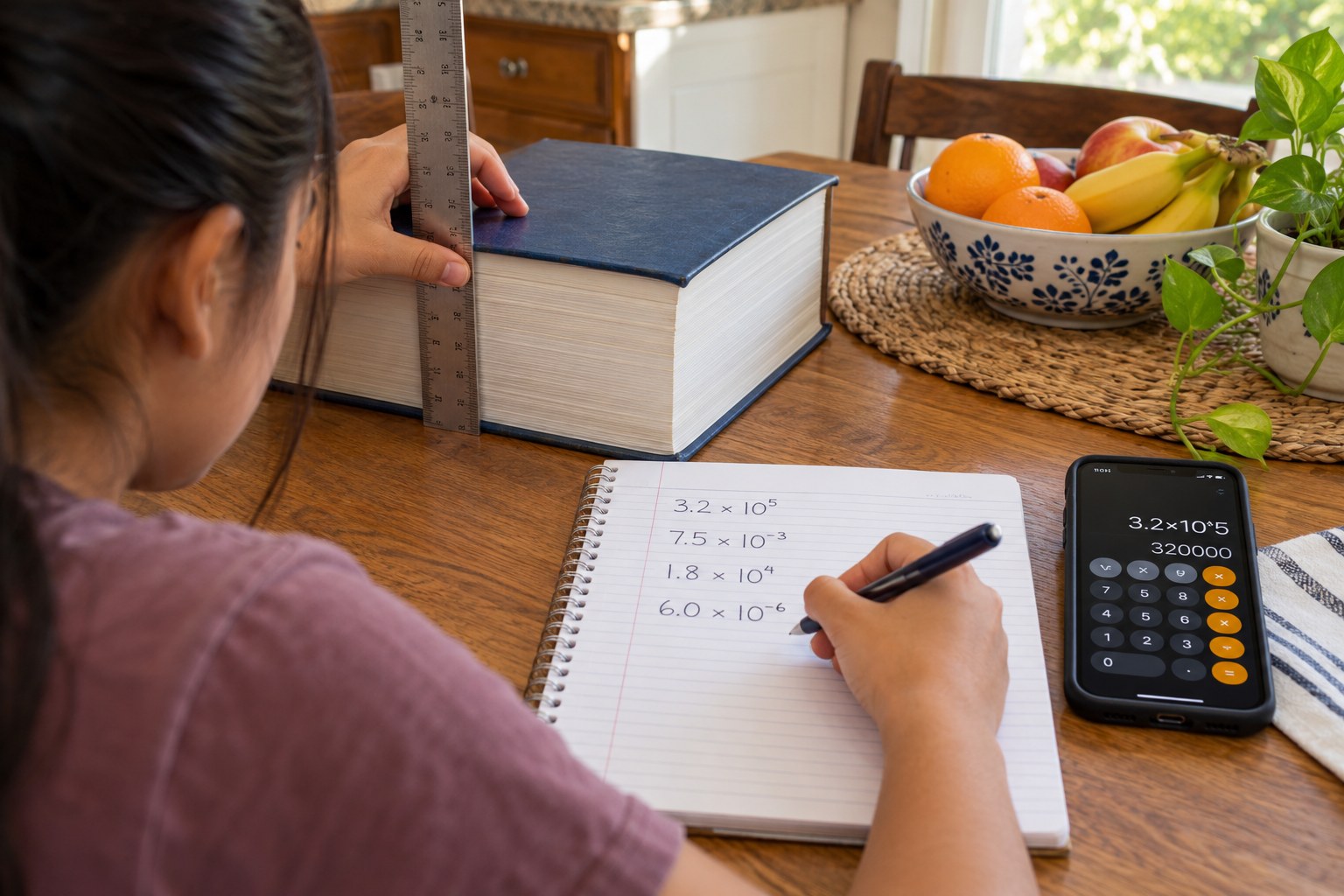
(12 min) Using the model in the problem set, your teen finds the volume of 1 km of wall (7 m tall by 6 m wide by 1,000 m long) and the volume of one brick (0.4 m by 0.2 m by 0.1 m), writing both in scientific notation. They divide to estimate bricks per kilometer and discuss why the real number is lower (most of the wall is filled with earth and rubble, with brick only on the outside).
4Step 4
Test the space myth
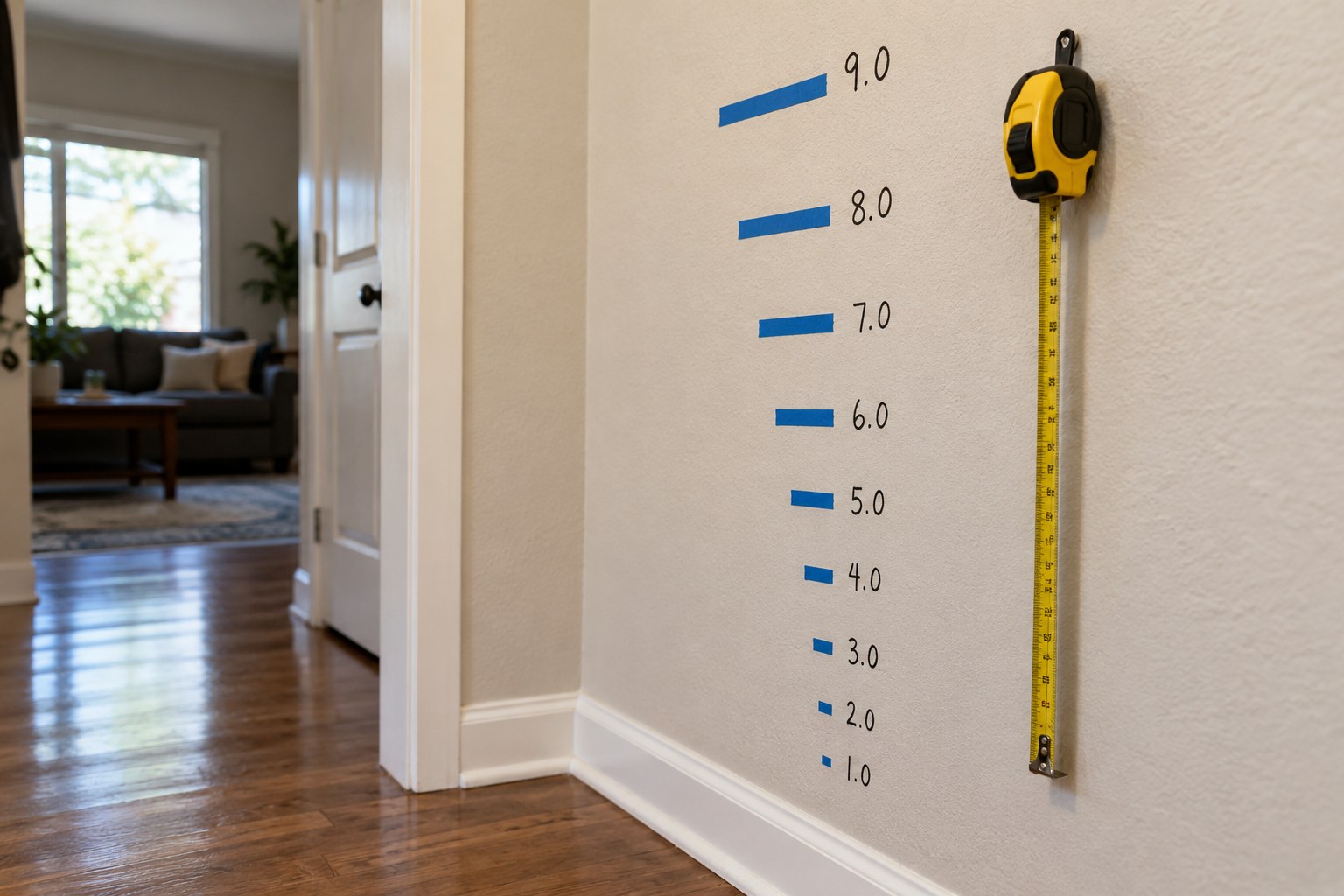
(10 min) The wall is about 6 m wide and the International Space Station orbits about 4 x 10^5 m up. Your teen finds the ratio of width to distance, then figures out how far away a hair (about 1 x 10^-4 m wide) would be at the same ratio, then holds a hair at that distance (about 6-7 m) to see if it is visible.
5Step 5
Check the guesses
(6 min) Your teen compares each answer with their opening guesses and writes one sentence on which estimate was furthest off and why. Then they explain in their own words why the space claim is a myth.
Conclusion
Ask: "Which result surprised you most? How did scientific notation make these comparisons faster?"
Make your own lesson plan in minutes
Describe a topic and Resource Portal AI writes the objectives, materials and steps for your group.
Try Resource Portal AI