Lesson planEarthquake Magnitude and Powers of Ten
Math45 minutesGrades: 6th, 7th, 8th
Overview
Measure and compare earthquakes with powers of ten.
Description
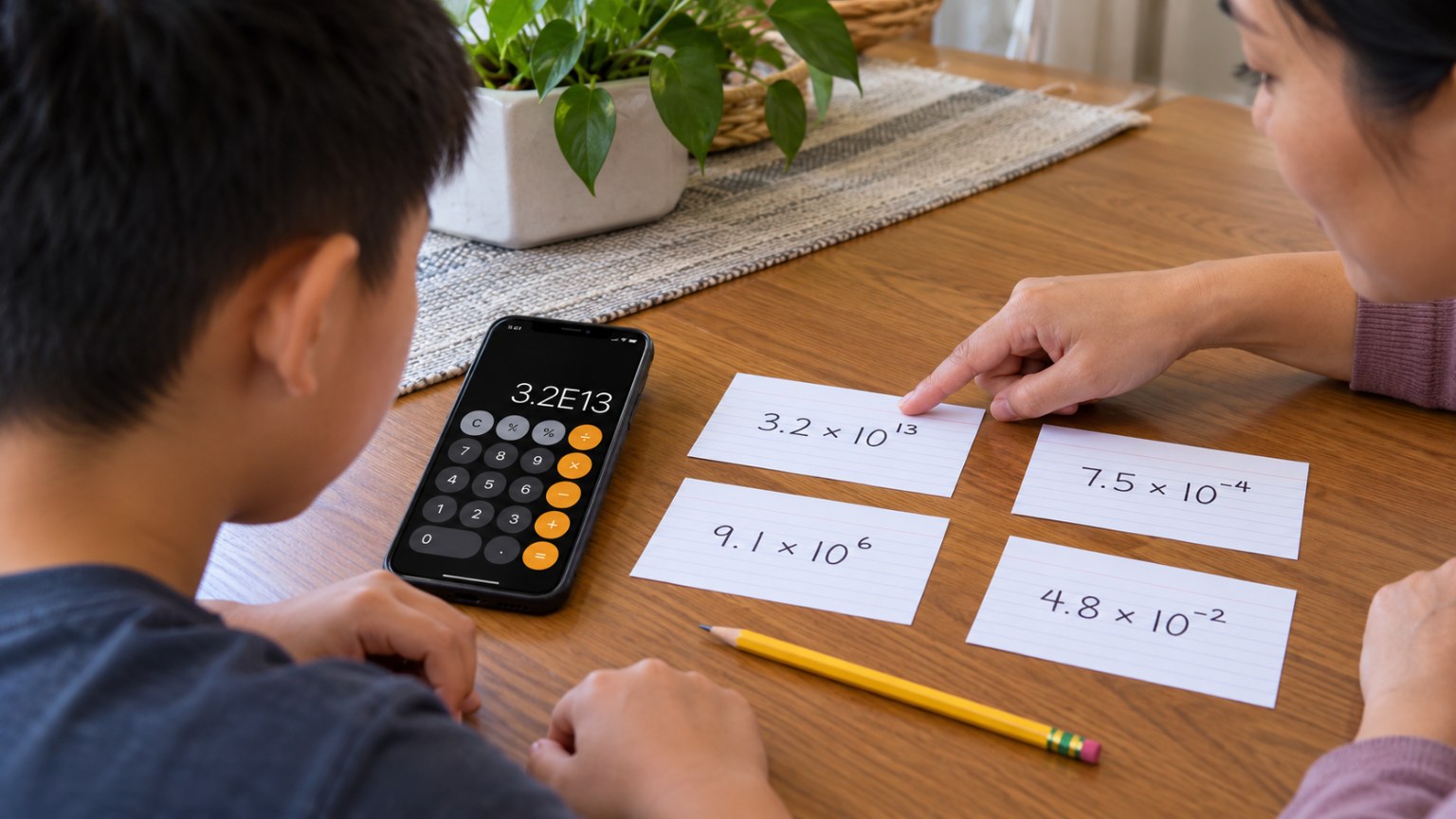
Your teen discovers why a magnitude 7 earthquake is far more than 'a little bigger' than a magnitude 6. They tape out seismograph wave heights that grow by powers of ten along a wall, then use scientific notation to compare the energy released by famous California and world earthquakes.
Objective
Your teen will use exponents and scientific notation to compare earthquake magnitudes, finding how many times greater the shaking and energy of one earthquake is than another.
Standards
6.EE.1Math · Grade 6 · Expressions & Equations Write and evaluate numerical expressions involving whole-number exponents.
8.EE.3Math · Grade 8 · Expressions & Equations Use numbers expressed in the form of a single digit times an integer power of 10 to estimate very large or very small quantities, and to express how many times as much one is than the other.
8.EE.4Math · Grade 8 · Expressions & Equations Perform operations with numbers expressed in scientific notation, including problems where both decimal and scientific notation are used. Use scientific notation and choose units of appropriate size for measurements of very large or very small quantities (e.g., use millimeters per year for seafloor spreading). Interpret scientific notation that has been generated by technology.
Materials
| Item | Quantity |
|---|
| Tape measure or meter stick | 1 |
| Painter's tape or masking tape | 1 roll |
| Marker | 1 |
| Paper and pencil | 1 each per teen |
| Calculator (optional, for checking) | 1 |
| Sticky notes | 6 |
Vocabulary
Magnitude
A number that describes the size of an earthquake based on the energy it releases.
Logarithmic scale
A scale where each step up multiplies by the same amount instead of adding.
Amplitude
The height of a wave on a seismogram, showing how strongly the ground moved.
Scientific notation
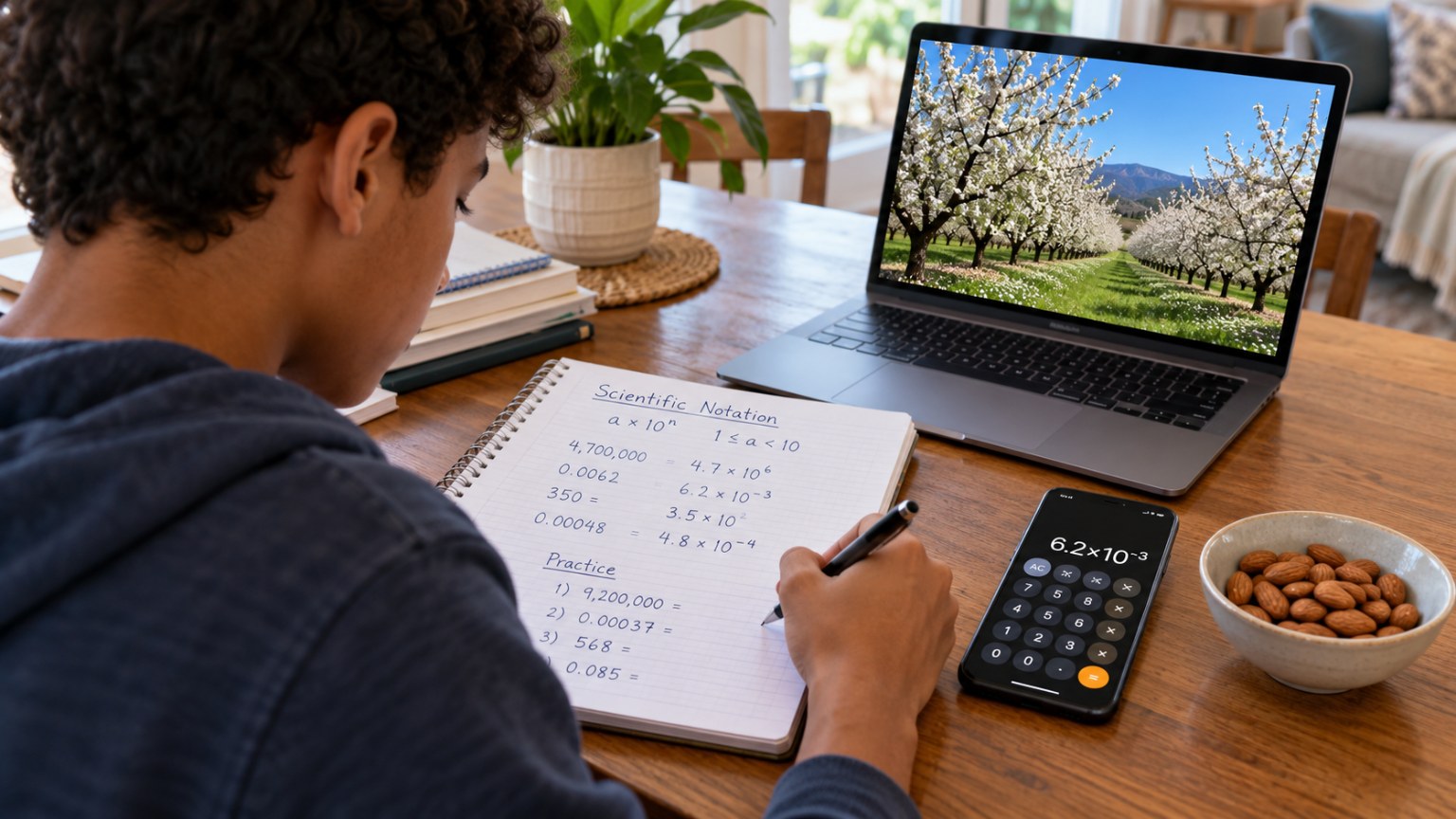
Writing a number as a value from 1 to 10 times a power of 10, like 2 x 10^15.
Preparation
- Find a long wall, hallway or driveway with at least 1 meter of vertical space (or use the floor).
- Copy the 'Energy table' onto paper.
Introduction
Ask your teen: if a magnitude 6 earthquake is a 6 and a magnitude 7 is a 7, is the 7 about 17 percent bigger? Make a guess, then let's find out what the number really means.
Have you ever felt an earthquake? What magnitude was it?
Why might scientists use a scale that multiplies instead of adds?
Steps
1Step 1
Wave heights on the wall
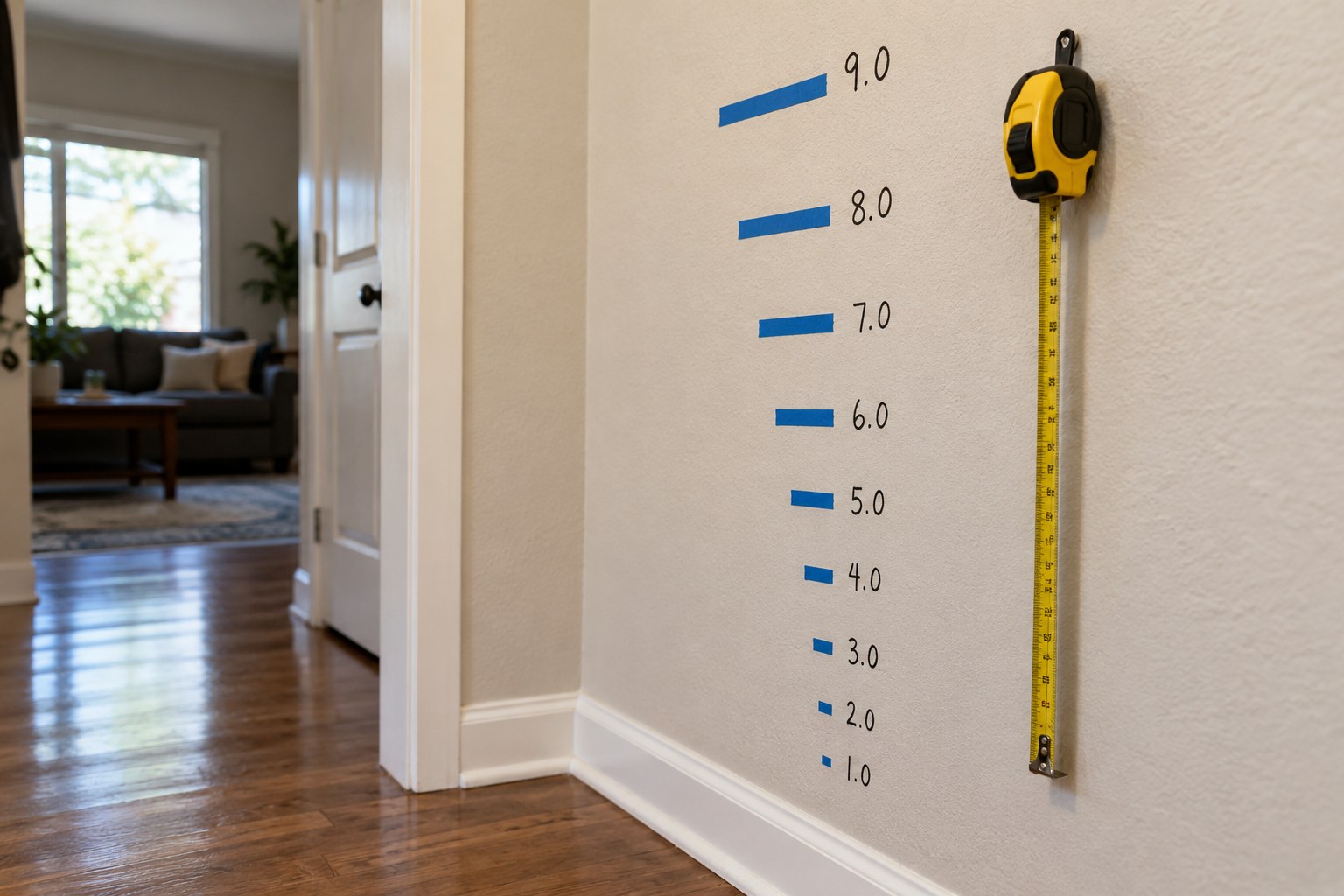
(10 min) Explain that each whole step in magnitude means the seismogram wave is 10 times taller. Starting from a floor line, your teen tapes a 1 mm mark for magnitude 2, 1 cm for magnitude 3, 10 cm for magnitude 4 and 1 meter for magnitude 5, labeling each with a sticky note. Ask: how tall would magnitude 6 be (10 m) and magnitude 7 (100 m, about a 30-story building)?
2Step 2
Write it with exponents
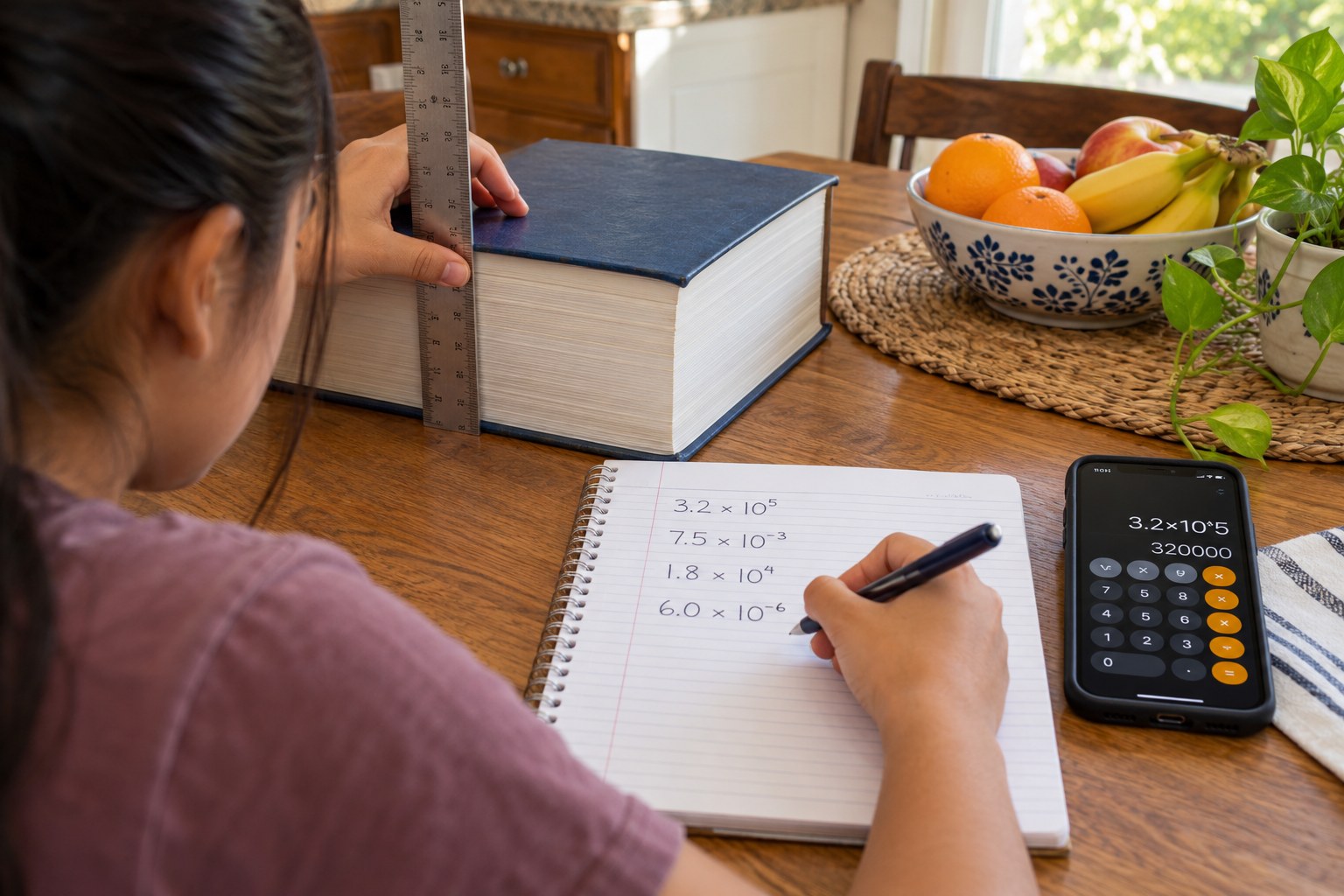
(7 min) Your teen writes each wave height in meters as a power of ten (magnitude 3 = 10^-2 m, magnitude 5 = 10^0 m) and notices that magnitude goes up by 1 when the exponent goes up by 1. Then they find how many times taller a magnitude 7 wave is than a magnitude 4 (10^3 = 1,000 times).
3Step 3
Energy grows even faster
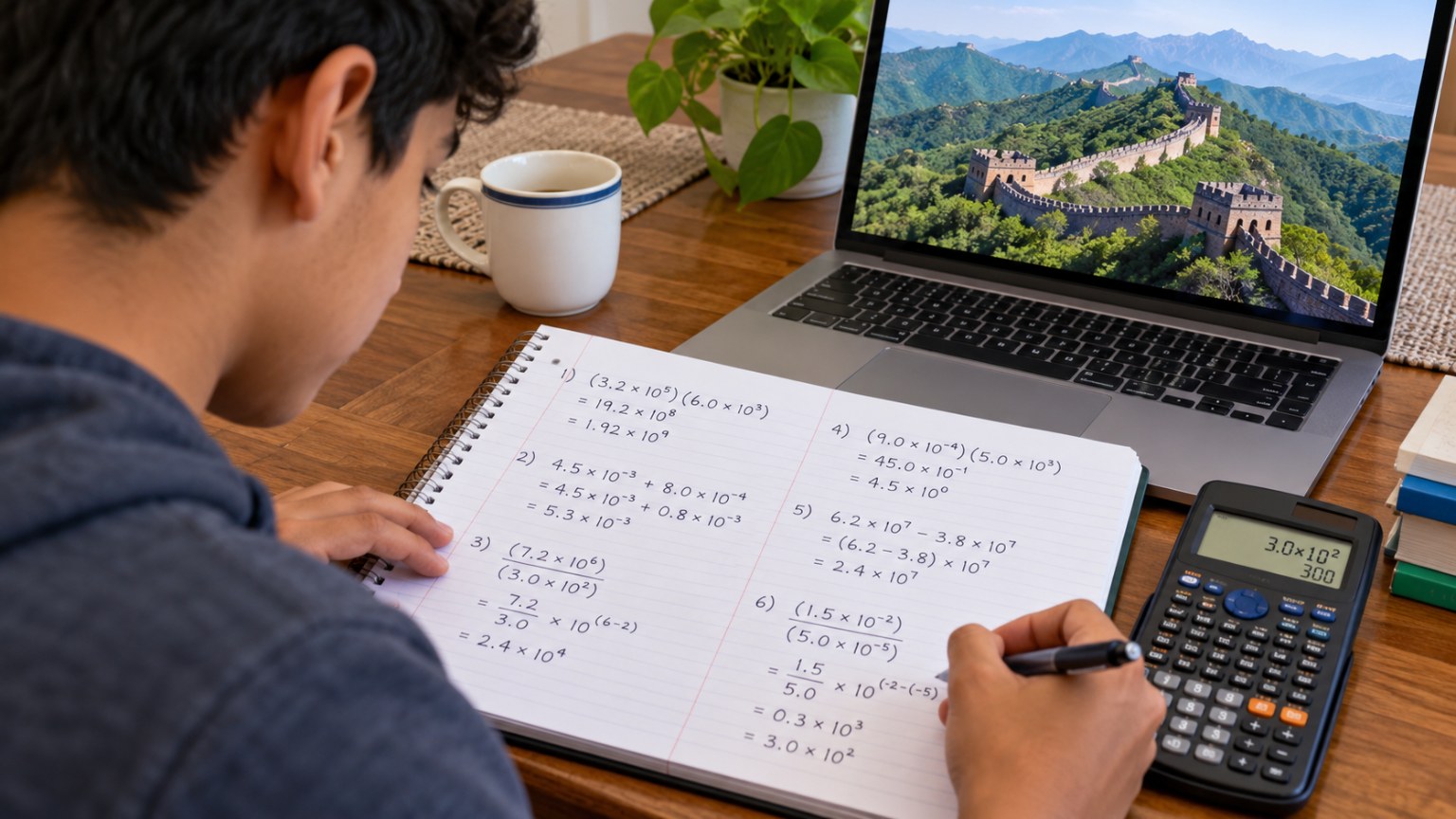
(10 min) Explain that energy grows about 32 times for each step in magnitude. Using the 'Energy table,' your teen compares a magnitude 7 to a magnitude 5 by dividing numbers in scientific notation: (2 x 10^15) / (2 x 10^12) = 10^3, so 1,000 times more energy, and checks it with 32 x 32.
4Step 4
Compare famous earthquakes
(12 min) Your teen solves the 'Earthquake comparison problems,' writing each answer as a single digit times a power of ten and then in words. Discuss what surprised them most.
5Step 5
Make it real
(5 min) Your teen writes one sentence explaining to a younger sibling why a magnitude 7.9 is not 'just a bit worse' than a 6.7. Connect it to why California building codes and Drop, Cover and Hold On matter.
Conclusion
Ask: how many times more energy did the 1906 San Francisco earthquake release than the 1994 Northridge earthquake? (About 60 times.) Logarithmic scales are also used for sound (decibels) and acidity (pH).
Make your own lesson plan in minutes
Describe a topic and Resource Portal AI writes the objectives, materials and steps for your group.
Try Resource Portal AI