Kitchen Science Catalyst Foam: How Much Yeast Makes the Tallest Foam?
Overview
Test yeast as a catalyst and analyze foam data.
Description
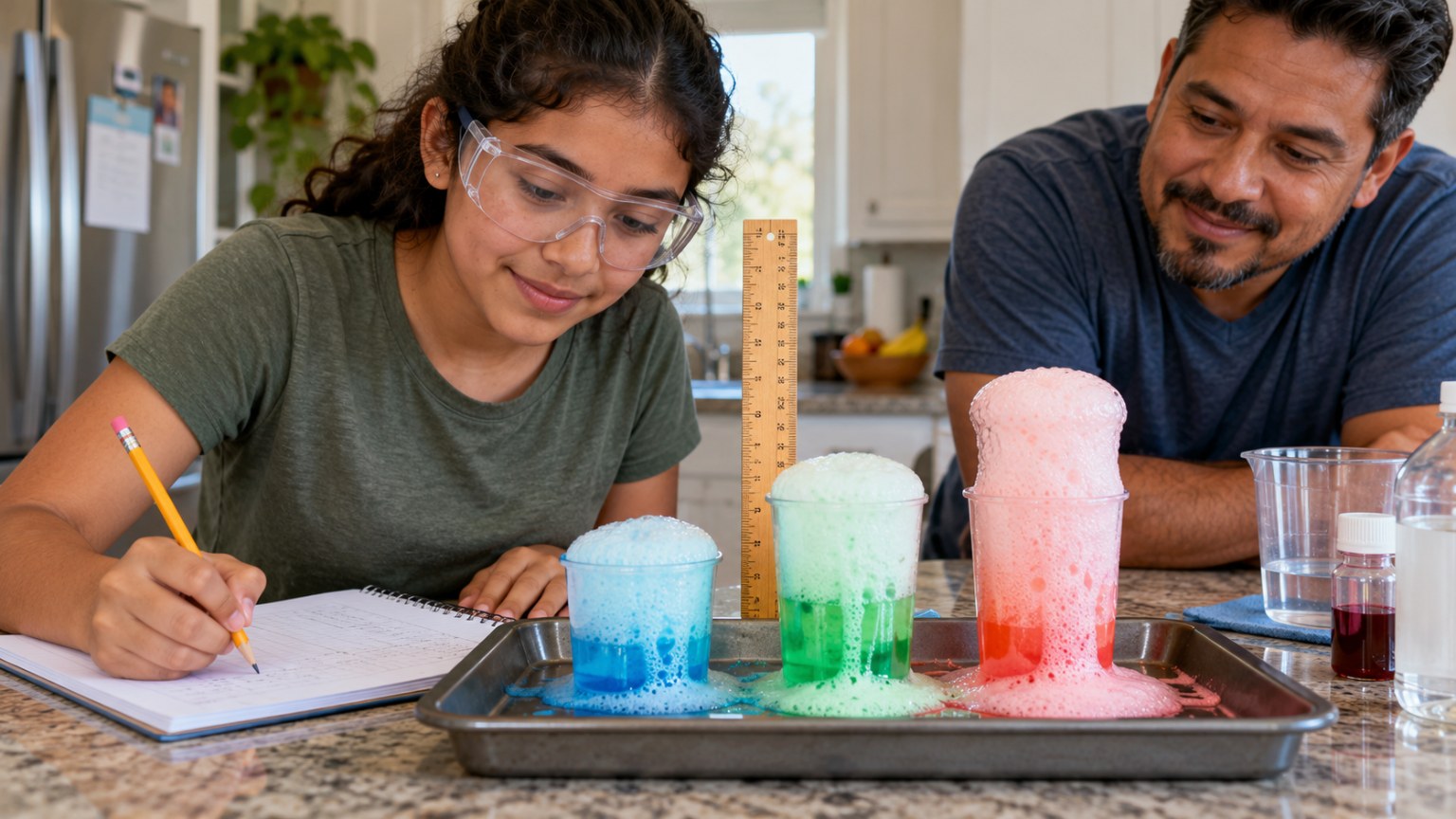
Your teen mixes 3% hydrogen peroxide with dish soap and three different amounts of yeast, measures how tall the foam climbs in 30 seconds, runs three trials of each, and uses medians and ranges to decide whether more catalyst really makes a faster reaction.
Objective
Your teen will run a controlled experiment with repeated trials, summarize the data with median and range, and explain how the enzyme catalase in yeast speeds up the breakdown of hydrogen peroxide.
Standards
Materials
| Item | Quantity |
|---|---|
| 3% hydrogen peroxide (standard drugstore strength only) | 1 bottle (about 2 1/4 cups needed) |
| Active dry yeast | about 11 teaspoons (5 packets or a small jar) |
| Warm water | 2 cups |
| Liquid dish soap | 3 tablespoons |
| Identical clear cups or narrow jars (about 12 oz) | 3 |
| Baking pan or tray to catch overflow | 1 |
| Ruler taped upright behind the cups | 1 |
| Measuring spoons and cups | 1 set |
| Safety glasses or sunglasses | 1 per person |
| Timer and data table | 1 each |
Vocabulary
Preparation
- Set the cups in a baking pan with a ruler taped upright behind them. Work outside or in the sink area.
- Make yeast mixes in three small cups: 1/2 teaspoon, 1 teaspoon and 2 teaspoons of yeast, each in 3 tablespoons of warm water. Let them sit 3 minutes. You will need fresh mixes for each trial, so measure the yeast portions ahead.
- Copy the data table from below. Everyone wears safety glasses.
Introduction
Pour a little hydrogen peroxide into a cup and wait. Nothing much happens. Ask: "This bottle is slowly breaking down into water and oxygen on its own. What if we could speed that up thousands of times?"
What do you think a catalyst does?
If a little yeast speeds up the reaction, will twice as much make it twice as fast?
Steps
Conclusion
Ask: "Was the yeast used up? How do you know?" Catalysts are not used up, which is why a small amount of enzyme can break down a lot of peroxide.
Make your own lesson plan in minutes
Describe a topic and Resource Portal AI writes the objectives, materials and steps for your group.
Try Resource Portal AI