Penguin Belly Slide Ramp: Which Surface Is Slidiest?
Overview
Test which ramp surface makes a penguin slide farthest.
Description
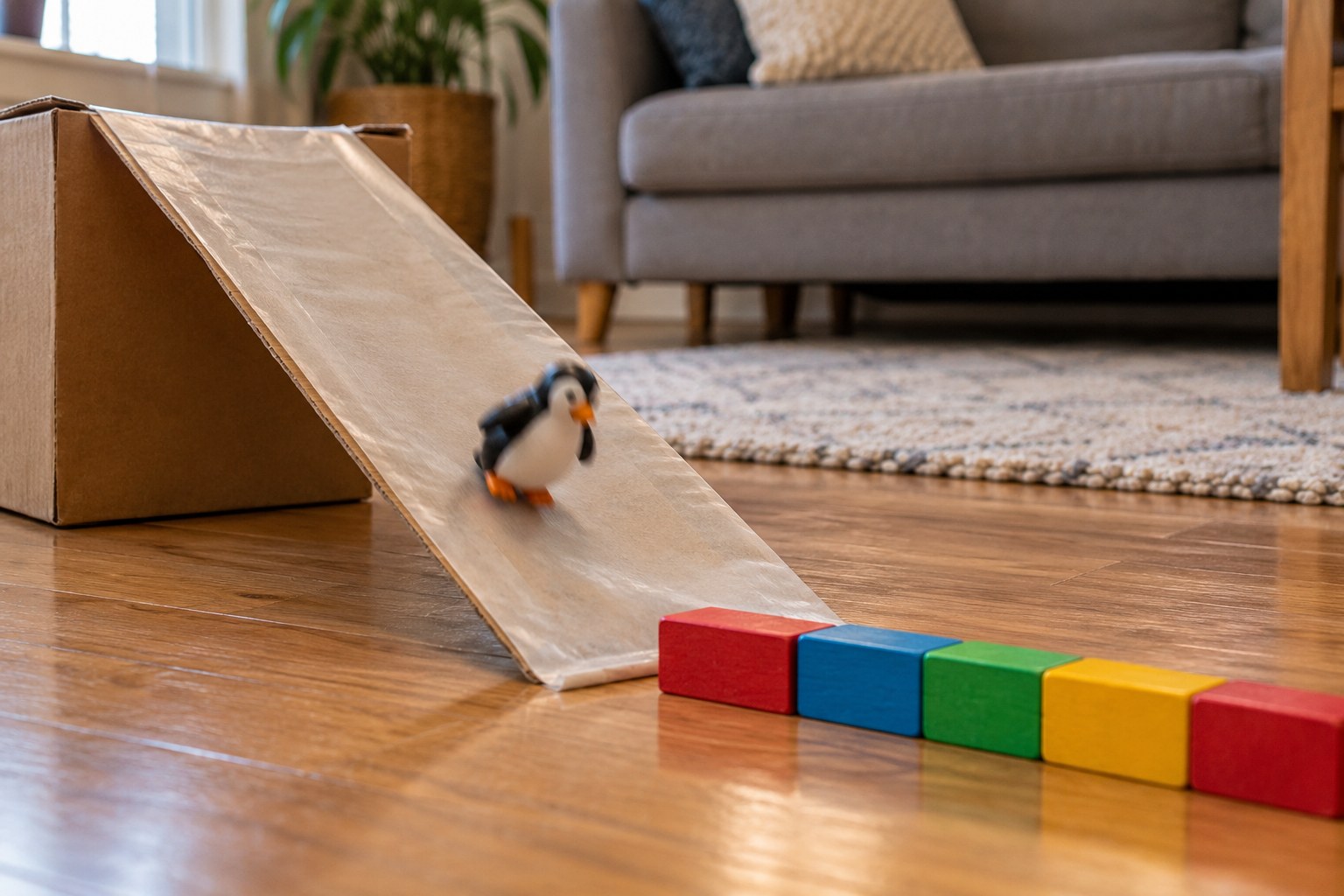
Your child learns that penguins slide on their bellies across snow, then sends a homemade bottle-cap penguin down a ramp covered with wax paper, foil, a towel and sandpaper or a bath mat, measuring each slide in block lengths.
Objective
Your child will compare how far a toy slides on different surfaces, measure each distance by laying blocks end to end, and explain that smooth surfaces have less friction.
Standards
Materials
| Item | Quantity |
|---|---|
| Large flat cardboard piece or a baking sheet for the ramp | 1 |
| Stack of books to prop up the ramp | 3-4 |
| Wax paper, aluminum foil, a hand towel and a piece of sandpaper or rubber bath mat | 1 piece each, about the size of the ramp |
| Small smooth toy, or a 'penguin' made from a clean yogurt cup or block with a paper penguin face taped on | 1 |
| Blocks, LEGO bricks or paper clips that are all the same size | about 20 |
| Tape | 1 roll |
| Paper and crayon | 1 each |
Vocabulary
Preparation
- Prop one end of the cardboard on 3 books to make a ramp, with a clear floor space at the bottom.
- Make the penguin: tape a small paper penguin face to the toy, block or upside-down yogurt cup.
- Draw a 4-row chart on paper: wax paper, foil, towel, sandpaper, with space to write a number for each.
Introduction
Lie on your belly on a smooth floor and push yourself forward with your hands and feet. Ask: did you know penguins do this on the snow to travel fast? Today we find out what kind of surface makes the best slide.
Which is easier to slide on in socks: a carpet or a smooth floor?
Why do you think penguins slide instead of walking sometimes?
Steps
Conclusion
Ask: which surface made the penguin slide the farthest? Which one had the most friction? Where else have you noticed friction, like on a playground slide?
Make your own lesson plan in minutes
Describe a topic and Resource Portal AI writes the objectives, materials and steps for your group.
Try Resource Portal AI