Lesson planAmerica's 250th Birthday Timeline Math
Math35 minutesGrades: 3rd, 4th, 5th
Overview
Subtract years on a floor timeline from 1776 to the 250th.
Description
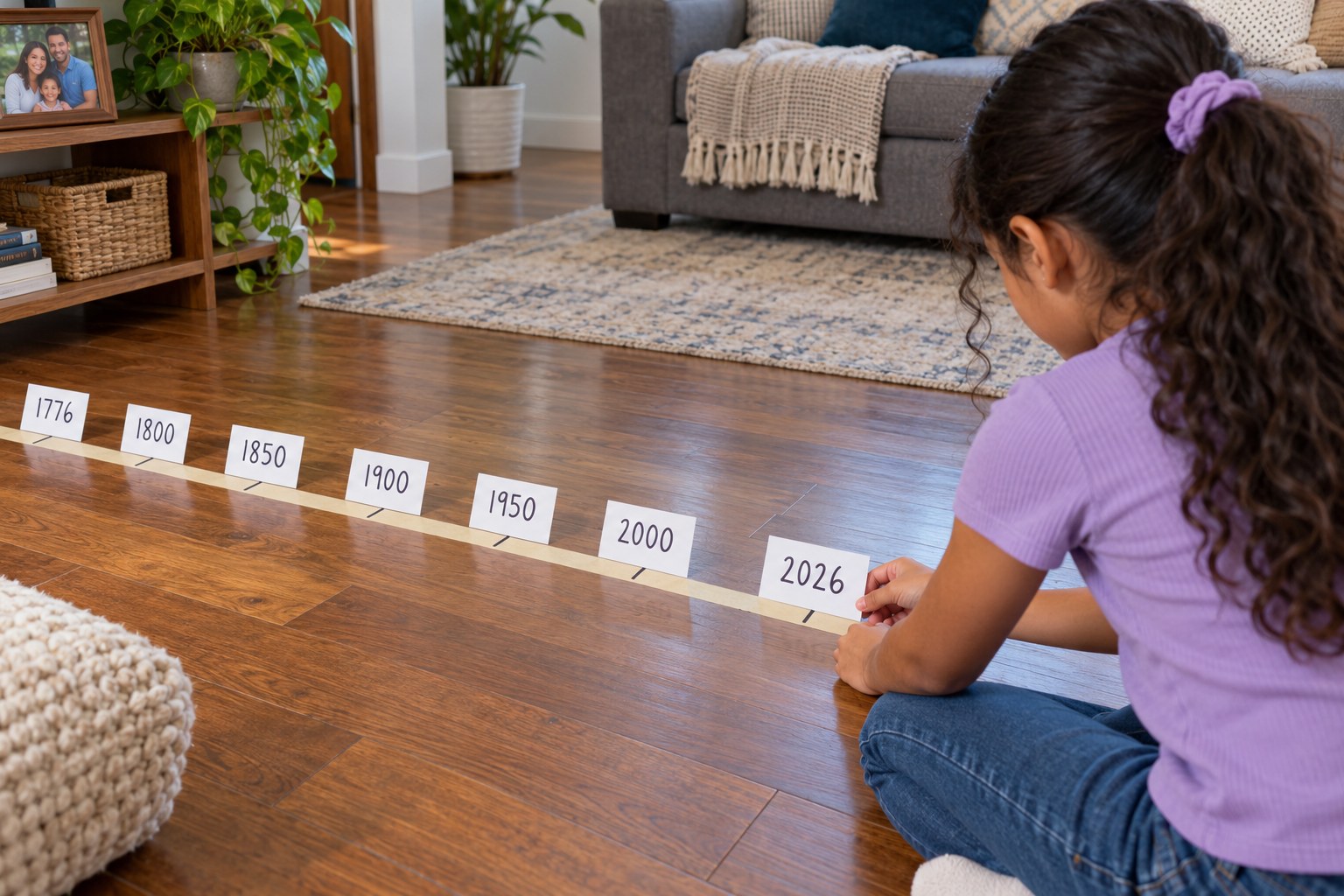
Your child builds a masking-tape timeline on the floor from 1776 to 2026, places eight Fourth of July history events on it, and subtracts years to find how long ago each event happened and how far apart they are, ending with how old the country turned on July 4, 2026.
Objective
Your child will place historical dates in order on a number line and use subtraction with regrouping to find elapsed years between events.
Standards
3.NBT.2Math · Grade 3 · Number & Operations in Base Ten Fluently add and subtract within 1000 using strategies and algorithms based on place value, properties of operations, and/or the relationship between addition and subtraction.
4.MD.2Math · Grade 4 · Measurement & Data Use the four operations to solve word problems involving distances, intervals of time, liquid volumes, masses of objects, and money, including problems involving simple fractions or decimals, and problems that require expressing measurements given in a larger unit in terms of a smaller unit. Represent measurement quantities using diagrams such as number line diagrams that feature a measurement scale.
4.NBT.4Math · Grade 4 · Number & Operations in Base Ten Fluently add and subtract multi-digit whole numbers using the standard algorithm.
Materials
| Item | Quantity |
|---|
| Masking tape or painter's tape | 1 roll |
| Index cards | 10 |
| Marker | 1 |
| Paper and pencil for calculations | 1 each per child |
| Optional: calculator for checking | 1 |
| Yardstick or measuring tape | 1 |
Vocabulary
Timeline
A line that shows events in the order they happened.
Elapsed time
How much time passes between two events.
Anniversary
The same date in a later year when people remember an event.
Semiquincentennial
A 250th anniversary.
Preparation
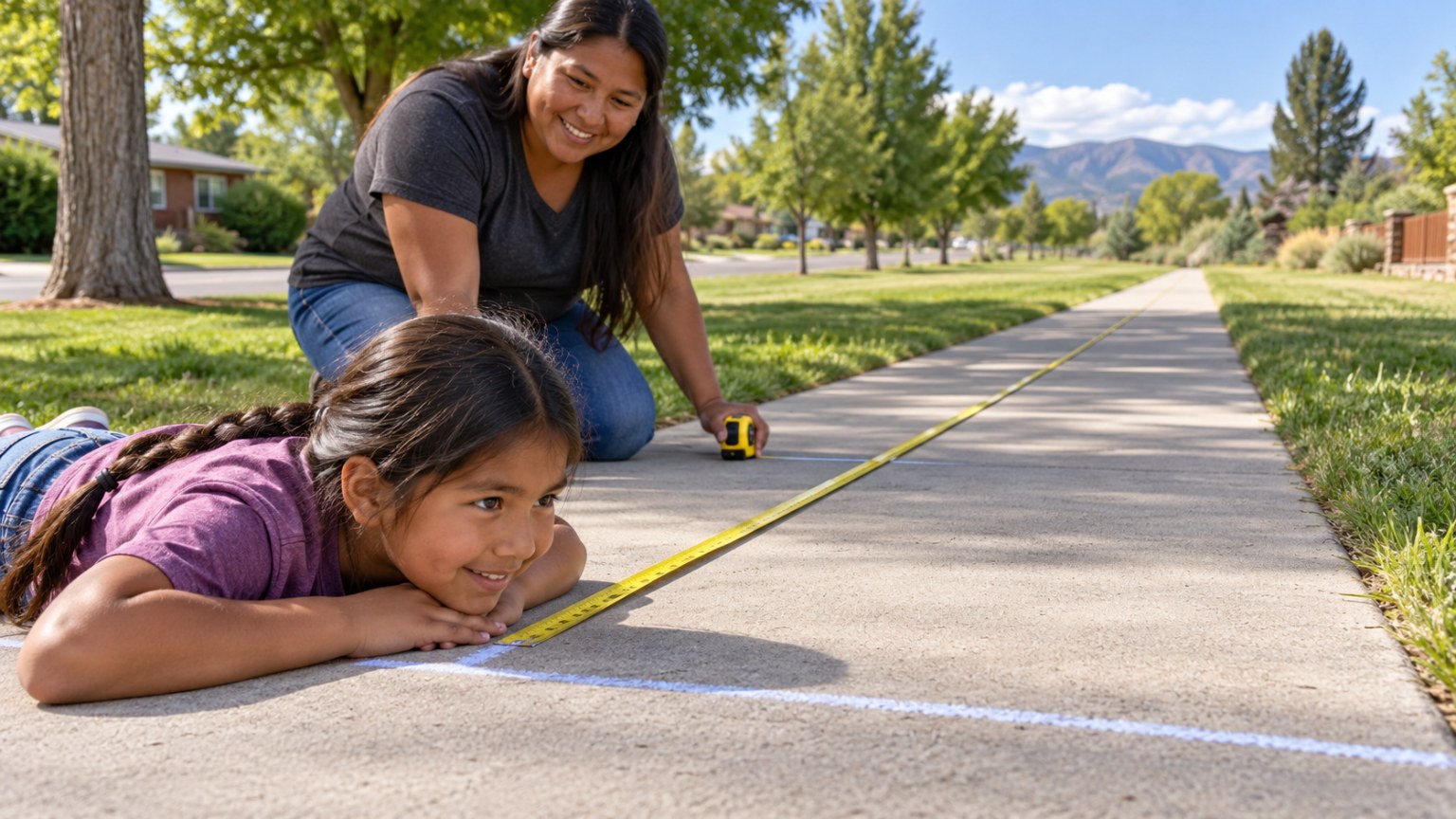
- Tape a straight line about 10 feet long across the floor. Mark 1776 at one end and 2026 at the other, with marks every 25 years (each mark about 1 foot apart).
- Write each event from the 'Timeline event cards' section on an index card with its year.
Introduction
Ask: if a person were born in 1776, how old would they be today? Could anyone live that long? Our country turned a very big number on July 4, 2026. Let's find it with math.
How do you figure out how old someone is from their birth year?
Which happened first: the moon landing or the 50-star flag?
Steps
1Step 1
Set up the line
(5 min) Read the background section and explain that July 4, 1776 is when the Declaration of Independence was approved. Your child walks the tape from 1776 to 2026 and reads the 25-year marks aloud.
2Step 2
Place the events
(7 min) Your child reads each event card and places it on the timeline at about the right spot, using the 25-year marks to estimate. Check the order together before doing any math.
3Step 3
How long ago?
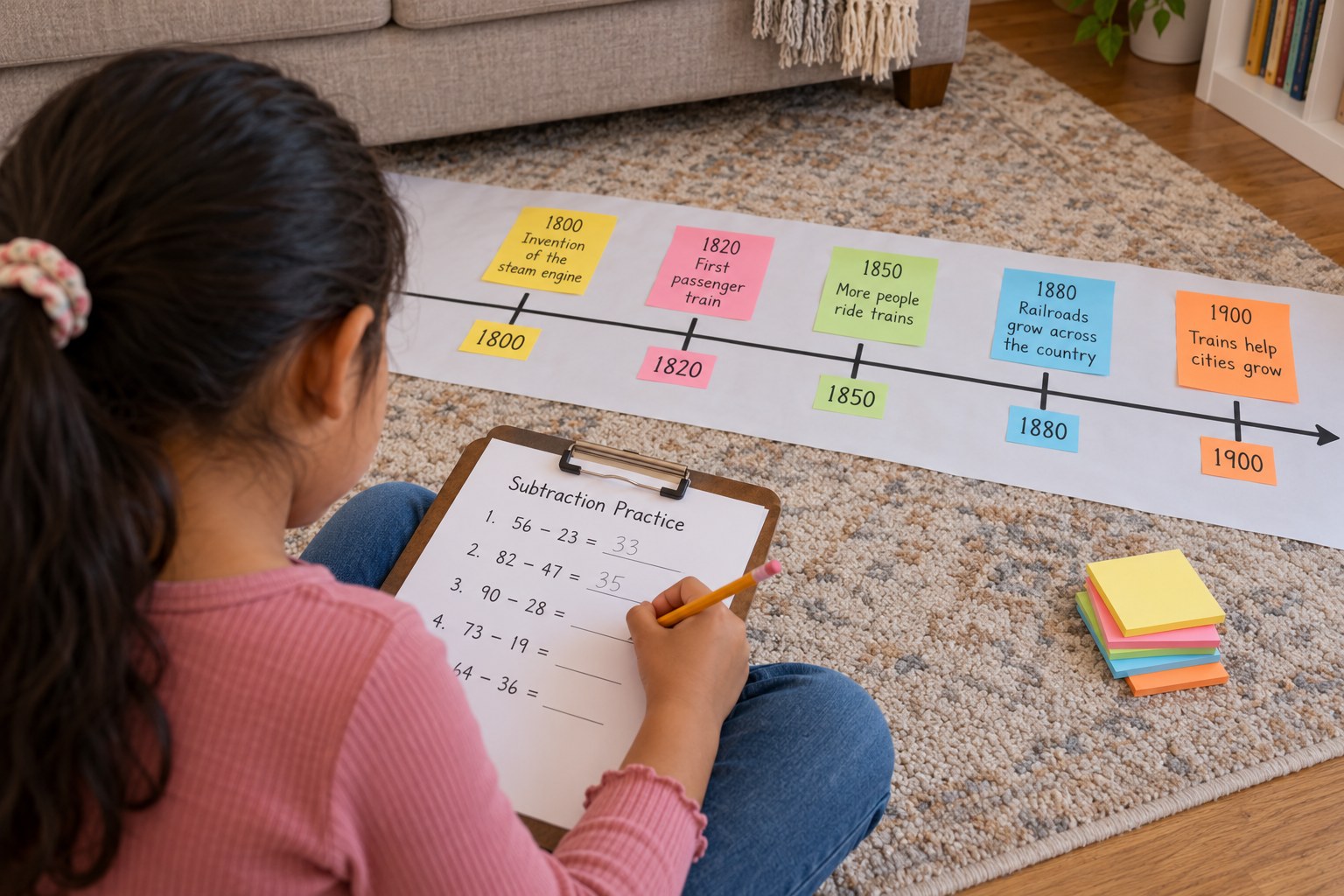
(10 min) For each event, your child subtracts its year from 2026 using the standard algorithm, showing the regrouping. Start with 2026 - 1776 to find the big birthday number, then do the rest.
4Step 4
Between events
(8 min) Your child answers the 'between events' questions, such as how many years passed between the Declaration and the first federal holiday. They check each answer by adding back up or with the calculator.
5Step 5
My own card
(5 min) Your child makes a card for the year they were born and one for a family member, places them on the timeline, and figures out how old the country was when each person was born. They write each subtraction problem on the card.
Conclusion
Ask: how old will the country be on July 4 the year you turn 18? Write the number problem and solve it.
Make your own lesson plan in minutes
Describe a topic and Resource Portal AI writes the objectives, materials and steps for your group.
Try Resource Portal AI