Complete or Incomplete? Insect Metamorphosis Card Sort
Overview
Sort insect life stages into two kinds of metamorphosis.
Description
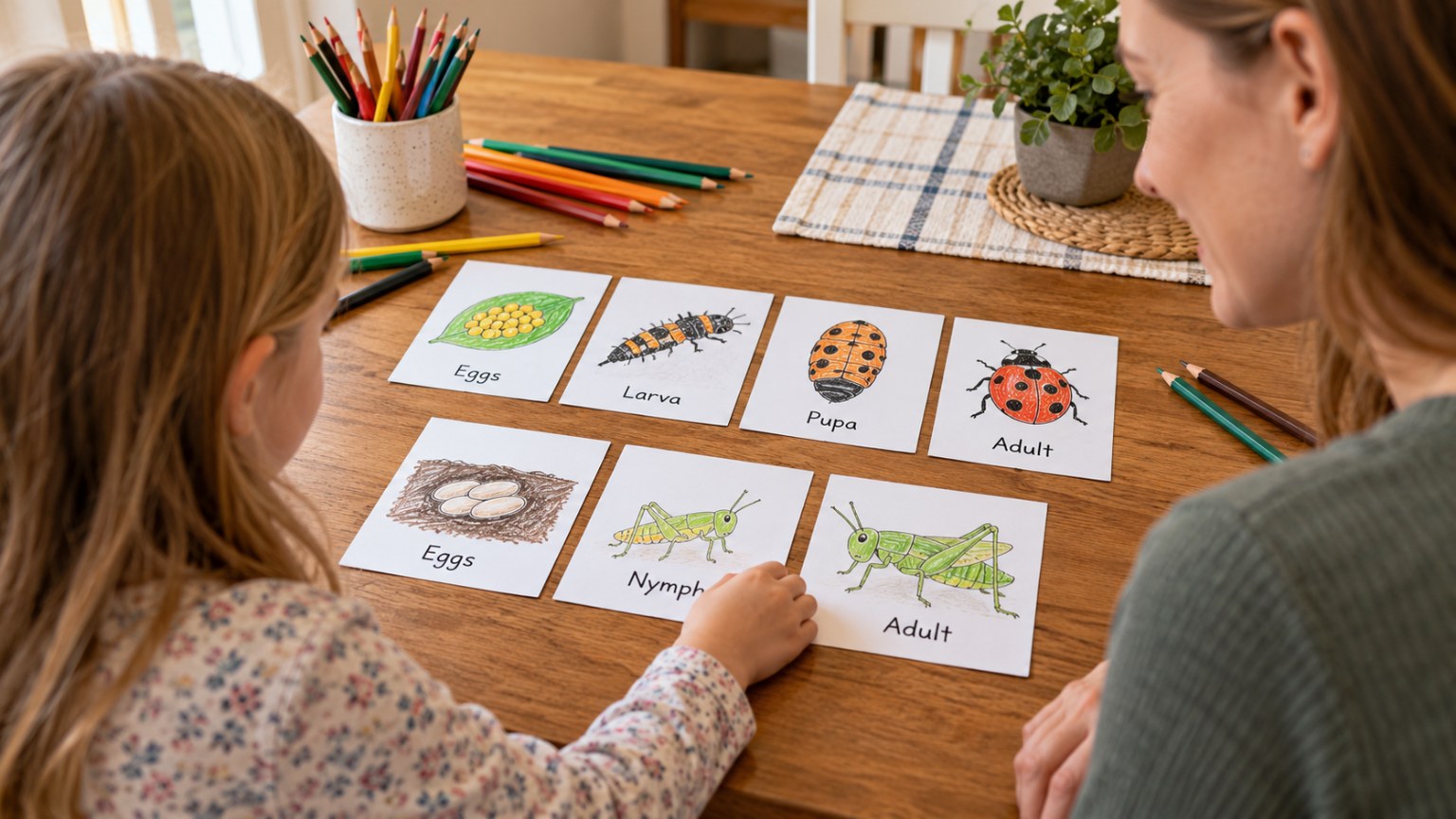
Your child makes life-stage cards for six insects, sorts them into complete metamorphosis (egg, larva, pupa, adult) and incomplete metamorphosis (egg, nymph, adult), then draws a labeled circular life-cycle diagram comparing a ladybug and a grasshopper.
Objective
Your child will distinguish complete and incomplete metamorphosis, sequence the stages for six insects, and explain one advantage of each life cycle.
Materials
| Item | Quantity |
|---|---|
| Index cards or paper rectangles | about 21 |
| Pencils, colored pencils or markers | 1 set |
| Two large sheets of paper labeled Complete and Incomplete | 2 |
| Life-stage fact sheet (below) | 1 |
| Optional: photos of each stage from a library book or website | 1 set |
Vocabulary
Preparation
- Copy the fact sheet or keep it nearby to read from.
- Label two large sheets Complete (4 stages) and Incomplete (3 stages).
Introduction
Show a picture of a caterpillar and a butterfly side by side and ask: 'If you didn't know, would you guess these were the same animal?' Then show a baby and an adult grasshopper, which look almost alike.
Why might a young insect look completely different from its parent?
What do you think happens inside a chrysalis?
Steps
Conclusion
Ask: 'Why might it help a butterfly that the caterpillar and the adult eat different food?' Look for egg clusters, caterpillars or nymphs on plants outdoors and decide which plan they follow.
Make your own lesson plan in minutes
Describe a topic and Resource Portal AI writes the objectives, materials and steps for your group.
Try Resource Portal AI