Lesson plan

Roll With Advantage: The Probability of the Higher of Two Dice

Math50 minutesGrades: 11th
Roll With Advantage: The Probability of the Higher of Two Dice

Overview

Prove exactly how much 'roll with advantage' really helps.

Description

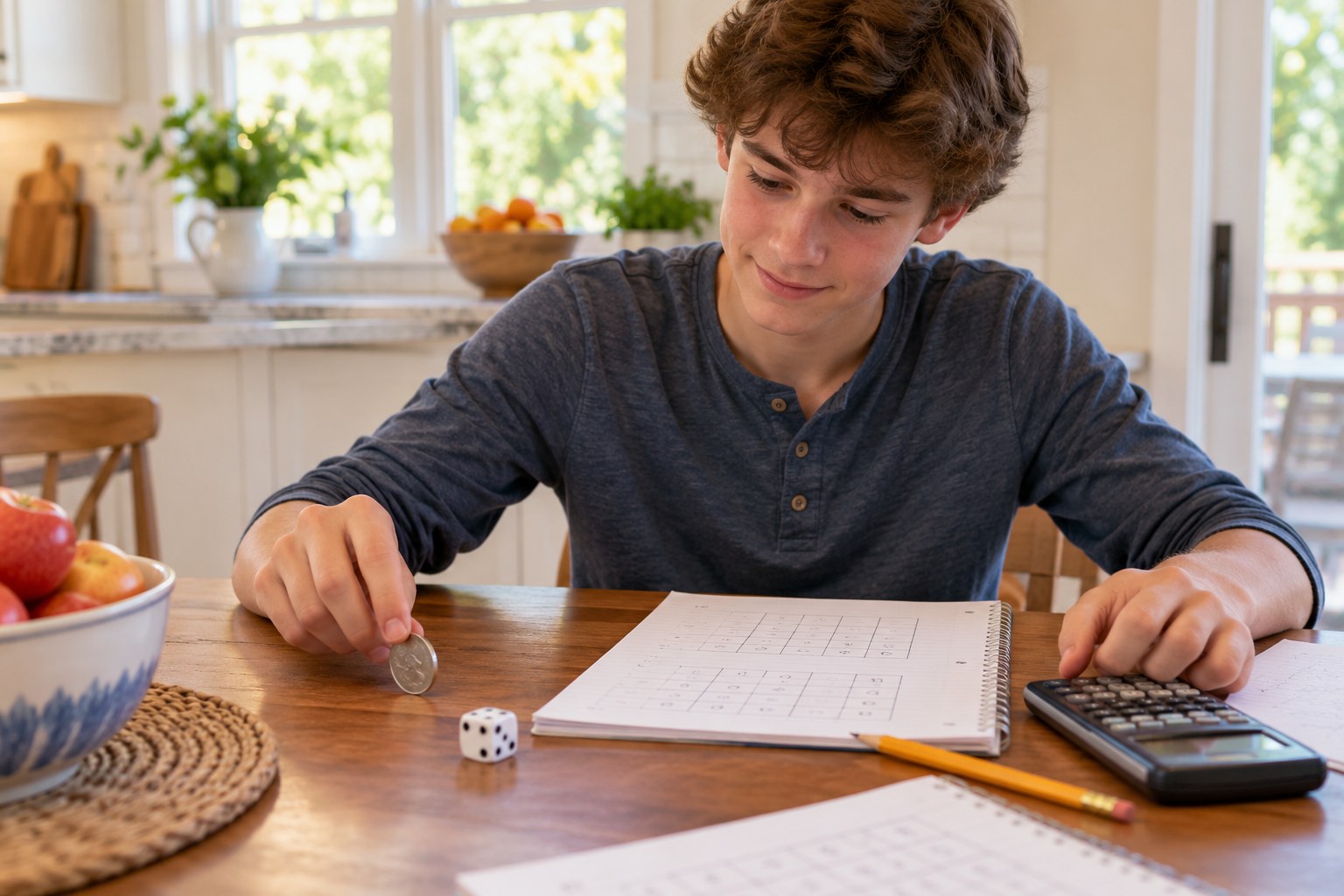
Your teen rolls two twenty-sided dice 50 times (or uses a free online dice roller), keeps the higher number each time, and tallies how often it meets targets of 11 and 15. They then use complements and the multiplication rule for independent events to prove that rolling with advantage succeeds with probability 1 - ((t - 1)/20)^2, build a comparison table against a single roll, and explain why the bonus is biggest at a target of 11 and tiny at 2 or 20.

Objective

Your teen will describe dice outcomes as subsets of a 400-outcome sample space using unions, intersections and complements, use the product rule to test whether two events are independent, and derive the exact probability of succeeding with advantage at any target.

Standards

S-CP.1Math · Grade HS · High School: Statistics & Probability — Conditional Probability & the Rules of Probability
Describe events as subsets of a sample space (the set of outcomes) using characteristics (or categories) of the outcomes, or as unions, intersections, or complements of other events ("or," "and," "not").
S-CP.2Math · Grade HS · High School: Statistics & Probability — Conditional Probability & the Rules of Probability
Understand that two events A and B are independent if the probability of A and B occurring together is the product of their probabilities, and use this characterization to determine if they are independent.

Materials

ItemQuantity
Twenty-sided dice (or a free online dice roller set to 2d20)2
Sheets of graph paper2
Pencil1
Calculator or phone calculator1
Highlighters in two colors2

Vocabulary

Advantage
A game rule where you roll two twenty-sided dice and keep the higher result instead of rolling just one.
Sample space
The set of all possible outcomes; for two twenty-sided dice it is the 400 ordered pairs from (1, 1) to (20, 20).
Complement
Everything in the sample space that is not in an event; P(not A) = 1 - P(A).
Independent events
Events where one happening does not change the chance of the other, which is true exactly when P(A and B) = P(A) x P(B).
Union and intersection
A or B (the union) contains outcomes in either event; A and B (the intersection) contains only outcomes in both.

Preparation

Introduction

Ask your teen: your character needs an 11 or higher to leap the chasm. A single twenty-sided die gives you a 50 percent chance. With advantage you roll two and keep the higher. Is that 100 percent, 75 percent, or something else? Have them commit to a guess and write it down.
Why can't you just add the two 50 percent chances together?
Do you think advantage helps more when you need a 19 or when you need an 11?

Steps

1Step 1
Guess and set up the tally
(6 min) Your teen writes their guesses for the chance of rolling 11 or higher and 15 or higher with advantage at the top of the first sheet of graph paper. Below that, they make a tally chart with the numbers 1 to 20 down the side so they can record the higher die from each pair.
2Step 2
Roll 50 pairs
(12 min) Your teen rolls the 2 twenty-sided dice 50 times, or clicks the dice roller 50 times, and puts a tally mark next to the higher number each time (if they tie, the shared number counts once). When all 50 are done, they count how many results were 11 or higher and how many were 15 or higher and write each as a fraction of 50 and as a decimal.
3Step 3
Map the sample space
(10 min) On the second sheet of graph paper, your teen uses the 20-by-20 grid to show all 400 equally likely pairs. With 1 highlighter they shade the 100 squares where both dice are below 11, and they explain to you that 'higher die is 11 or more' is the union 'Die 1 is 11+ or Die 2 is 11+', so its complement is exactly the shaded intersection 'both dice are 10 or less'.
4Step 4
Prove the formula
(10 min) Your teen shows that P(both 10 or less) = 100/400 = 0.25 and that this equals 0.5 x 0.5, which is the independence test from Common Core S-CP.2. They write the general rule on the graph paper, P(advantage hits t or more) = 1 - ((t - 1)/20)^2, and use the calculator to check it against their 50-roll tallies for targets 11 and 15 (exact answers 0.75 and 0.51).
5Step 5
Find where advantage matters most
(12 min) Your teen works Practice Problems 1 to 10 with the pencil and calculator and fills in the comparison table for targets 2, 6, 11, 16 and 20. They highlight the gain column with the second highlighter and explain, using the gain formula p(1 - p), why the boost peaks at 25 percentage points for a target of 11 and shrinks to under 5 points at 2 or 20, then check the Answer Key with you.

Conclusion

Ask your teen to say in one sentence when they would most want advantage. Then have them explain why advantage is never 'double' the chance, using the word complement.

Make your own lesson plan in minutes

Describe a topic and Resource Portal AI writes the objectives, materials and steps for your group.

Try Resource Portal AI