Why Fall Gets Cooler: Sun Angle and the Flashlight Spread Test
Overview
Use a flashlight and unit rates to explain cooler fall days.
Description
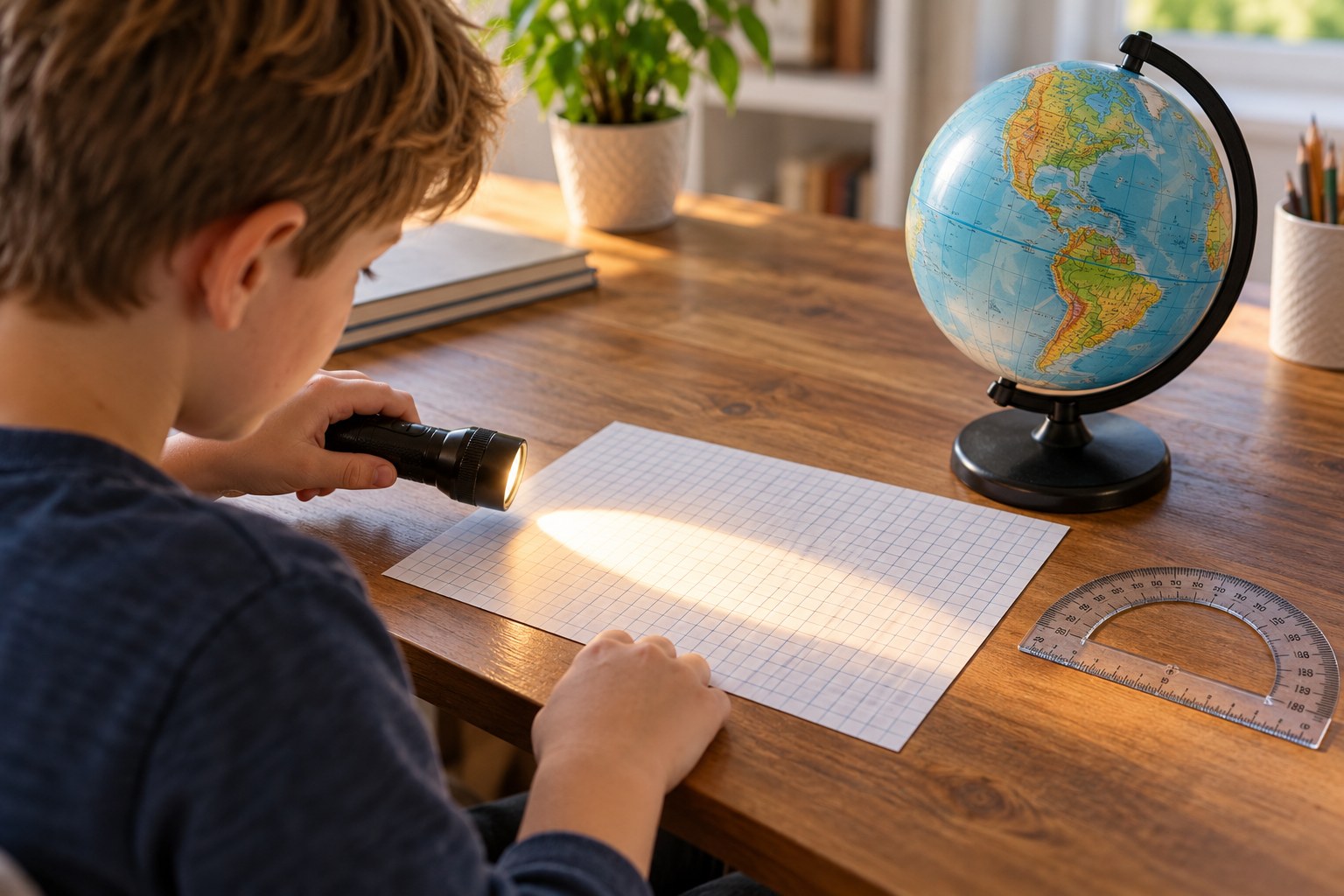
Your teen models the fall sun with a flashlight, measuring how the same beam spreads over more graph-paper squares as it tilts lower, then uses unit rates to calculate how much light each square gets and explains why fall gets cooler.
Objective
Your teen will measure how the area of a light beam changes with angle, calculate the unit rate of light per square, and explain how a lower fall sun angle and shorter days make the Northern Hemisphere cooler.
Standards
Materials
| Item | Quantity |
|---|---|
| Flashlight with a narrow, even beam (a phone light works) | 1 |
| Graph paper with 1/4-inch or 1-centimeter squares | 4 sheets |
| Protractor, or a paper triangle cut to 30, 45 and 60 degrees | 1 |
| Ruler | 1 |
| Books or a box to hold the flashlight steady | a small stack |
| Pencil and calculator | 1 each |
Vocabulary
Preparation
- Darken the room. Tape a sheet of graph paper flat on a table.
- Practice holding the flashlight at a fixed distance, measured with the ruler along the beam (for example 12 inches from lens to paper), using books to brace it.
Introduction
Ask: in fall, the Sun is still the same Sun, and Earth is actually a bit closer to it in winter than in summer. So why does it get colder? Shine the flashlight straight down, then tilt it low, and ask what changed.
Does the same flashlight look brighter when it shines straight down or at a slant?
Besides angle, what else changes about the Sun in fall?
Steps
Conclusion
Ask: why are mornings and evenings the coolest part of a fall day? (The Sun is lowest then.) Go outside at noon on a sunny fall day and compare your shadow length to a summer memory.
Make your own lesson plan in minutes
Describe a topic and Resource Portal AI writes the objectives, materials and steps for your group.
Try Resource Portal AI