Lesson planLocate the Epicenter: Seismic Wave Triangulation
Science45 minutesGrades: 6th, 7th, 8th
Overview
Use seismic wave timing and circles to find an earthquake's epicenter.
Description
Your teen plays seismologist: using the time gap between fast P waves and slower S waves at three stations, they calculate how far each station is from an earthquake, draw three circles on a scale map, and pinpoint the epicenter where the circles cross.
Objective
Your teen will use wave speeds and a constant rate to convert arrival-time gaps into distances, then use a scale map and three circles to locate an epicenter.
Standards
6.RP.3bMath · Grade 6 · Ratios & Proportional Relationships Solve unit rate problems including those involving unit pricing and constant speed.
7.RP.2Math · Grade 7 · Ratios & Proportional Relationships Recognize and represent proportional relationships between quantities.
Materials
| Item | Quantity |
|---|
| Graph paper or plain paper with a ruler | 1 sheet per teen |
| Drawing compass, or a pencil tied to a piece of string | 1 |
| Ruler with centimeters | 1 |
| Pencil and calculator | 1 each |
| Two toy cars or two people (for the P and S wave race demo) | 2 |
Vocabulary
Epicenter
The point on the surface directly above where an earthquake starts.
P wave
The fastest seismic wave; it pushes and pulls rock and arrives first.
S wave
A slower seismic wave that shakes rock side to side and arrives second.
Lag time
The number of seconds between the P wave and S wave arrivals.
Triangulation
Finding a location from distances to three known points.
Preparation
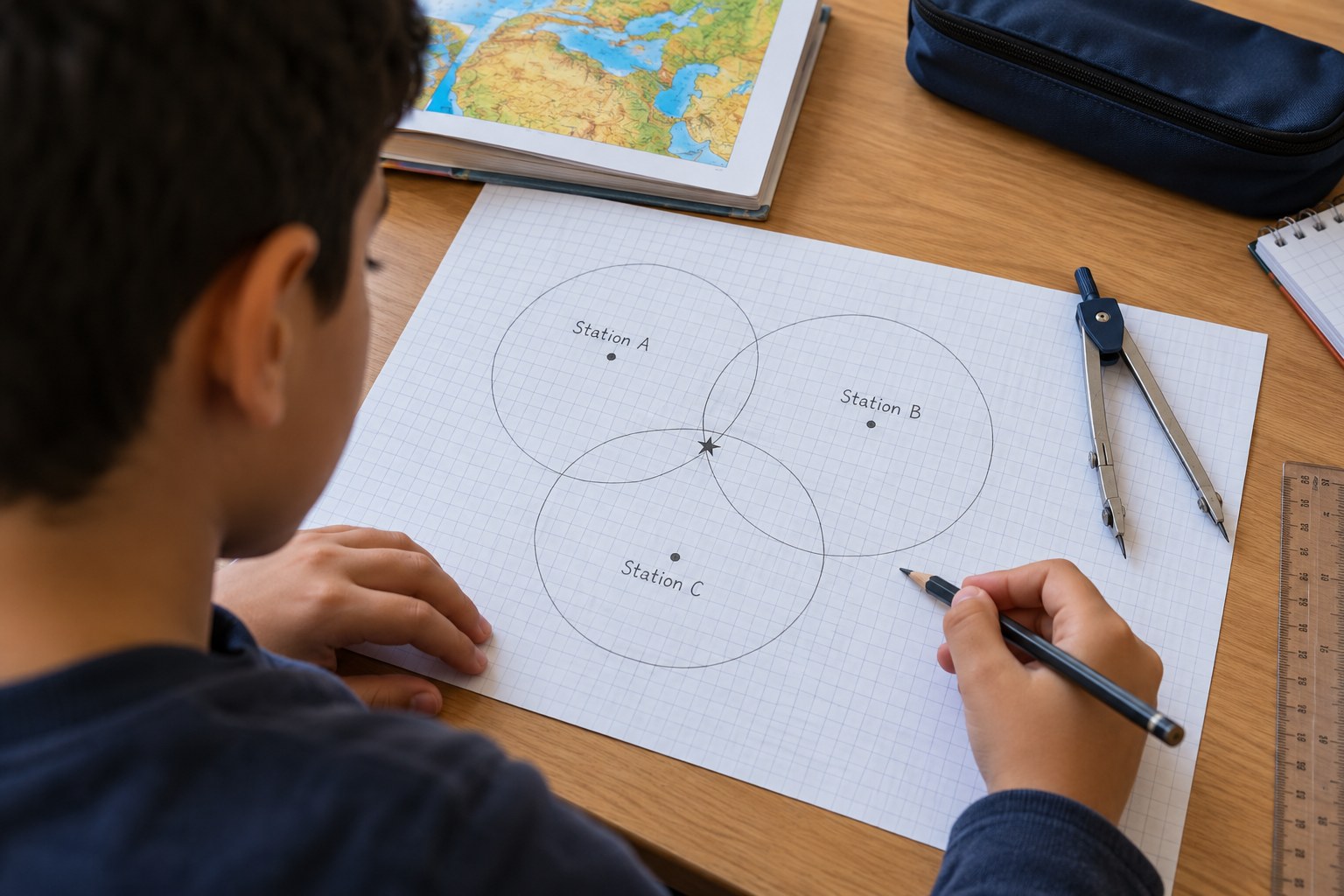
- On the paper, mark three seismograph stations using centimeter coordinates from the bottom-left corner: Station A at (2, 2), Station B at (12, 3) and Station C at (6, 11). Scale: 1 cm = 10 km.
- Copy the 'Station data' table.
Introduction
Stand at one end of a hallway with your teen. Both walk toward the other end, but you walk twice as fast. Ask: the farther we go, what happens to the gap between us? Seismic waves do the same thing.
How could knowing a speed and a time tell you a distance?
Why would one seismograph station not be enough to find an epicenter?
Steps
1Step 1
Race the waves
(6 min) Act out a P wave (fast walker) and S wave (slow walker) leaving the same starting point. Your teen notices the gap between arrivals grows the farther they travel, so a bigger lag time means a farther earthquake.
2Step 2
Find the rate
(8 min) Using speeds of about 6 km/s for P waves and 3.5 km/s for S waves, your teen calculates how long each wave takes to travel 100 km (about 16.7 s and 28.6 s) and finds the lag (about 12 s). They divide to get the unit rate: roughly 8 km of distance for every 1 second of lag.
3Step 3
Distances from lag times
(8 min) Your teen multiplies each station's lag time by 8 km/s to find its distance, then converts to map centimeters with the scale (divide by 10). They record both in the 'Station data' table.
4Step 4
Draw the circles
(12 min) Your teen sets the compass to each radius and draws a circle around each station. The circles should cross near one spot; your teen marks it with a star as the epicenter and reads its coordinates.
5Step 5
Check and reflect
(8 min) Compare with the answer key. Discuss why real seismologists use many stations and computers, and how the same idea lets California's ShakeAlert system detect P waves and send warnings seconds before strong S-wave shaking arrives.
Conclusion
Ask your teen to explain why three circles are needed (two circles can cross in two places). Seismic waves let scientists 'see' inside the Earth, too: S waves cannot travel through the liquid outer core.
Make your own lesson plan in minutes
Describe a topic and Resource Portal AI writes the objectives, materials and steps for your group.
Try Resource Portal AI