Lesson planCrater Lab: Modeling Impacts with Flour, Cocoa and Marbles
Science50 minutesGrades: 9th
Overview
Drop marbles into flour, graph the craters and fit a model.
Description
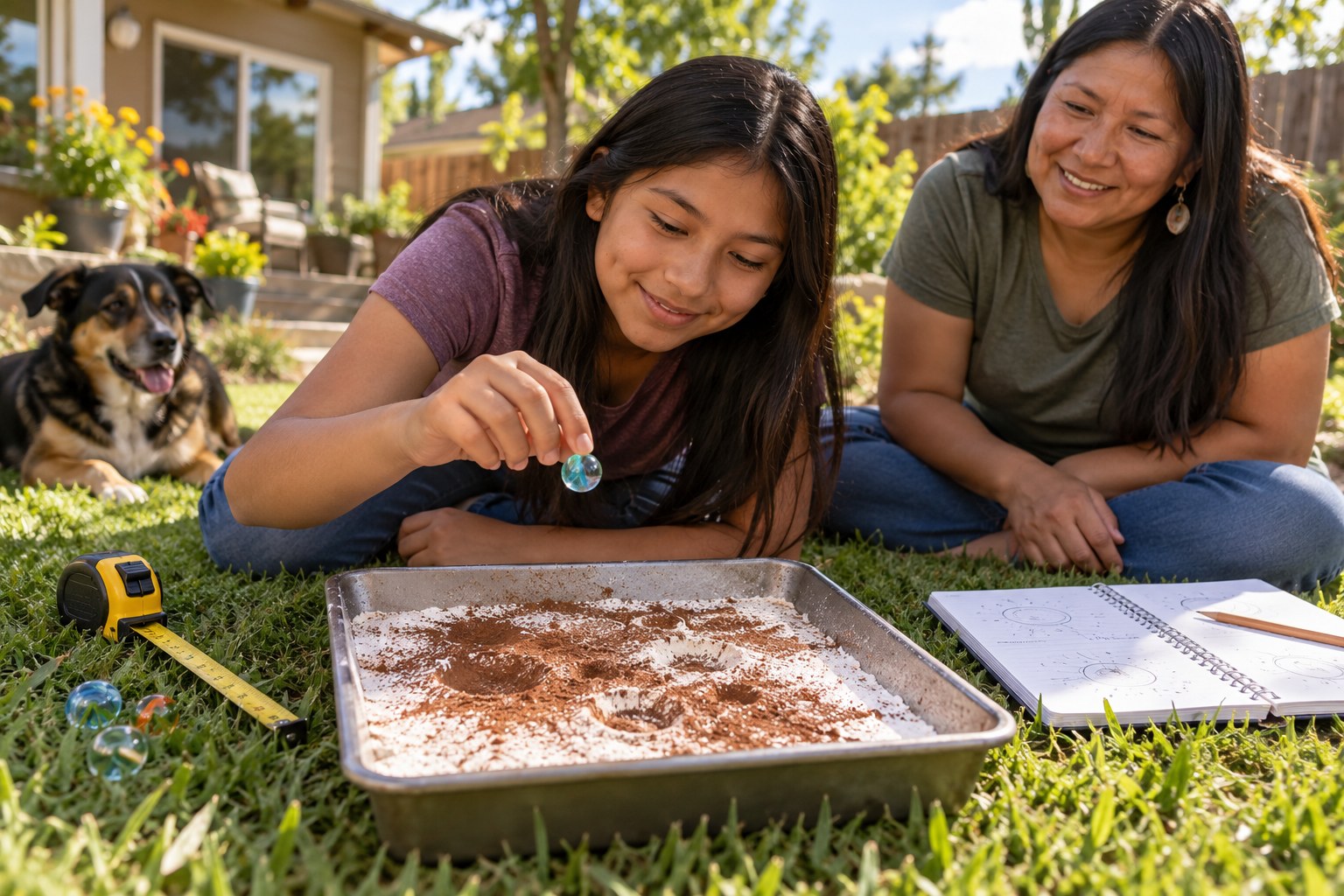
Your teen fills a baking pan with flour, dusts it with a thin layer of cocoa, and drops a marble from four measured heights, measuring the crater diameter and ejecta rays each time. They graph diameter against drop height, compare a linear fit with a curved power model, use the better model to predict, and learn why the Moon keeps craters for billions of years while Earth erases them.
Objective
Your teen will collect impact data, graph crater diameter against drop height, fit and compare linear and power functions, and use the better-fitting model to make and check predictions.
Standards
S-ID.6aMath · Grade HS · High School: Statistics & Probability — Interpreting Categorical & Quantitative Data Fit a function to the data; use functions fitted to data to solve problems in the context of the data.
Materials
| Item | Quantity |
|---|
| Baking pan at least 23 cm × 33 cm | 1 |
| All-purpose flour | about 6 cups (enough for a 4 cm layer) |
| Unsweetened cocoa powder | 2 tablespoons |
| Fine sieve or small strainer | 1 |
| Glass marble | 1 |
| Tape measure or meter stick | 1 |
| Ruler in centimeters | 1 |
| Newspaper or old sheet | 1 |
| Graph paper or a spreadsheet app | 1 |
Vocabulary
Ejecta
Material thrown out of a crater by an impact, often forming bright streaks called rays.
Line of best fit
A straight line that comes as close as possible to a set of data points.
Power function
A function of the form y = a·x^b, which can model data that rises quickly at first and then more slowly.
Residual
The difference between an actual data value and the value predicted by a model.
Preparation
- Spread the newspaper on the floor, outdoors if possible, and set the pan on it; flour dust should stay away from faces and open flames.
- Fill the pan with about 4 cm of flour, smooth it with the ruler, and sift the 2 tablespoons of cocoa evenly on top through the sieve.
Introduction
Show your teen a photo of the Moon's surface and ask: why is the Moon covered in craters while Earth, which is bigger and closer to most incoming rocks, barely shows any? Today they create their own crater field and find the math behind the holes.
If you drop a marble from twice as high, will the crater be twice as wide?
What on Earth could erase a crater over time?
Steps
1Step 1
Drop and measure
(15 min) Your teen drops the marble straight down from 25, 50, 100 and 200 cm above the flour, measured with the tape measure, doing two trials at each height in fresh spots. After each drop they measure the crater's diameter across the rim with the ruler, count the white flour rays streaking across the cocoa, and lift the marble out carefully.
2Step 2
Organize the data
(7 min) Your teen averages the two trials at each height and records the results in a table on the graph paper or spreadsheet. They write one sentence describing the pattern, such as 'diameter goes up but by less each time the height doubles.'
3Step 3
Fit two models
(15 min) Your teen graphs diameter (y) against height (x), then fits a straight line and a power curve, using a spreadsheet trendline or the sample models in the extra section. They calculate the residuals for the linear model and check whether they form a pattern, which would show the line is the wrong shape.
4Step 4
Predict and test
(8 min) Using the better model, your teen predicts the crater diameter for a 150 cm drop, then tests it with the marble and compares the prediction with the real measurement. They write the percent difference.
5Step 5
Explain the Moon's craters
(5 min) Your teen writes three sentences explaining why the Moon keeps craters for billions of years: it has no air, no weather, no flowing water and no plate tectonics to erode or recycle its surface. They contrast that with how wind, water and plate tectonics wear down Earth's craters.
Conclusion
Ask your teen: 'Why was the straight line a worse model, even though it went through the middle of the points?' Choosing the right shape of function is half of modeling.
Make your own lesson plan in minutes
Describe a topic and Resource Portal AI writes the objectives, materials and steps for your group.
Try Resource Portal AI