Full lesson previewVeterans Day Primary Source Detective: 1919 vs. 1954
Reading45 minutesGrades: 6th, 7th, 8th
Overview
Compare the 1919 and 1954 statements that shaped November 11.
Description
Your teen reads two official statements about November 11, President Wilson's 1919 Armistice Day message and President Eisenhower's 1954 Veterans Day proclamation, cites evidence for each author's purpose, and explains how the meaning of the day changed between them.
Objective
Your teen will cite textual evidence from two primary sources, determine each author's purpose and point of view, and explain how the meaning of November 11 shifted from 1919 to 1954.
Standards
RI.6.1ELA · Grade 6 · Reading: Informational Text Cite textual evidence to support analysis of what the text says explicitly as well as inferences drawn from the text.
RI.7.1ELA · Grade 7 · Reading: Informational Text Cite several pieces of textual evidence to support analysis of what the text says explicitly as well as inferences drawn from the text.
RI.8.6ELA · Grade 8 · Reading: Informational Text Determine an author's point of view or purpose in a text and analyze how the author acknowledges and responds to conflicting evidence or viewpoints.
Materials
| Item | Quantity |
|---|
| Device with internet to read the two primary sources (see 'Where to find the sources') | 1 |
| Printed copies of both sources, if possible | 1 set per teen |
| Two highlighters in different colors | 2 |
| Comparison chart from this lesson, copied on paper | 1 per teen |
| Pen or pencil | 1 |
Vocabulary
Primary source
A document or object created at the time of an event by someone who was part of it.
Proclamation
An official public announcement by a leader.
Author's purpose
The reason a writer creates a text: to inform, persuade, honor, explain and so on.
Armistice
A formal agreement to stop fighting.
Preparation
- Find and print or bookmark both sources (see 'Where to find the sources'). Each is short, about a page.
- Copy the comparison chart onto paper.
Introduction
Ask your teen: if you had to explain why a holiday exists in one paragraph, what would you include? Say: two presidents did exactly that for November 11, 35 years apart. Your job is to figure out what changed and why.
What happened in the world between 1919 and 1954?
How can an official document tell us what people valued at the time?
Steps
1Step 1
Set the context
(7 min) Your teen reads the 'About Veterans Day' section and notes what happened between 1919 and 1954: World War II and the Korean War. They predict how a 1954 statement might differ from a 1919 one.
2Step 2
Read the 1919 message
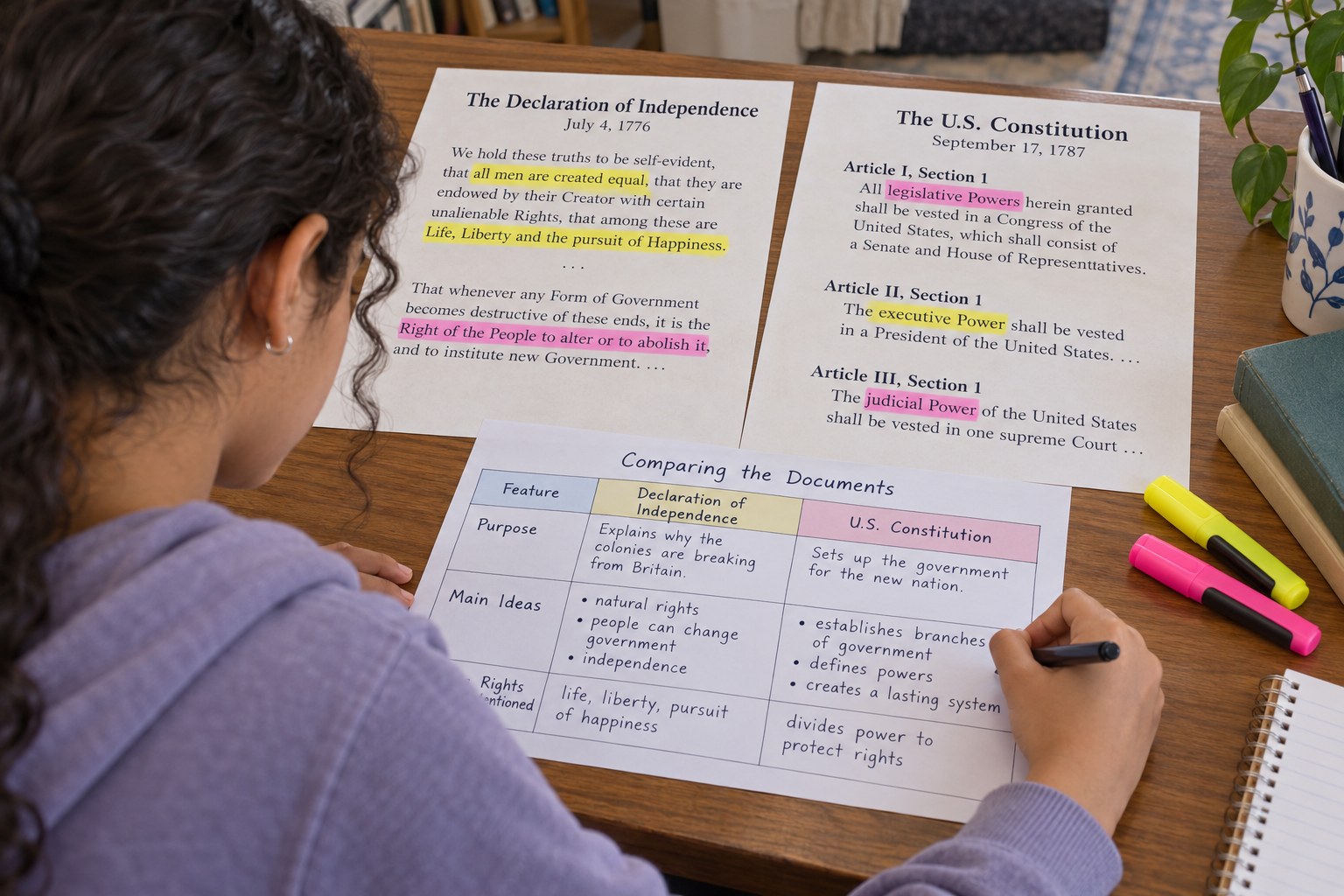
(9 min) Your teen reads Wilson's Armistice Day message and highlights in one color the words that show who is being honored and what feelings the author wants readers to have. They fill in the 1919 column of the chart, quoting at least 2 short phrases.
3Step 3
Read the 1954 proclamation
(10 min) Your teen reads Eisenhower's Veterans Day proclamation and highlights in the second color who is honored and what actions citizens are asked to take. They fill in the 1954 column with quoted evidence.
4Step 4
Compare purposes
(10 min) Using the chart, your teen writes 3 to 4 sentences answering: how did the purpose of November 11 change, and what evidence shows it? Push them to explain why the change makes sense given the events between the two documents.
5Step 5
Discuss and defend
(7 min) Your teen shares their claim and best piece of evidence with you or a small group. Ask a challenge question, such as whether anything stayed the same, and have them answer using the texts.
Conclusion
Ask: what one word sums up 1919, and what one word sums up 1954? How would you write a Veterans Day statement for today?
Make your own lesson plan in minutes
Describe a topic and Resource Portal AI writes the objectives, materials and steps for your group.
Try Resource Portal AI