Lesson planKnights and Lords: Reading a Real 1127 Oath of Fealty
Reading45 minutesGrades: 7th, 8th
Overview
Analyze a real medieval loyalty ceremony and test the feudal pyramid.
Description
Your teen reads an eyewitness account written in 1127 by Galbert of Bruges describing knights and nobles swearing loyalty to a new count, breaks the ceremony into its three acts (homage, fealty, investiture), cites evidence about what each side promised, and then tests the familiar "feudal pyramid" diagram against the source.
Objective
Your teen will cite several pieces of textual evidence to explain what a vassal and lord promised each other, analyze how the ceremony connected people, objects and ideas, and evaluate how well a simple feudal pyramid represents the source.
Standards
RI.7.1ELA · Grade 7 · Reading: Informational Text Cite several pieces of textual evidence to support analysis of what the text says explicitly as well as inferences drawn from the text.
RI.7.3ELA · Grade 7 · Reading: Informational Text Analyze the interactions between individuals, events, and ideas in a text (e.g., how ideas influence individuals or events, or how individuals influence ideas or events).
Materials
| Item | Quantity |
|---|
| The Galbert of Bruges excerpt (in the Primary source section below) | 1 copy or on screen |
| Three colored highlighters or pencils | 3 |
| Paper for a 3-column chart and a pyramid sketch | 2 sheets |
| Pencil | 1 |
| Ribbon or string and a pencil or stick (to act out the ceremony, optional) | 1 each |
Vocabulary
Vassal
A person who promised loyalty and service to a lord in exchange for protection and land or income.
Homage
The ceremony in which a vassal declared himself the lord's "man."
Fealty
A sworn promise of loyalty to a lord.
Investiture
Formally handing over land or rights, often by giving a symbolic object.
Fief
Land or income a lord granted to a vassal in return for service.
Preparation
- Read the excerpt and the About section yourself; note any words your teen may need help with (relics, investitures, deceit).
- Draw a 3-column chart with headings: Homage, Fealty, Investiture.
Introduction
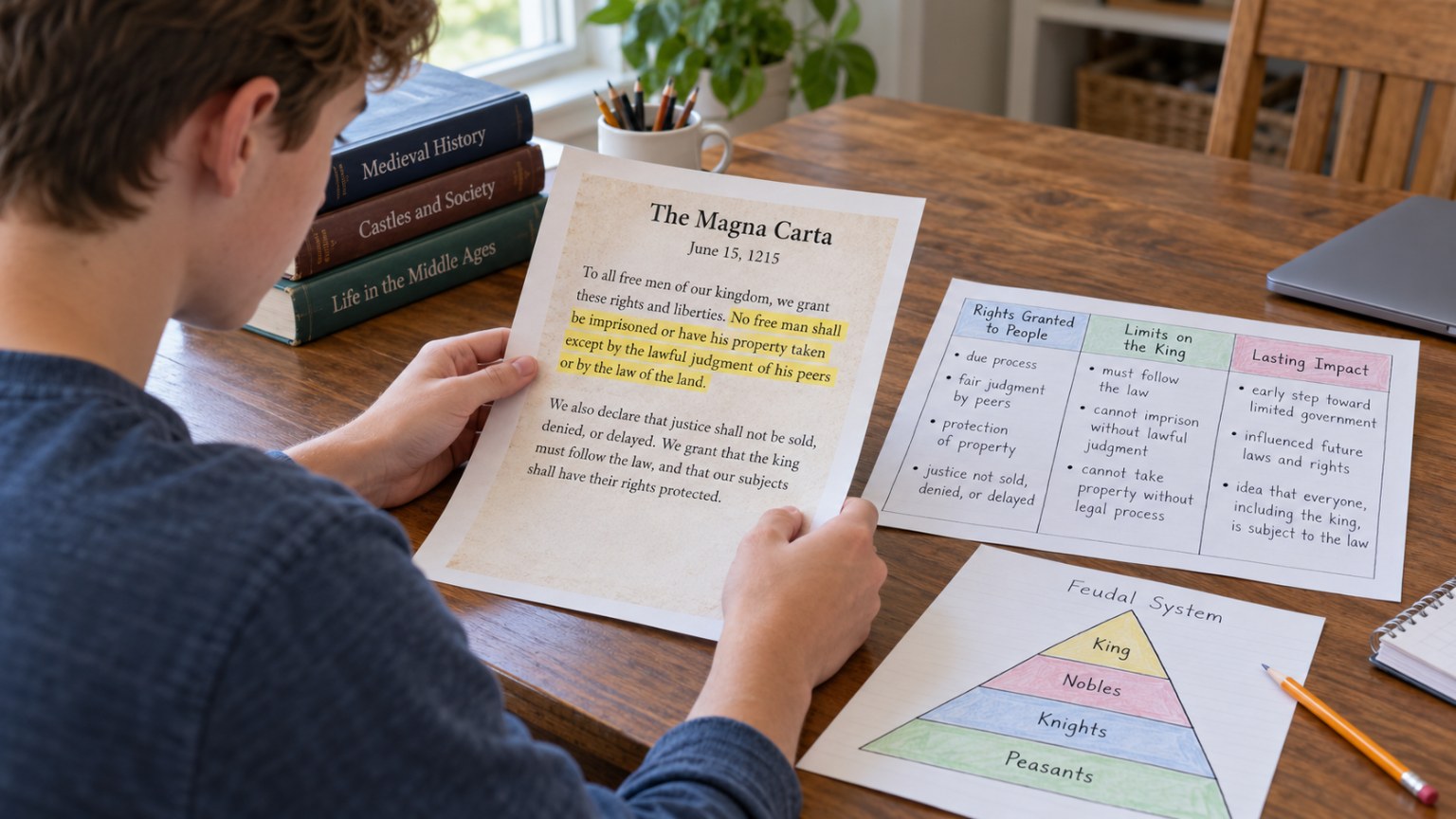
Draw a quick pyramid labeled king, lords, knights, peasants and ask: have you seen this in a textbook? Today your teen will read what a real person who watched knights swear loyalty actually wrote in 1127, and decide whether the pyramid tells the whole story.
What does it mean to promise loyalty to someone?
Why might a knight want a lord, and a lord want knights?
Steps
1Step 1
Set the scene
(6 min) Read the About section together. Your teen finds Flanders (today part of Belgium and northern France) on a map and notes who Galbert was, when he wrote, and why new oaths were needed in 1127.
2Step 2
Read and annotate
(10 min) Your teen reads the excerpt twice and highlights it in three colors: homage in one color, fealty in a second, and investiture in a third. They write a margin note defining each unfamiliar word from context.
3Step 3
Chart the three acts
(10 min) In the 3-column chart, your teen records for each act what was said, what was done with hands or objects, and who took part, quoting at least one phrase per column. Then they act it out with you: clasped hands, the spoken promise and the rod handed over.
4Step 4
Analyze the relationship
(9 min) Your teen answers in writing: what did the vassal promise, and what does the investiture suggest the lord gave in return? They cite two pieces of evidence and make one inference, such as why public gestures and sacred objects made the promise feel binding in a time when few people could read written contracts.
5Step 5
Test the pyramid
(10 min) Your teen compares the source with the pyramid diagram: what does the source show that the pyramid does not (a personal, two-way, ceremonial bond between specific people)? They write a 4 to 5 sentence claim about whether the pyramid is a useful model, citing the source and the historians' debate in the About section.
Conclusion
Ask: if you could ask Galbert one question, what would it be? Connect the ceremony to castles: castles were often held by vassals as fiefs, and a lord's castle was the center where oaths like these were sworn and services were owed.
Make your own lesson plan in minutes
Describe a topic and Resource Portal AI writes the objectives, materials and steps for your group.
Try Resource Portal AI