Lesson planPresidents' Day Electoral College Math: The Road to a Majority
Math45 minutesGrades: 6th, 7th, 8th
Overview
Use percents to explore how the Electoral College chooses a president.
Description
Your teen learns how the Electoral College picks the president, then plays out an election in the made-up country of Landia, finding combinations of states that reach a majority and using percents to compare electoral votes with the popular vote.
Objective
Your teen will find percents of a quantity, compare ratios, and explain how a candidate can win a majority of electoral votes without winning the popular vote.
Standards
6.RP.3cMath · Grade 6 · Ratios & Proportional Relationships Find a percent of a quantity as a rate per 100 (e.g., 30% of a quantity means 30/100 times the quantity); solve problems involving finding the whole, given a part and the percent.
7.RP.3Math · Grade 7 · Ratios & Proportional Relationships Use proportional relationships to solve multistep ratio and percent problems.
Materials
| Item | Quantity |
|---|
| Calculator | 1 |
| Paper and pencil | 2 sheets |
| Five index cards for the Landia states | 5 |
| Two colors of markers or colored pencils | 2 |
| The 'Landia election' section printed or on a screen | 1 copy |
Vocabulary
Elector
A person chosen in each state to cast an official vote for president.
Popular vote
The total number of votes cast by individual voters.
Winner-take-all
A rule where the candidate with the most votes in a state gets all of its electors.
Preparation
- Write each Landia state's name and number of electors on an index card.
- Print the Landia election table.
Introduction
Ask: 'Is it possible to become U.S. president without getting the most votes nationwide?' Let your teen answer, then say it has happened five times, and today's math will show how.
Why might the Constitution's writers have designed a system with electors?
What does it mean to win a majority?
Steps
1Step 1
How the real system works
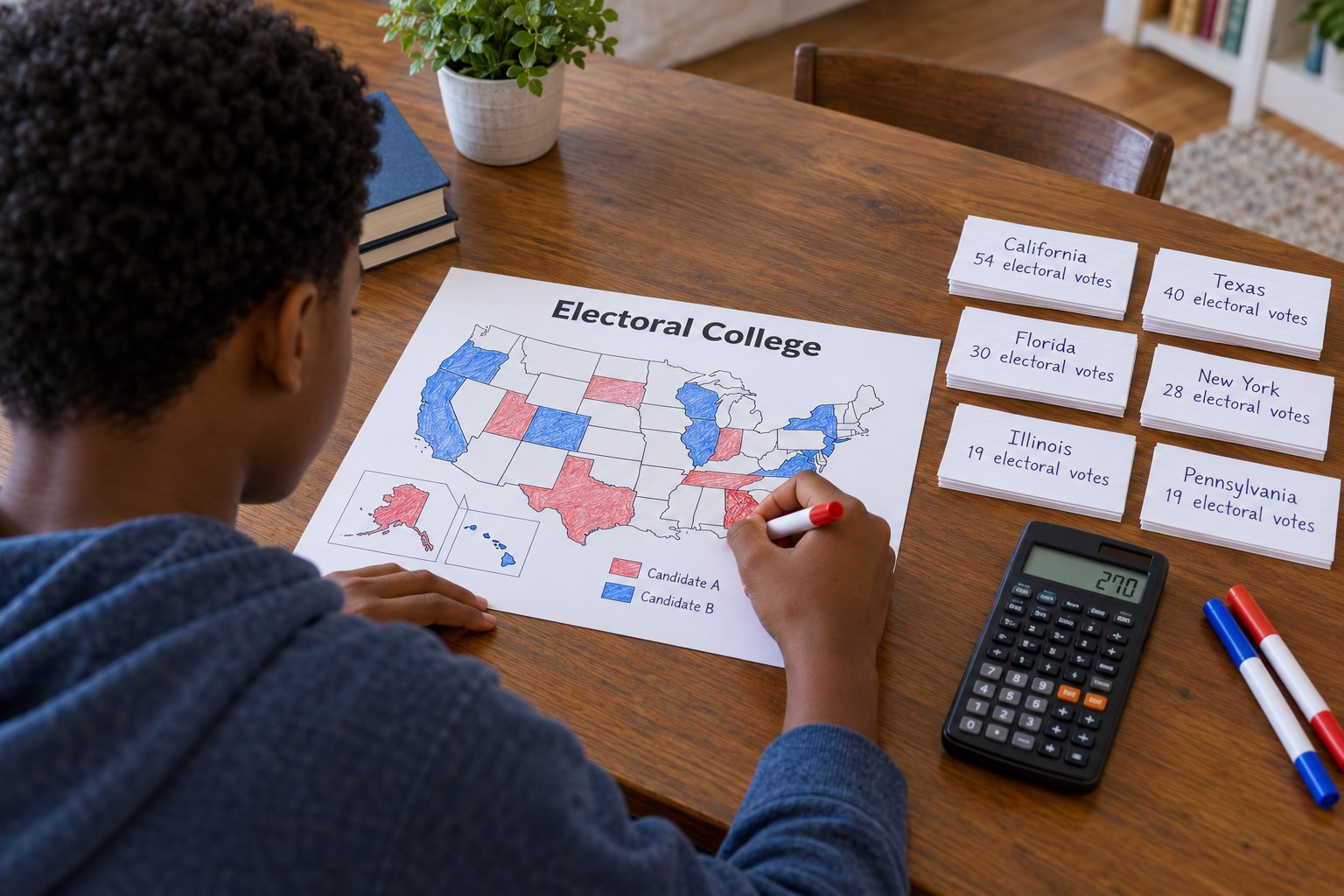
(7 min) Read the 'About the Electoral College' section together. Your teen calculates what percent 270 is of 538 and explains why 269 is not enough.
2Step 2
Build a majority in Landia
(10 min) Landia has 60 electors spread across five states, so a candidate needs 31. Using the state cards, your teen finds the fewest states that make a majority and a way to win without the biggest state, and writes each combination with its total.
3Step 3
Count the election
(12 min) Using the Landia election table, your teen colors each state by its winner, totals the electoral votes, and totals the popular votes. They calculate each candidate's percent of the electoral vote and of the popular vote.
4Step 4
Explain the gap
(10 min) Your teen writes an explanation of how Candidate A won the election with fewer total votes, pointing to the large margin in Northport and the close wins elsewhere. They then change one state's results so the popular-vote winner also wins the Electoral College.
5Step 5
Discuss
(5 min) Talk about arguments people make for keeping the Electoral College and for changing it, keeping the discussion respectful and focused on reasons. Your teen states one argument on each side in their own words.
Conclusion
Ask: what is the smallest percent of the popular vote that could still win Landia's Electoral College? Why do candidates spend more time in close states?
Make your own lesson plan in minutes
Describe a topic and Resource Portal AI writes the objectives, materials and steps for your group.
Try Resource Portal AI