Lesson planVeterans Day Poppy Poems with Similes
Writing40 minutesGrades: 3rd, 4th, 5th
Overview
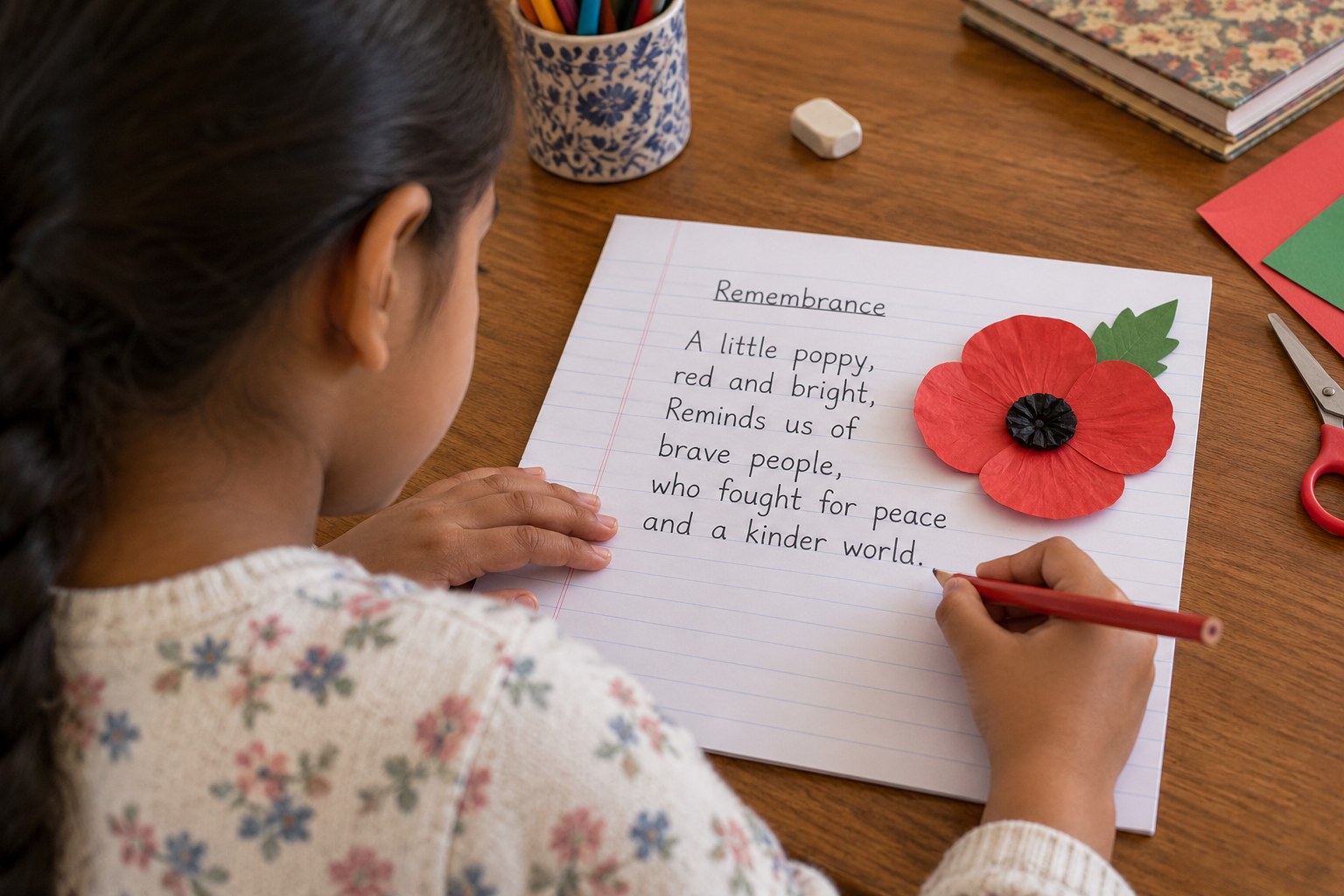
Write a simile-rich poem and mount it on a paper poppy.
Description
Your child learns why the red poppy became a symbol of remembrance after World War I, brainstorms sense words and similes, writes a cinquain or simile poem about remembering and thanking veterans, and mounts it on a paper poppy.
Objective
Your child will explain what the poppy symbolizes, explain the meaning of similes, and write a clear, organized short poem that uses at least two similes.
Standards
W.3.4ELA · Grade 3 · Writing With guidance and support from adults, produce writing in which the development and organization are appropriate to task and purpose.
L.4.5aELA · Grade 4 · Language Explain the meaning of simple similes and metaphors (e.g., as pretty as a picture) in context.
W.4.4ELA · Grade 4 · Writing Produce clear and coherent writing in which the development and organization are appropriate to task, purpose, and audience.
L.5.5aELA · Grade 5 · Language Interpret figurative language, including similes and metaphors, in context.
Materials
| Item | Quantity |
|---|
| Red construction paper or cardstock | 2 sheets per child |
| Black and green paper scraps or markers | a few |
| Lined paper and pencil | 2 sheets per child |
| Scissors and glue stick | 1 each |
| Optional: photo of a poppy field, found online | 1 |
Vocabulary
Poppy
A red wildflower that became a symbol of remembering those who served in World War I and later wars.
Symbol
Something that stands for an idea, like a heart standing for love.
Simile
A comparison using like or as, such as red as a fire engine.
Cinquain
A five-line poem with a set pattern of words.
Preparation
- Look up a photo of a poppy field to show your child, if you can.
- Draw a large 5-petal poppy outline on the red paper for your child to cut out (or let them draw it).
Introduction
Show a photo of a field of red poppies, or hold up red paper. Ask: what does this color make you think of or feel? Say: after World War I, this flower became a way to remember people who served. Today you'll write a poem that people can wear or display.
What is a symbol you see every day?
Can you finish this: the poppy was as red as ___?
Steps
1Step 1
The story of the poppy
(6 min) Read the 'Why the poppy?' section together. Talk about how a flower growing in a damaged field became a symbol of remembering and of hope.
2Step 2
Brainstorm similes
(8 min) Your child makes three lists: what a poppy looks like, how a veteran might be described (brave, kind, steady), and feelings on Veterans Day. Turn some list words into similes, such as petals soft as tissue paper or steady as a lighthouse, and talk about what each comparison means.
3Step 3
Draft the poem
(12 min) Your child picks the cinquain pattern or the simile poem frame from 'Poem patterns' and writes a draft using at least 2 similes. Read it aloud together and choose the strongest words.
4Step 4
Make the poppy
(8 min) Your child cuts out the red poppy, adds a black center and a green stem, then copies the final poem neatly on paper and glues it beside or on the poppy. Check spelling and capital letters before gluing, especially in Veterans Day.
5Step 5
Share the poem
(4 min) Your child reads the poem aloud to family or a group and explains what each simile means. Display the poppies together on a window or door.
Conclusion
Ask: which simile in your poem is your favorite, and why? Share a photo of the poem with a veteran you know, or display it on November 11.
Make your own lesson plan in minutes
Describe a topic and Resource Portal AI writes the objectives, materials and steps for your group.
Try Resource Portal AI