Spring Pollinator Bed Design: A Scale Drawing
Overview
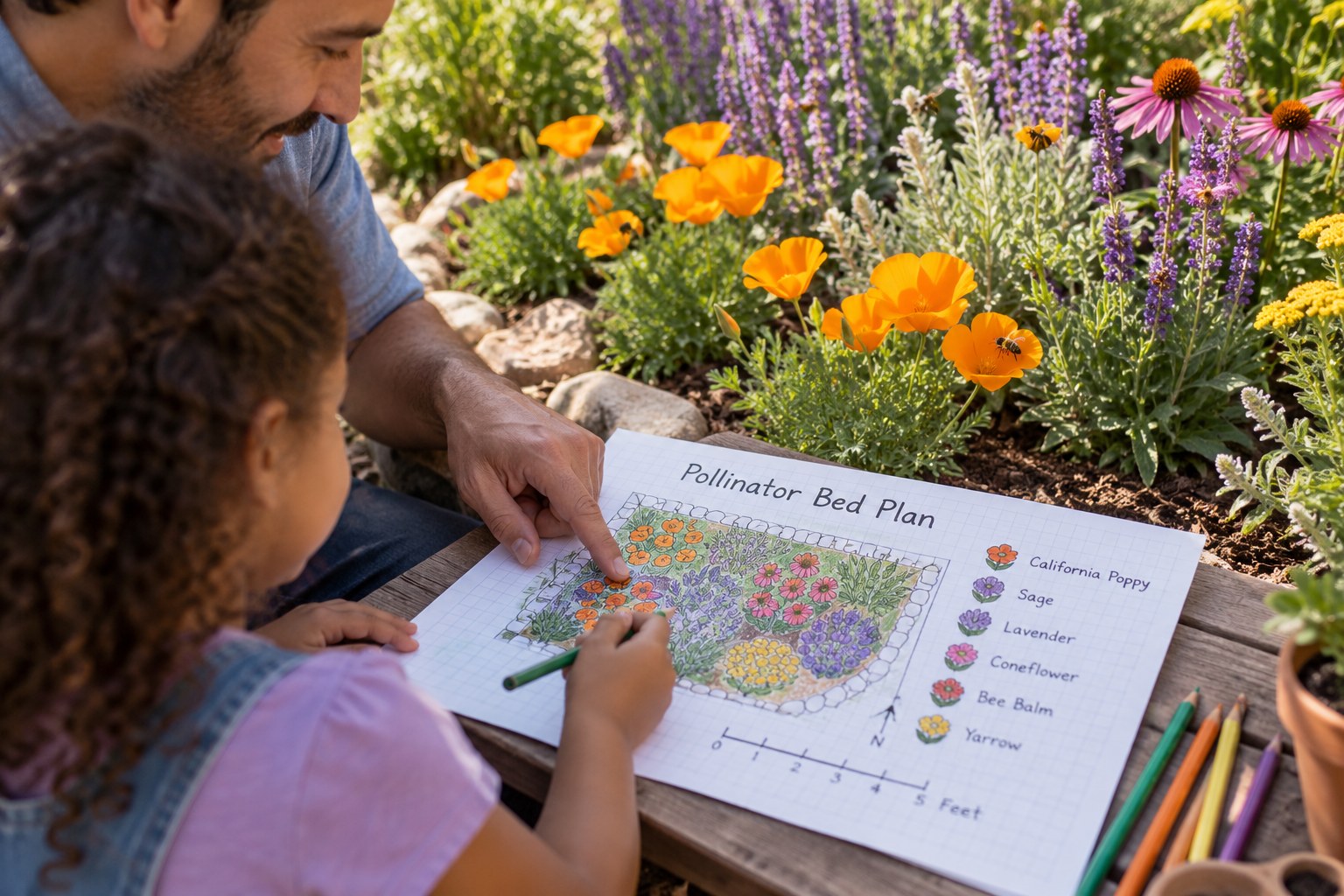
Design a pollinator garden bed with a true scale drawing.
Description
Your teen designs a 4-by-8-foot spring pollinator garden bed on graph paper at a scale of 1 inch = 1 foot, places bee- and butterfly-friendly plants by their mature spread, computes real lengths and areas from the drawing, and redraws the plan at a new scale.
Objective
Your teen will create a scale drawing, compute actual lengths and areas from it, reproduce it at a different scale, and explain how area changes with the scale factor.
Standards
Materials
| Item | Quantity |
|---|---|
| Graph paper (1/4-inch grid) | 2 sheets per teen |
| Ruler, compass (or round lids to trace) and pencil | 1 set |
| Colored pencils | 1 set |
| Plant list with mature spreads (in additional sections) | 1 copy |
| Tape measure and string to lay out the bed outdoors (optional) | 1 |
Vocabulary
Preparation
- Print or copy the plant list. If you have a real garden space, measure a 4-by-8-foot area; if not, the design can be for a school or community garden.
- Set aside both sheets of graph paper: one for the 1 in = 1 ft plan and one for the redraw.
Introduction
Ask: 'In spring, bees are hungry after winter. If we only had a space the size of a door laid flat, how many flowers could we fit, and how would we plan it without guessing?'
Why do pollinators matter in spring?
Why do garden designers draw plans to scale?
Steps
Conclusion
Ask: how many plants fit, and what fraction of the bed is planted? If you have space, lay out the real bed with string and stakes using the plan, and plant in early spring after the last frost.
Make your own lesson plan in minutes
Describe a topic and Resource Portal AI writes the objectives, materials and steps for your group.
Try Resource Portal AI