Full lesson preview

Backcountry Hydration Plan: Unit Rates, Water Weight and Heat Safety
Health45 minutesGrades: 6th, 7th
Backcountry Hydration Plan: Unit Rates, Water Weight and Heat Safety

Overview

Calculate how much water a hike needs and what it weighs.

Description

Your teen learns how hikers plan water, computes liters needed from unit rates for hikes of different lengths and temperatures, converts liters to ounces and pounds to see what it weighs in a pack, and learns the warning signs of dehydration and heat illness.

Objective

Your teen will use unit rates to plan water for a hike, convert between liters, fluid ounces and pounds with ratio reasoning, and name signs of dehydration and heat exhaustion.

Standards

6.RP.3bMath · Grade 6 · Ratios & Proportional Relationships
Solve unit rate problems including those involving unit pricing and constant speed.
6.RP.3dMath · Grade 6 · Ratios & Proportional Relationships
Use ratio reasoning to convert measurement units; manipulate and transform units appropriately when multiplying or dividing quantities.

Materials

ItemQuantity
1-liter bottle (or a 32-ounce bottle) filled with water1
Bathroom or kitchen scale1
Backpack1
Hydration problem set (in the section below)1 per teen
Pencil and calculator1 each

Vocabulary

Dehydration
When the body loses more water than it takes in.
Heat exhaustion
A heat illness with heavy sweating, dizziness, headache, nausea and weakness.
Unit rate
A rate per one unit, such as liters per hour.
Electrolytes
Minerals like sodium and potassium the body loses in sweat.

Preparation

Introduction

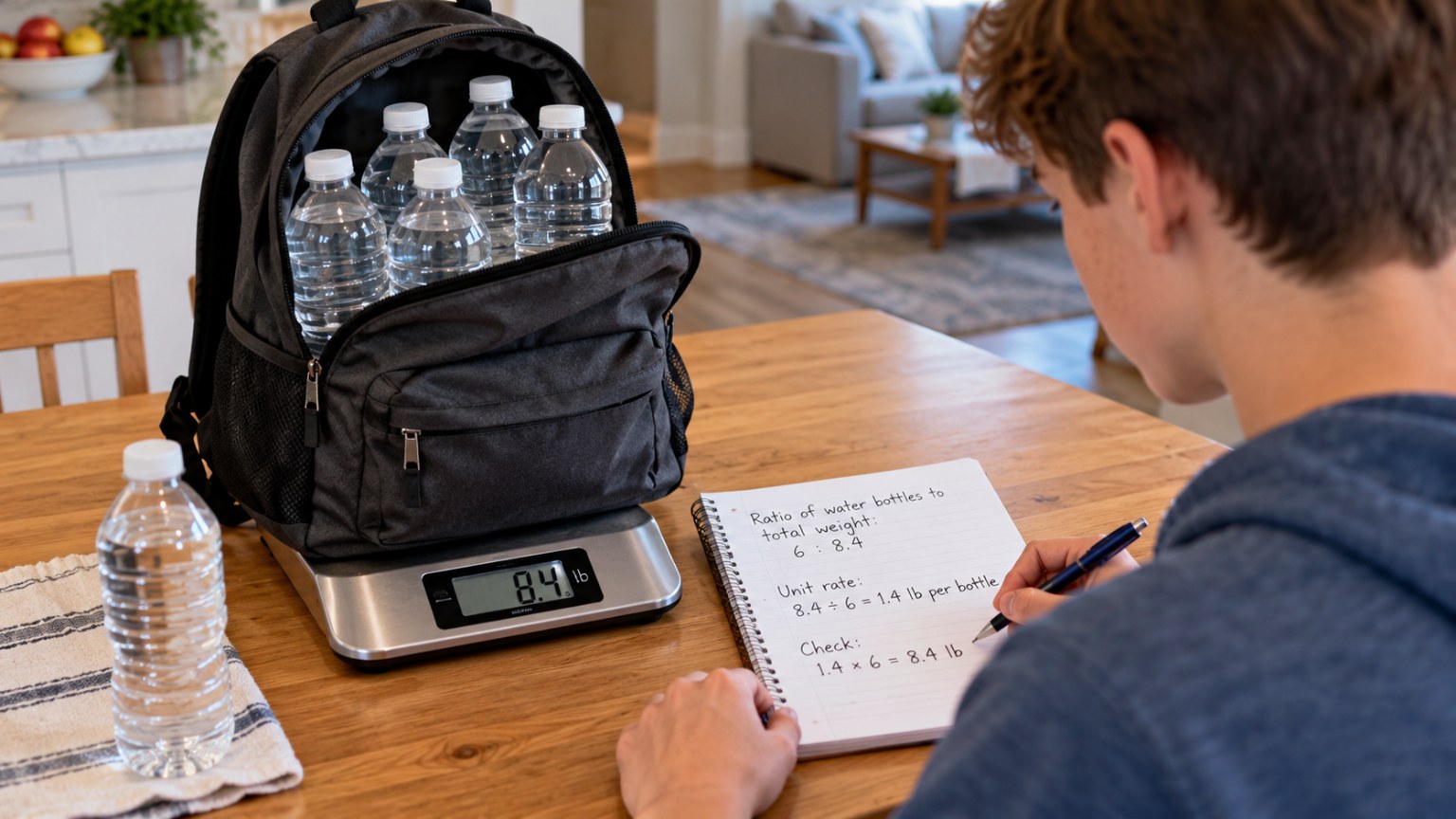
Hand your teen the full backpack with 3 liters of water inside (or 3 bottles). Ask: 'Would you carry this for 5 hours? Too much water is heavy, too little is dangerous. How do hikers decide?'
How can you tell when your body needs water?
Why do hikers need more water on hot days or uphill climbs?

Steps

1Step 1
Weigh the water
(6 min) Your teen weighs the empty bottle and then the full bottle, and finds the weight of 1 liter of water (about 2.2 pounds). Discuss why water is the heaviest thing in most day packs.
2Step 2
Learn the planning rate
(6 min) Read the background section together. Your teen writes the unit rates: about 0.5 liter per hour for moderate hiking in mild weather and about 1 liter per hour in heat or on steep climbs.
3Step 3
Solve the hike problems
(18 min) Your teen solves the problem set, showing a ratio table or unit-rate work for each. Check answers with the key and fix any conversion mistakes.
4Step 4
Heat illness signs
(8 min) Together, list signs of dehydration (thirst, dark urine, headache, tiredness) and heat exhaustion (heavy sweating, dizziness, nausea, cool clammy skin). Role-play what to do: stop in shade, sip water or an electrolyte drink, cool the skin, and get help if symptoms get worse or the person becomes confused.
5Step 5
Plan a real hike
(5 min) Your teen picks a local trail, estimates the time, and writes how much water to bring and where it will be carried. Add sunscreen, a hat and salty snacks to the list.

Conclusion

Ask: how could a hiker lighten the load on a long hike? (Refill from a treated water source along the way, start early to avoid heat.) Use the plan on your next family walk.

Make your own lesson plan in minutes

Describe a topic and Resource Portal AI writes the objectives, materials and steps for your group.

Try Resource Portal AI