Full lesson previewFour-Chamber Cow Stomach: Modeling How Ruminants Digest Grass
Science45 minutesGrades: 6th, 7th
Overview
Model a cow's four stomach chambers to scale with percents.
Description
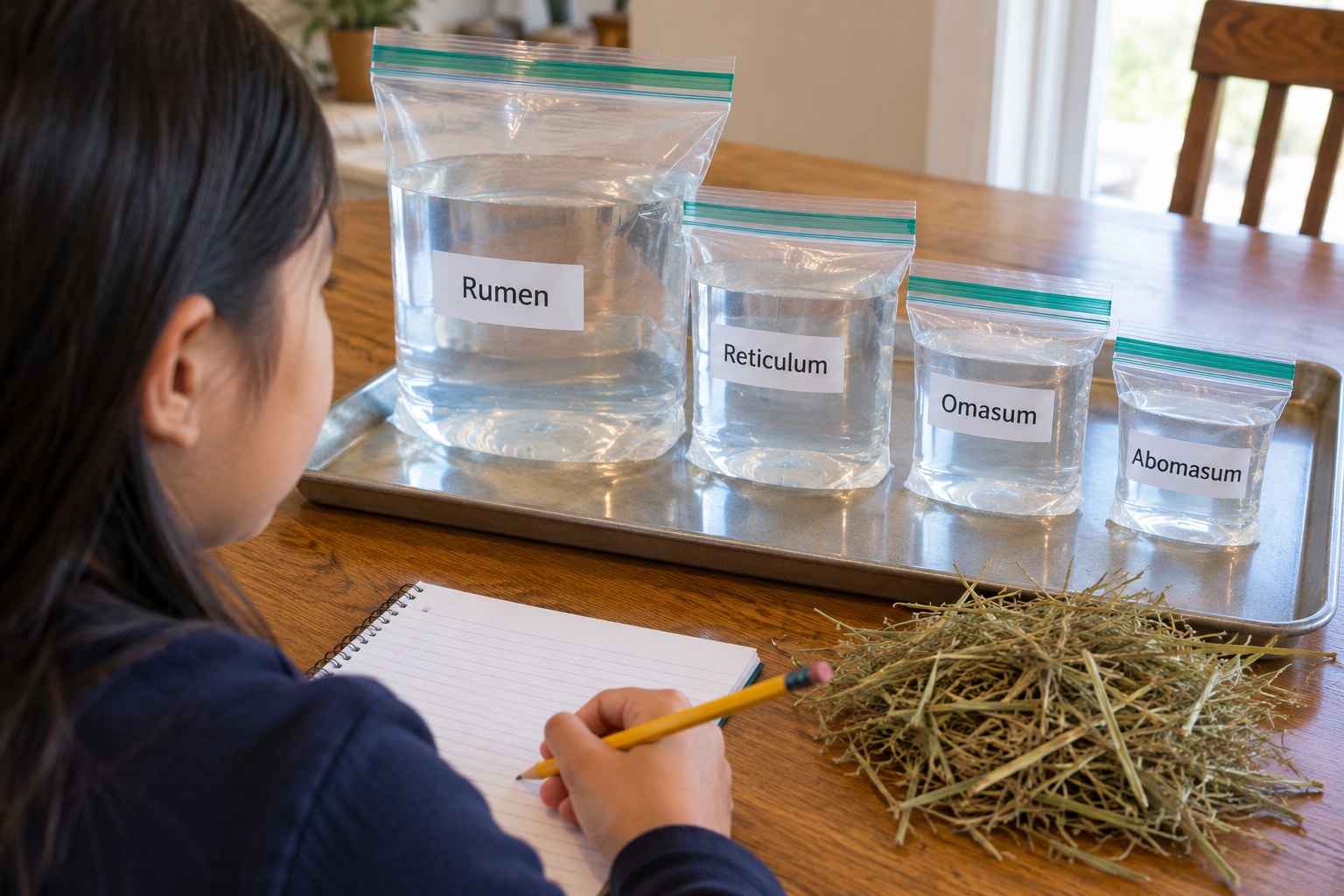
Your teen builds a to-scale model of a cow's four stomach chambers (rumen, reticulum, omasum and abomasum) using zip bags filled with water in amounts set by real percentages, compares an adult cow to a newborn calf, and writes a short explanation of how microbes let cows turn grass and hay into milk.
Objective
Your teen will use percents to scale the volumes of a cow's stomach chambers, build a physical model, and write an explanation of ruminant digestion using relevant facts and precise definitions.
Standards
Develop the topic with relevant facts, definitions, concrete details, quotations, or other information and examples.
6.RP.3cMath · Grade 6 · Ratios & Proportional Relationships Find a percent of a quantity as a rate per 100 (e.g., 30% of a quantity means 30/100 times the quantity); solve problems involving finding the whole, given a part and the percent.
Materials
| Item | Quantity |
|---|
| Zip-top bags: 1 gallon, 1 quart and 2 snack size | 4 total |
| Liquid measuring cup in milliliters | 1 |
| Water, with a few drops of food coloring per bag (optional) | about 1 liter |
| Marker to label bags | 1 |
| Tray to hold the model | 1 |
| Paper, pencil and calculator | 1 each |
Vocabulary
Ruminant
A hoofed mammal, such as a cow, sheep or goat, that digests plants in a multi-chamber stomach and chews cud.
Rumen
The largest chamber, where microbes ferment and break down tough plant fiber.
Cellulose
The tough fiber in plant cell walls that people cannot digest.
Abomasum
The 'true stomach' that uses acid and enzymes, like a human stomach.
Fermentation
Microbes breaking down food without oxygen, releasing gases and useful compounds.
Preparation
- Copy the Chamber Percent table from Additional Sections. Lay out the bags and a tray to catch drips.
- Optional: pull up a labeled diagram of a cow's digestive system to compare.
Introduction
Hand your teen a handful of dry grass or hay and say, 'You could chew this all day and get almost no energy from it. A cow turns it into about 8 gallons of milk a day. How?'
Why can't people live on grass?
What do you think lives inside a cow's stomach that helps it digest?
Steps
1Step 1
Do the percents
(8 min) Your teen uses the table to find each chamber's share of a 1,000 mL model for an adult cow: rumen 80%, reticulum 5%, omasum 7%, abomasum 8%. Then they find the real volumes for a cow whose total stomach holds about 50 gallons.
2Step 2
Build the model
(10 min) Your teen measures each amount of water into a labeled bag (rumen in the gallon bag), seals it and lays the bags on the tray in order: rumen, reticulum, omasum, abomasum. Notice how much bigger the rumen is than the rest.
3Step 3
Follow the food
(8 min) Using the chamber descriptions, your teen traces a mouthful of hay through the model: swallowed into the rumen, fermented by microbes, sent back up as cud to rechew, then through the reticulum and omasum to the abomasum. They explain why rechewing helps the microbes.
4Step 4
Calf comparison
(7 min) Your teen recalculates with the newborn calf percents (rumen 25%, reticulum 5%, omasum 10%, abomasum 60%) and rearranges or refills the bags. Discuss why a calf drinking milk relies mostly on the abomasum, and how the rumen grows as it starts eating hay and grain.
5Step 5
Write the explanation
(10 min) Your teen writes a paragraph explaining how a cow turns grass into energy and milk, using at least 3 vocabulary terms with definitions and 2 numbers from the model. Read it aloud and check that every fact is accurate.
Conclusion
A cow's stomach is a partnership with trillions of microbes. Because ruminants can digest fiber, they turn land and crop by-products people can't eat, such as hay, almond hulls and cottonseed, into milk and meat.
Make your own lesson plan in minutes
Describe a topic and Resource Portal AI writes the objectives, materials and steps for your group.
Try Resource Portal AI