Hammer and Feather: The Space Gravity Drop Test
Overview
Do heavy things fall faster? Test it, then see what happened on the Moon.
Description
Your child tests whether heavy and light objects fall at the same speed, discovers how air slows down flat things like paper, then learns how an Apollo 15 astronaut dropped a hammer and a feather on the airless Moon and they hit the ground together.
Objective
Your child will make predictions, run fair drop tests with pairs of objects, record results, and explain how air resistance affects falling objects on Earth but not on the Moon.
Standards
Materials
| Item | Quantity |
|---|---|
| Pairs of objects: a book and a sheet of paper the same size, a full and an empty water bottle with caps, a tennis ball and a ping-pong ball (or 2 balls of different weight) | 3 pairs |
| Sheet of printer paper (one to crumple) | 2 |
| A feather (or a tissue) and a spoon | 1 each |
| Recording sheet and pencil | 1 per child |
| Phone camera with slow-motion video (optional) | 1 |
Vocabulary
Preparation
- Draw a recording sheet with columns: Pair, My prediction (which lands first?), Trial 1, Trial 2, Trial 3, Result.
- Choose a safe drop spot where your child can drop objects from shoulder height onto a rug or grass, away from anything breakable.
Introduction
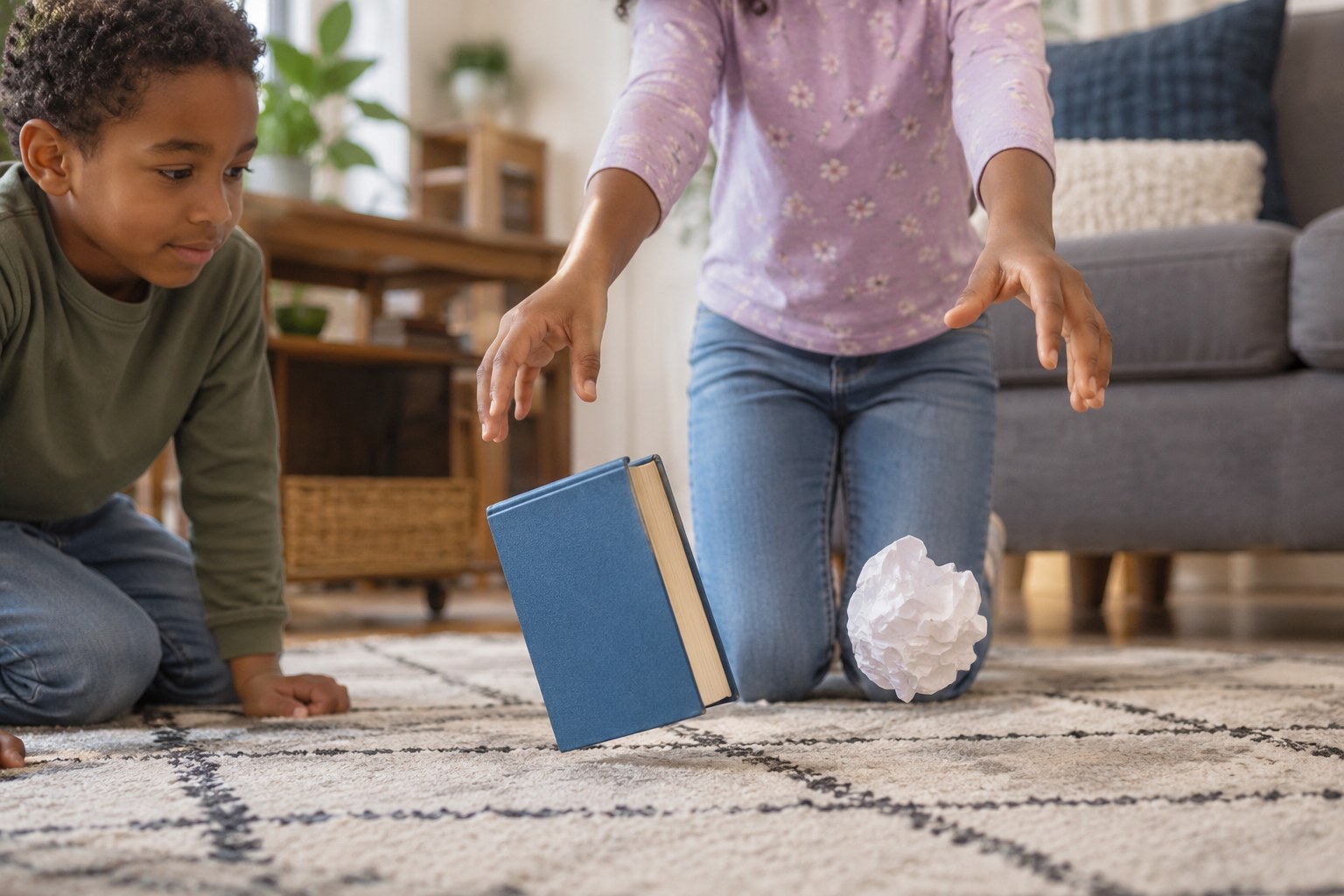
Hold up a heavy book and a sheet of paper. Ask: if I drop them at the same time, which hits the floor first? Write down predictions before anyone drops anything.
Do heavier things always fall faster?
What might be different about dropping things on the Moon?
Steps
Conclusion
Ask: without air, would a feather and a hammer fall together? Gravity pulls on all objects, and when air isn't in the way, they fall at the same rate no matter their weight.
Make your own lesson plan in minutes
Describe a topic and Resource Portal AI writes the objectives, materials and steps for your group.
Try Resource Portal AI