Lesson planLetter from Birmingham Jail: Mapping Dr. King's Argument
Reading50 minutesGrades: 7th, 8th
Overview
Map the claims and counterarguments in Letter from Birmingham Jail.
Description
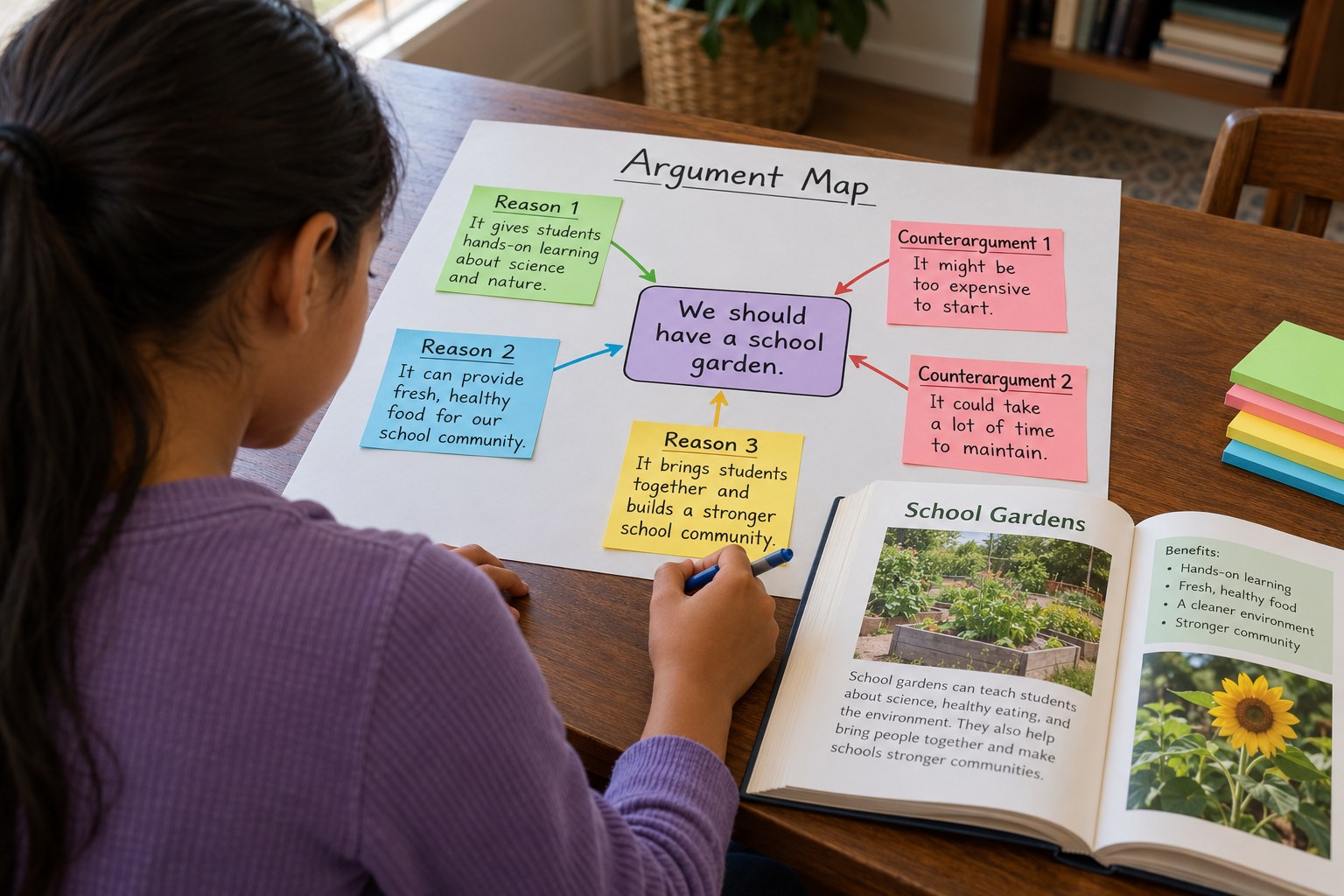
Your teen reads selected passages from Dr. King's 1963 Letter from Birmingham Jail, maps his claims, reasons and evidence on a large argument map, and analyzes how he acknowledges and answers the objections raised by the eight Alabama clergymen who criticized the protests.
Objective
Your teen will trace and evaluate Dr. King's central argument, identify specific claims and the evidence supporting them, and analyze how he responds to opposing viewpoints.
Standards
RI.7.8ELA · Grade 7 · Reading: Informational Text Trace and evaluate the argument and specific claims in a text, assessing whether the reasoning is sound and the evidence is relevant and sufficient to support the claims.
RI.8.6ELA · Grade 8 · Reading: Informational Text Determine an author's point of view or purpose in a text and analyze how the author acknowledges and responds to conflicting evidence or viewpoints.
RI.8.8ELA · Grade 8 · Reading: Informational Text Delineate and evaluate the argument and specific claims in a text, assessing whether the reasoning is sound and the evidence is relevant and sufficient; recognize when irrelevant evidence is introduced.
Materials
| Item | Quantity |
|---|
| Copy of Letter from Birmingham Jail from a library, anthology or reputable educational archive | 1 |
| Large paper or poster board for an argument map | 1 sheet |
| Sticky notes in 3 colors | 1 pad each |
| Pencil and highlighter | 1 each |
| Summary of the clergymen's objections from the 'Background' section | 1 |
Vocabulary
Claim
A statement the writer argues is true.
Counterargument
An opposing view that a writer acknowledges and answers.
Direct action
Nonviolent protest, such as marches and sit-ins, that creates pressure for change.
Just and unjust laws
Dr. King's distinction between laws that uplift human dignity and laws that degrade it.
Moderate
A person who avoids strong positions; Dr. King criticized those who preferred order over justice.
Preparation
- Find the letter in a library book, an anthology of American documents, or a reputable educational archive. It is long; mark these passages: the response to being called an outsider, the explanation of why direct action was needed, the passage answering the call to wait, the discussion of just and unjust laws, and the section on the white moderate.
- Draw a large central box on the poster labeled Main claim, with space around it for reasons and objections.
Introduction
Read your teen the clergymen's objections in the 'Background' section. Ask: if you were Dr. King, sitting in a jail cell with no books, how would you answer these critics?
Is it ever right to break a law?
Why would someone who agrees that segregation is wrong still say 'wait'?
Steps
1Step 1
Understand the situation
(6 min) Read the 'Background' section together, focusing on the four main objections from the clergymen. Your teen writes each objection on its own sticky note in the first color.
2Step 2
Read the passages
(16 min) Your teen reads the marked passages, highlighting each sentence where Dr. King makes a claim. Pause after each passage to summarize it in one sentence out loud.
3Step 3
Build the argument map
(12 min) Your teen writes Dr. King's main claim in the center box, adds each reason on a second-color note around it, and adds supporting evidence or examples on third-color notes under each reason. Then they connect each clergymen objection to the reason that answers it with a pencil line.
4Step 4
Evaluate the reasoning
(10 min) For each reason, your teen decides whether it is supported by evidence, by moral reasoning, or by both, and marks it. Discuss: which answer to the critics is the strongest, and how does acknowledging the clergymen respectfully make the letter more persuasive?
5Step 5
Sum it up
(5 min) Your teen writes a 3-sentence summary of the argument: the claim, the strongest reason, and how Dr. King answers his critics.
Conclusion
Ask: which sentence from the letter would you put on a poster today, and why? Compare the letter's argument with a current debate about fairness.
Make your own lesson plan in minutes
Describe a topic and Resource Portal AI writes the objectives, materials and steps for your group.
Try Resource Portal AI