Lesson planJuneteenth by the Numbers: 900 Days to Freedom
Math45 minutesGrades: 6th, 7th
Overview
Use ratios to measure the delay that made Juneteenth.
Description
Your teen calculates exactly how many days passed between the Emancipation Proclamation and June 19, 1865, converts that delay into weeks, hours and years, builds a to-scale Juneteenth timeline from 1863 to 2021, and solves unit-rate problems about Opal Lee's symbolic 2.5-mile walks.
Objective
Your teen will use ratio reasoning to convert days to weeks, hours and years, create a scale timeline using a cm-per-year ratio, and solve unit-rate problems.
Standards
6.RP.3bMath · Grade 6 · Ratios & Proportional Relationships Solve unit rate problems including those involving unit pricing and constant speed.
6.RP.3dMath · Grade 6 · Ratios & Proportional Relationships Use ratio reasoning to convert measurement units; manipulate and transform units appropriately when multiplying or dividing quantities.
Materials
| Item | Quantity |
|---|
| Paper strip or taped paper about 40 cm long (or a long sheet of paper) | 1 |
| Ruler with centimeters | 1 |
| Calculator | 1 |
| Pencil and colored pencils | 1 set |
| Copy of the problem set (in Additional Sections) | 1 |
Vocabulary
Ratio
A comparison of two quantities, like 1 cm for every 5 years.
Unit rate
How much of one quantity for 1 unit of another, like miles per hour.
Conversion factor
A ratio equal to 1 used to change units, like 7 days per 1 week.
Leap year
A year with 366 days; 1864 was one.
Preparation
- Copy the problem set onto paper. Tape paper together to make a strip at least 35 cm long.
- Read the About section so you can check that your teen's timeline events are accurate.
Introduction
Ask your teen to guess how many days passed between January 1, 1863 and June 19, 1865. Write the guess down; you will check it soon.
Why do historians say freedom came about two and a half years late?
How would you turn days into hours without a calculator?
Steps
1Step 1
Count the days
(8 min) Your teen counts the days from January 1, 1863 to June 19, 1865, remembering 1864 was a leap year: 365 days in 1863, 366 in 1864, and the days of 1865 up to June 19. Compare the total to the guess.
2Step 2
Convert the delay
(8 min) Using conversion factors written as ratios (7 days per week, 24 hours per day, 365 days per year), your teen converts the 900-day delay into weeks, hours and years. They show units canceling in each step.
3Step 3
Build a scale timeline
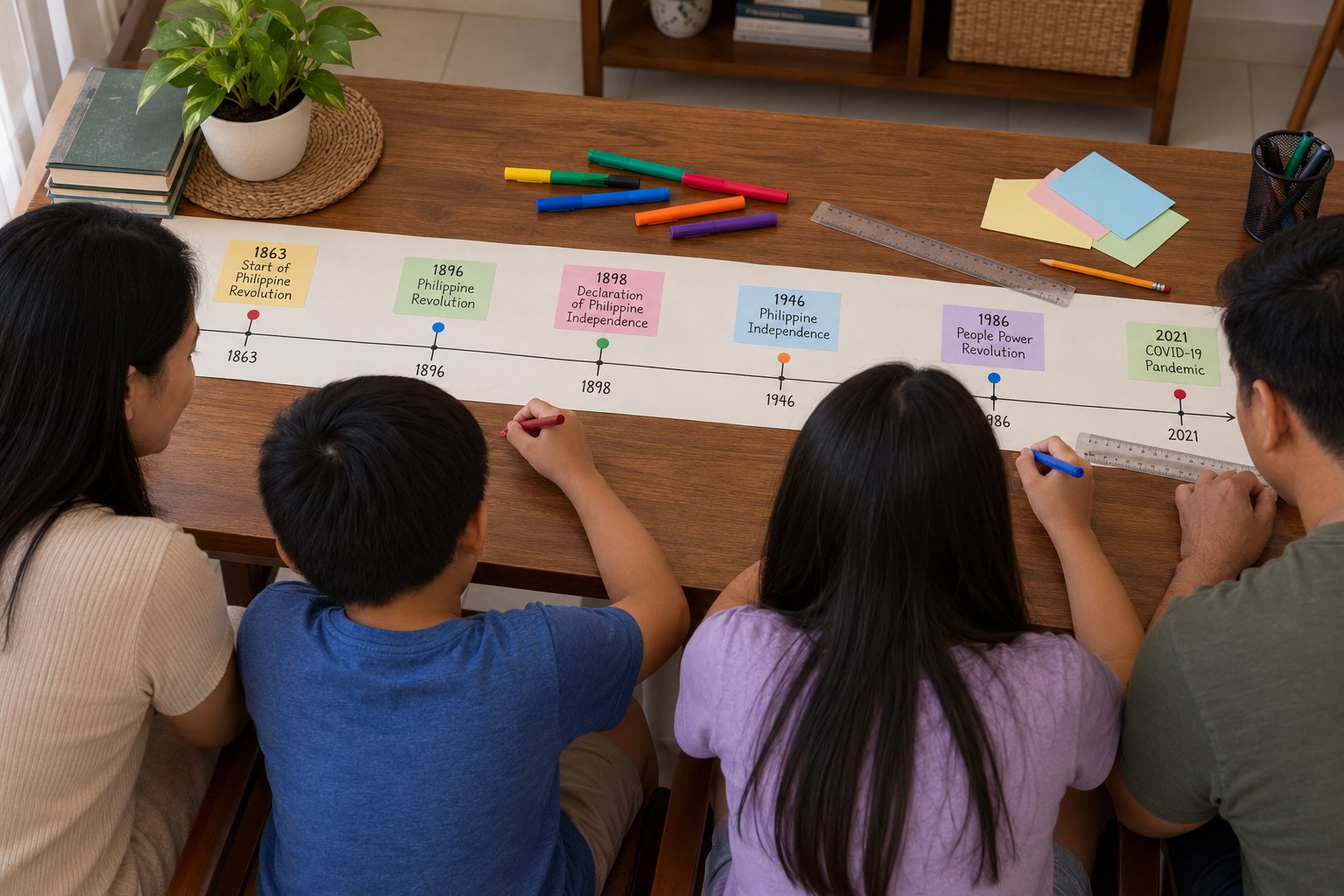
(15 min) Using a scale of 1 cm for every 5 years, your teen calculates the length from 1863 to 2021 and marks key events at the right distances: 1863 Proclamation, 1865 Juneteenth and 13th Amendment, 1866 first celebrations, 1872 Emancipation Park, 1980 Texas state holiday, 2021 federal holiday. Color-code and label each mark.
4Step 4
Unit-rate problems
(10 min) Your teen solves the Opal Lee walk and news-travel problems in the problem set, writing each answer as a unit rate with units. Discuss why Opal Lee chose 2.5 miles for her walks.
Conclusion
Ask: which number from today makes the delay feel most real to you, 900 days, 128 weeks or 21,600 hours? Use it to explain Juneteenth to someone else.
Make your own lesson plan in minutes
Describe a topic and Resource Portal AI writes the objectives, materials and steps for your group.
Try Resource Portal AI