Full lesson previewUV Bead Lab: Which Sunscreen or Fabric Blocks the Most UV?
Science60 minutesGrades: 11th
Overview
Let tiny color-changing beads show what sun protection really blocks.
Description
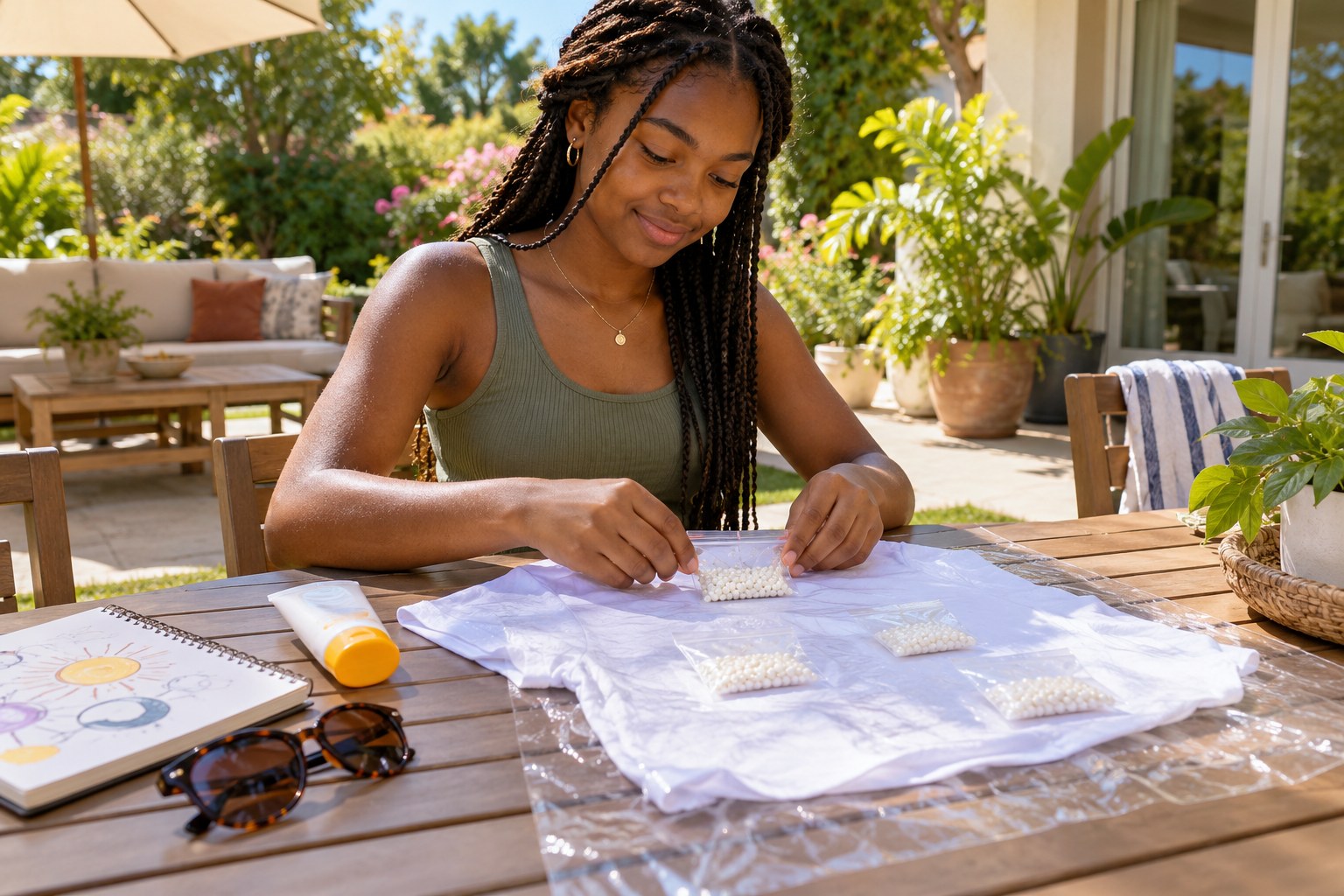
Your teen sets up six small bags of UV-color-changing beads on a sunny surface: one kept in the dark, one unprotected, two under clear plastic smeared with SPF 15 and SPF 50 sunscreen, one under a T-shirt and one behind a sunglasses lens. They score how fast and how deeply each set changes color, then back up their results with two or three reputable sources on SPF, UPF and UV.
Objective
Your teen will design a controlled comparison of UV protection, collect and interpret color-change data, and synthesize their results with outside sources to answer a research question about how well sunscreen, fabric and lenses block ultraviolet light.
Standards
WHST.11-12.7ELA · Grade 11-12 · Writing in History/Social Studies, Science & Technical Subjects Conduct short as well as more sustained research projects to answer a question (including a self-generated question) or solve a problem; narrow or broaden the inquiry when appropriate; synthesize multiple sources on the subject, demonstrating understanding of the subject under investigation.
Materials
| Item | Quantity |
|---|
| UV-color-changing beads (white indoors; sold cheaply online or at craft stores) | 30 |
| Small clear zip-top snack bags | 6 |
| Clear plastic sheet protectors or squares of clear plastic wrap | 2 |
| Sunscreen, one SPF 15 and one SPF 50 (or the lowest and highest SPF you have) | 1 of each |
| Old T-shirt (thin, light-colored works best) | 1 |
| Pair of sunglasses | 1 |
| Envelope or small box for the dark control | 1 |
| Notebook and pen | 1 |
| Phone with a timer | 1 |
Vocabulary
Ultraviolet (UV) radiation
Invisible light with shorter wavelengths than violet light; UVA (about 315-400 nm) and UVB (about 280-315 nm) reach the ground and affect skin.
SPF
Sun Protection Factor; a lab rating of how much a sunscreen delays sunburn, mostly from UVB. SPF 15 blocks about 93% of UVB and SPF 50 about 98% when applied thickly.
UPF
Ultraviolet Protection Factor; a rating for fabric. A UPF 50 fabric lets through about 1/50 (2%) of UV.
Photochromic
Describes a material that changes color when exposed to light, such as UV beads, then changes back in the dark.
Control
A part of an experiment that gets no treatment, used as a baseline for comparison.
Preparation
- Check the forecast and pick a sunny time between about 10 a.m. and 3 p.m.; on a cloudy day the beads still change, just more slowly.
- Put 5 beads in each of the 6 snack bags and keep them indoors, away from windows, until the test starts.
- Smear about 1/4 teaspoon of SPF 15 evenly over a palm-sized area of one sheet protector and the same amount of SPF 50 on the other; label each with a marker.
Introduction
Hand your teen a white UV bead indoors, then let them carry it to a sunny window or doorway. Ask: what made it change, and why can't you see the thing that did it?
If SPF 50 blocks about 98% of UVB and SPF 15 about 93%, is SPF 50 'three times better'? What would you need to test?
Which do you think blocks more UV: a white T-shirt or a pair of cheap sunglasses?
Steps
1Step 1
Write a testable question
(8 min) Your teen writes a research question in the notebook, such as 'How does the amount of UV that reaches the beads change under SPF 15, SPF 50, a T-shirt and sunglasses?' They list the independent variable, the dependent variable (color change), and at least three things to keep the same, like bead count, time in the sun and the 1/4 teaspoon of sunscreen on each sheet.
2Step 2
Make a color scale and data table
(10 min) In the notebook your teen draws a 0-to-4 color scale (0 = white, 4 = the deepest color seen on a test bead) and a data table with rows for the 6 bags and columns for 15 seconds, 1 minute and 3 minutes. They decide how they will score fairly, for example by always comparing against the unprotected bag in the same light.
3Step 3
Run the sun test
(15 min) Outside, your teen lays the 6 snack bags in a row on a flat surface in full sun at the same moment: the dark control goes in the envelope, one bag sits uncovered, two sit under the SPF 15 and SPF 50 sheet protectors, one goes under a single layer of the T-shirt and one sits under a sunglasses lens. Using the phone timer, they peek and score each bag at 15 seconds, 1 minute and 3 minutes, then repeat the whole run once to check that the scores hold up.
4Step 4
Check the sources
(12 min) Your teen reads two or three reputable sources (for example a national dermatology association, a government environmental or health agency, or a cancer foundation) about SPF, UPF and UVA versus UVB. They write down one fact from each source with its name and decide whether to narrow or broaden their question, for example 'Do sunglasses block UVA too?'
5Step 5
Synthesize and report
(15 min) Your teen writes a one-page report in the notebook that states the question, summarizes the data table, explains the results using at least two of the sources, and names two limits of UV beads, such as the fact that they max out quickly in strong sun. They read the conclusion to you and answer one follow-up question about what they would test next.
Conclusion
Ask your teen: 'Which result surprised you, and would it change what you grab before a long day outside?' Good science ends with a better decision, not just a data table.
Make your own lesson plan in minutes
Describe a topic and Resource Portal AI writes the objectives, materials and steps for your group.
Try Resource Portal AI