Lesson plan

Robot Arm Angle Commands: Turn by Degrees
Math40 minutesGrades: 4th
Robot Arm Angle Commands: Turn by Degrees

Overview

Program a paper robot arm with angle commands.

Description

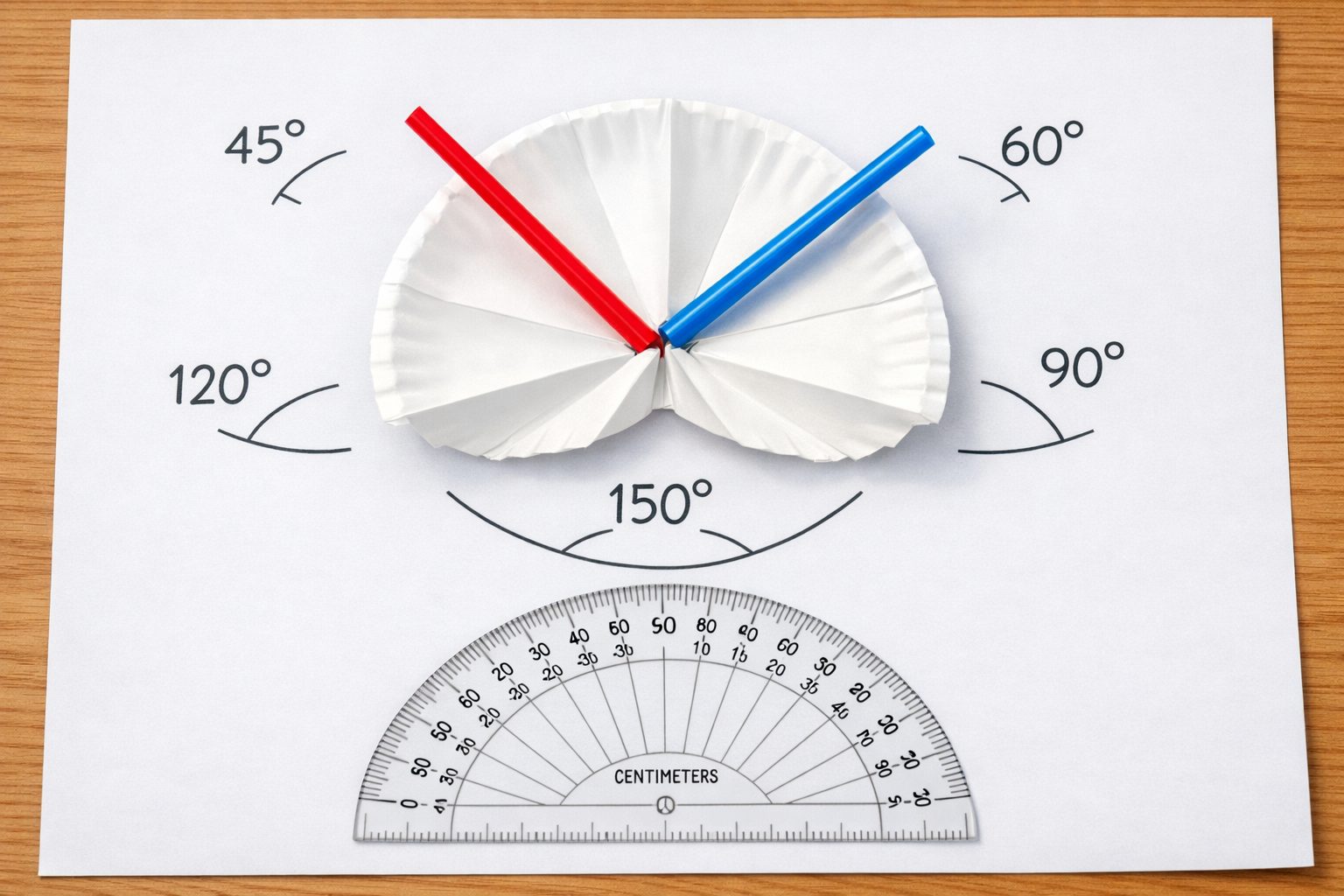
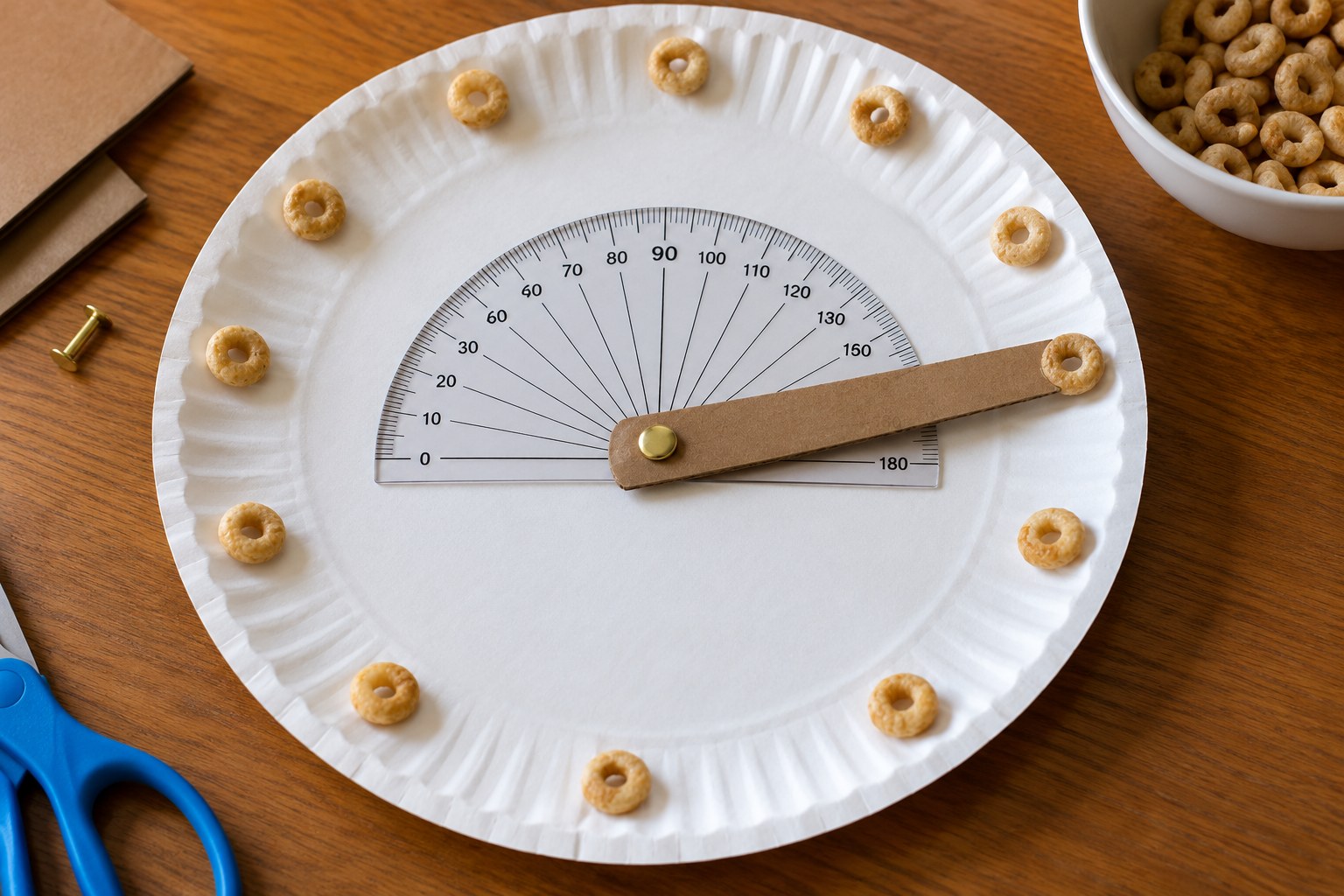
Your child builds a paper-plate robot arm that spins around a center point and programs it with turn commands in degrees to pick up 'parts' placed around the plate. They measure each turn with a protractor and add turns together.

Objective

Your child will measure and sketch angles with a protractor, write turn commands in degrees, and use addition and subtraction of angles to find a robot arm's total turn.

Standards

4.MD.5aMath · Grade 4 · Measurement & Data
An angle is measured with reference to a circle with its center at the common endpoint of the rays, by considering the fraction of the circular arc between the points where the two rays intersect the circle. An angle that turns through 1/360 of a circle is called a "one-degree angle," and can be used to measure angles.
4.MD.6Math · Grade 4 · Measurement & Data
Measure angles in whole-number degrees using a protractor. Sketch angles of specified measure.
4.MD.7Math · Grade 4 · Measurement & Data
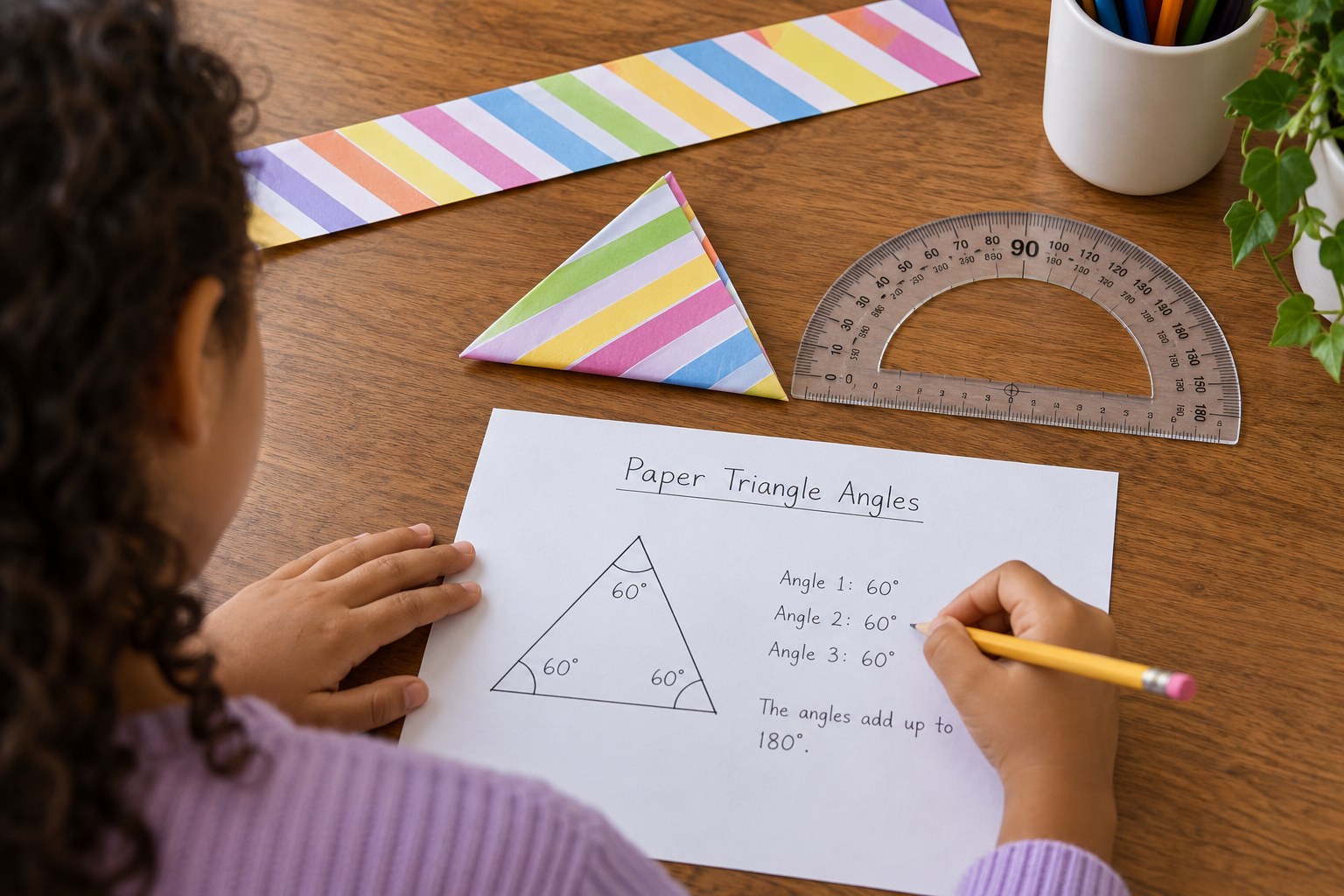
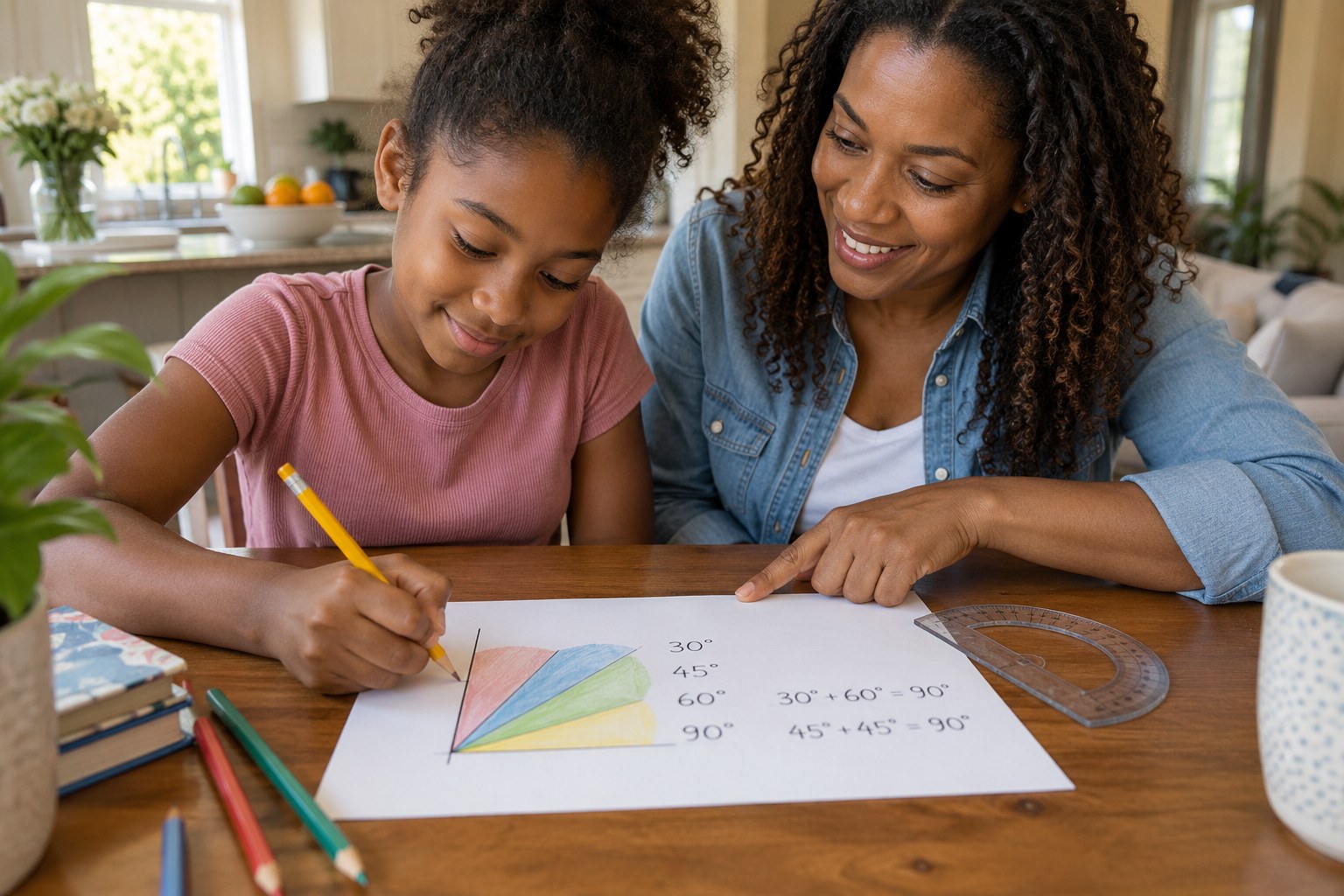
Recognize angle measure as additive. When an angle is decomposed into non-overlapping parts, the angle measure of the whole is the sum of the angle measures of the parts. Solve addition and subtraction problems to find unknown angles on a diagram in real world and mathematical problems, e.g., by using an equation with a symbol for the unknown angle measure.

Materials

ItemQuantity
Paper plate1 per child
Cardboard strip for the arm, about 1 by 5 inches1 per child
Brass fastener (brad) or a pushpin and eraser1
Protractor (or a paper one printed or traced)1 per child
Small 'parts': cereal pieces, buttons or paper squares6
Pencil and paper1 each

Vocabulary

Angle
The amount of turn between two rays that share an endpoint.
Degree
A unit for measuring angles; a full turn is 360 degrees.
Protractor
A tool for measuring angles in degrees.
Additive
When parts of an angle add up to the whole angle.

Preparation

Introduction

Point the arm at 0. Say: 'A factory robot arm cannot see where to go unless we tell it how many degrees to turn. Let's program one.'
How many degrees is a full turn? A half turn?
Why would a robot need exact numbers instead of 'turn a little'?

Steps

1Step 1
Mark the circle
(8 min) Your child uses the protractor at the center to mark 45, 90, 135, 180 and 270 degrees around the plate, turning clockwise from the 0 line. Ask how a quarter turn relates to 360.
2Step 2
Place the parts
(6 min) A grown-up places 6 parts at different spots around the rim. Your child measures the angle from 0 to each part with the protractor and writes it down.
3Step 3
Write the program
(10 min) Your child writes a robot program that starts at 0 and visits each part, writing each step as a turn command such as TURN 60, GRAB, TURN 45, DROP. Each turn is measured from where the arm is now, not from 0.
4Step 4
Run and check
(10 min) Run the program by turning the arm with the protractor for each command. Then add up all the turns and compare the total to the angle of the last part measured from 0, to see that the parts add up to the whole.
5Step 5
Reverse challenge
(5 min) Write a program that brings the arm back to 0 using counterclockwise turns. Check that the turns back add up to the same total.

Conclusion

Ask: when you added your turns, did they match the total angle? Real robot arms use these same angle calculations for each joint.

Make your own lesson plan in minutes

Describe a topic and Resource Portal AI writes the objectives, materials and steps for your group.

Try Resource Portal AI