Lesson plan

Robot Number Line Hops: Code the Moves to the Charger
Math30 minutesGrades: 1st, 2nd
Robot Number Line Hops: Code the Moves to the Charger

Overview

Code a robot's hops on a number line to 20.

Description

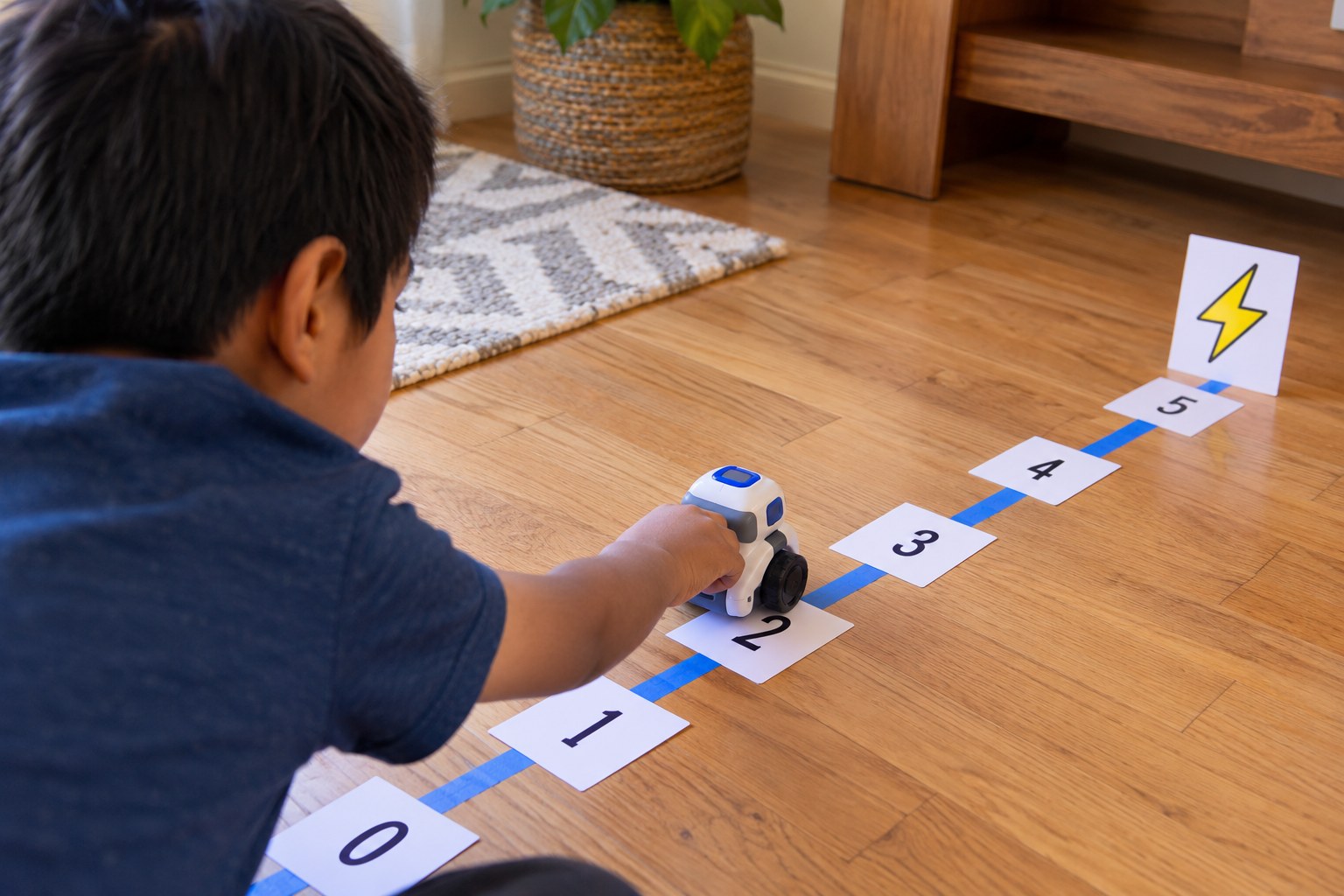
Your child programs a toy robot to travel along a floor number line from 0 to 20 using move cards like +3 and -2. They plan a code to reach the charging station, run it, and write the addition and subtraction that matches the path.

Objective

Your child will plan a sequence of plus and minus moves to land on a target number within 20, check it on a number line, and write the matching number sentence.

Standards

1.OA.6Math · Grade 1 · Operations & Algebraic Thinking
Add and subtract within 20, demonstrating fluency for addition and subtraction within 10. Use strategies such as counting on; making ten (e.g., 8 + 6 = 8 + 2 + 4 = 10 + 4 = 14); decomposing a number leading to a ten (e.g., 13 — 4 = 13 — 3 — 1 = 10 — 1 = 9); using the relationship between addition and subtraction (e.g., knowing that 8 + 4 = 12, one knows 12 — 8 = 4); and creating equivalent but easier or known sums (e.g., adding 6 + 7 by creating the known equivalent 6 + 6 + 1 = 12 + 1 = 13).
2.OA.2Math · Grade 2 · Operations & Algebraic Thinking
Fluently add and subtract within 20 using mental strategies. By end of Grade 2, know from memory all sums of two one-digit numbers.

Materials

ItemQuantity
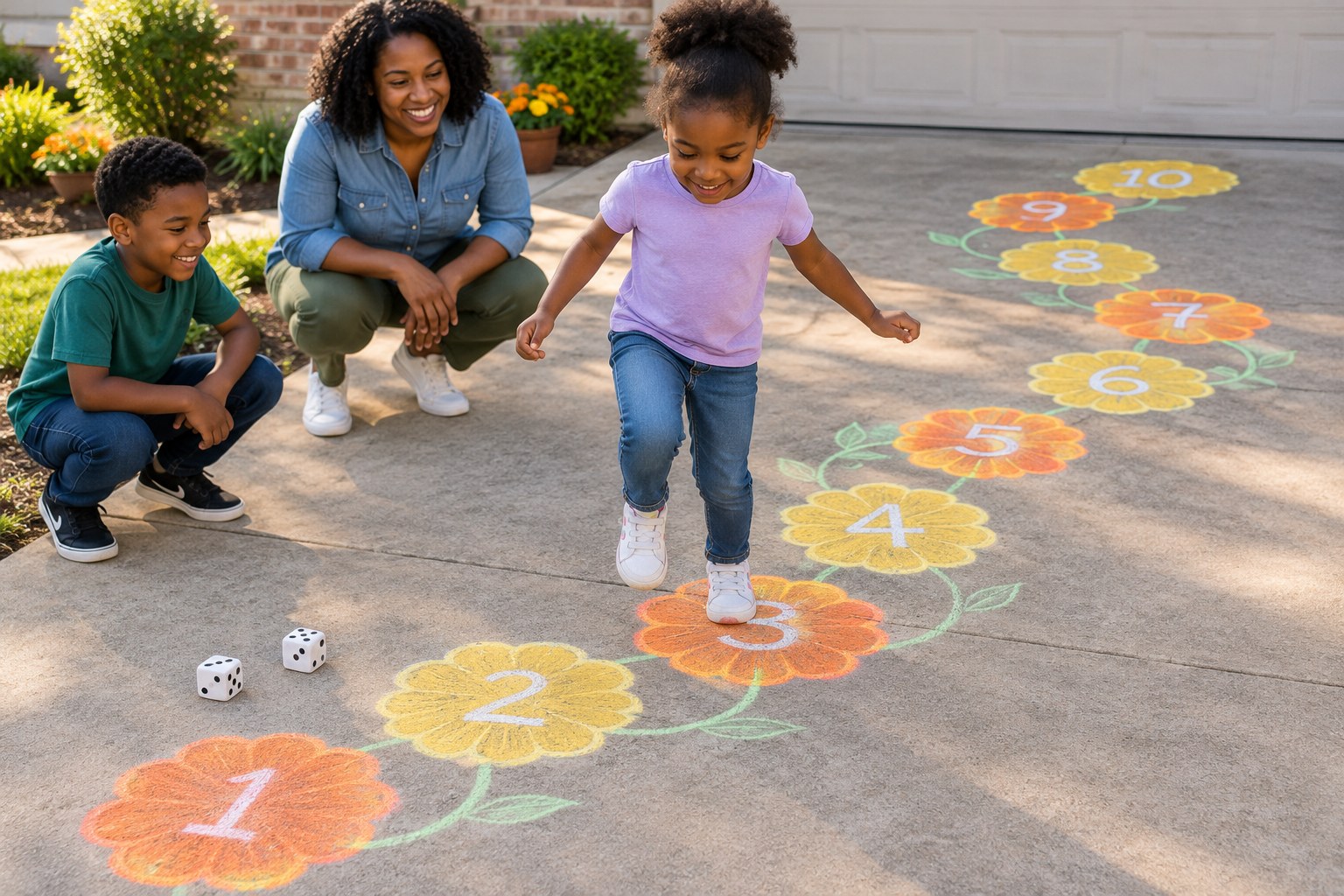
Painter's tape or sidewalk chalk1 roll or a few pieces
Index cards or paper squares for numbers 0-20 and move cardsabout 35
Small toy as the robot (action figure, toy car or a paper robot)1
Paper and pencil1 each per child

Vocabulary

Number line
A line with numbers in order, evenly spaced.
Code
Instructions written so a robot or computer can follow them.
Sum
The answer when you add.
Difference
The answer when you subtract.

Preparation

Introduction

Put the toy robot on 0 and the charging station on 9. Say: 'Robot's battery is low! It can only move by the cards we give it. Which cards will get it to 9?'
How could the robot get to 9 in just two moves?
Is there more than one way?

Steps

1Step 1
Test moves
(5 min) Your child places the robot on 0, draws one move card at a time, and hops the robot that many spaces forward or back. Say each hop as a number sentence, like 0 plus 3 equals 3.
2Step 2
Plan a code
(8 min) Put the charger on a new number from 10 to 20. Your child chooses 2 or 3 move cards and lines them up as the code before the robot moves, then writes the number sentence, like 0 + 10 + 4 = 14.
3Step 3
Run and debug
(7 min) Run the code by hopping the robot. If it misses the charger, your child changes one card to fix the bug and runs it again.
4Step 4
Detours with minus
(6 min) Add a puddle on one number that the robot must hop over, then make the robot go past the charger and come back with a minus card. Your child writes the full number sentence, like 0 + 10 + 5 - 2 = 13.
5Step 5
Fewest moves challenge
(4 min) Pick a target like 17. Who can find a code with the fewest cards? Compare codes and check each one.

Conclusion

Ask: which code was the shortest? Programmers look for codes that work and are efficient, just as mathematicians look for quick strategies like making ten.

Make your own lesson plan in minutes

Describe a topic and Resource Portal AI writes the objectives, materials and steps for your group.

Try Resource Portal AI