Lesson planChrist the Redeemer Scale Model: Surface Area and Soapstone Tiles
STEAM50 minutesGrades: 6th, 7th
Overview
Build a scale model and estimate a statue's tile skin.
Description
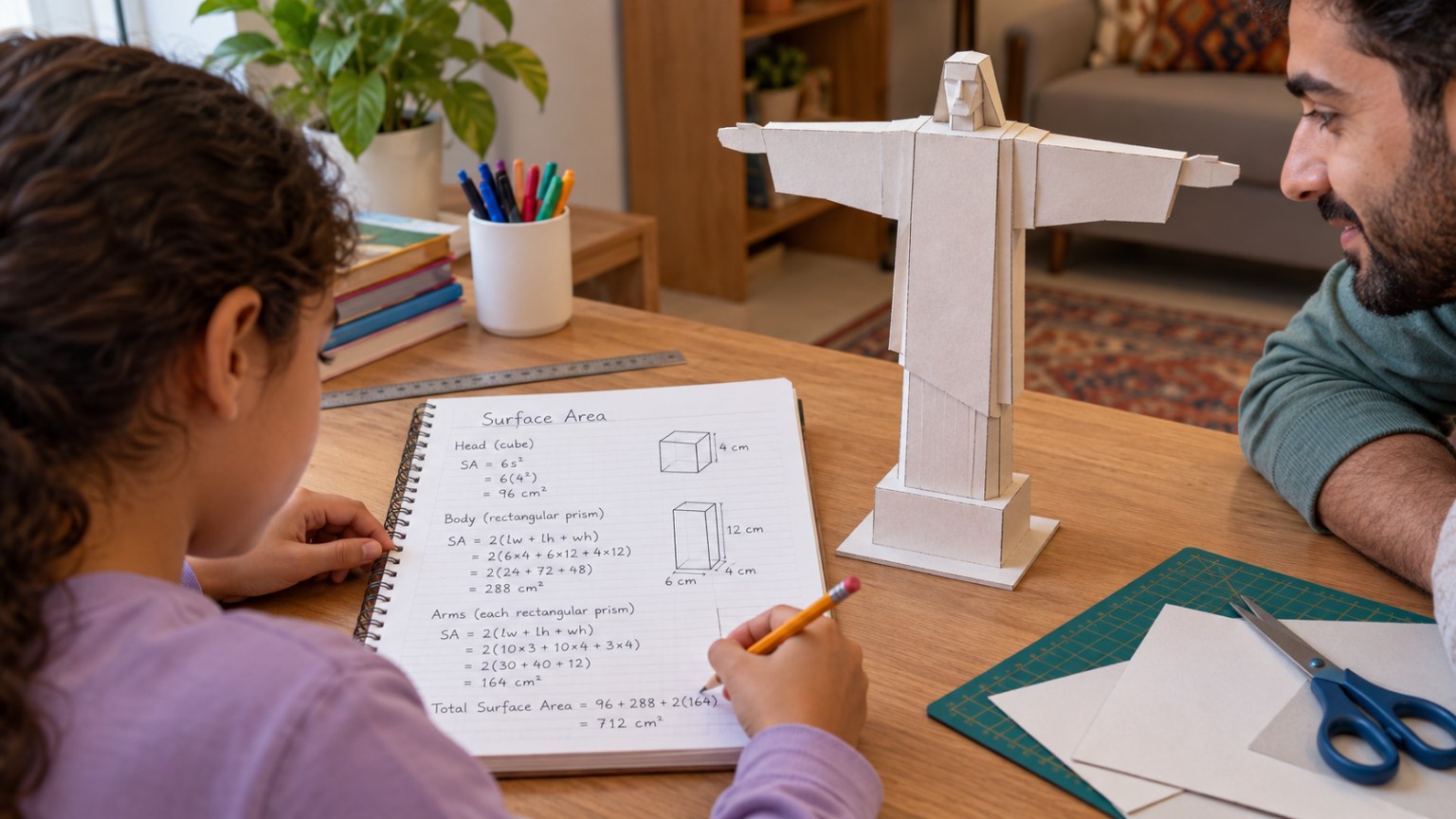
Your teen learns how the Christ the Redeemer statue in Rio de Janeiro was engineered from reinforced concrete and covered in a mosaic of small soapstone tiles, then builds a simplified 1 cm = 1 m paper model from prism nets, calculates its surface area and estimates how many tiles it would take to cover the real statue.
Objective
Your teen will build rectangular prism nets to scale, compute the surface area of a composite figure (excluding hidden faces), and convert to estimate the number of tiles covering the real statue.
Standards
6.G.4Math · Grade 6 · Geometry Represent three-dimensional figures using nets made up of rectangles and triangles, and use the nets to find the surface area of these figures. Apply these techniques in the context of solving real-world and mathematical problems.
7.G.1Math · Grade 7 · Geometry Solve problems involving scale drawings of geometric figures, including computing actual lengths and areas from a scale drawing and reproducing a scale drawing at a different scale.
7.G.6Math · Grade 7 · Geometry Solve real-world and mathematical problems involving area, volume and surface area of two- and three-dimensional objects composed of triangles, quadrilaterals, polygons, cubes, and right prisms.
Materials
| Item | Quantity |
|---|
| Cardstock or cereal-box cardboard | 3-4 sheets |
| Ruler with centimeters, pencil and scissors | 1 each |
| Tape or glue | 1 |
| Calculator | 1 |
| Gray or green colored pencil for the soapstone texture (optional) | 1 |
| Photo of Christ the Redeemer on Corcovado mountain | 1 |
Vocabulary
Reinforced concrete
Concrete with steel bars inside it, which makes it much stronger.
Soapstone
A soft, smooth stone that is easy to carve and resists weather.
Surface area
The total area of all the outside faces of a 3D object.
Net
A flat pattern that folds up into a 3D shape.
Composite figure
A shape made by joining simpler shapes together.
Preparation
- Copy the model dimensions and the worksheet from the additional section.
- Clear a table for cutting and building.
Introduction
Show the photo of the statue on Corcovado. Say: "The surface of this statue is covered in millions of little triangle tiles that volunteers glued onto cloth by hand. How would you even begin to estimate how many?"
Why might engineers choose concrete with steel inside for a statue on a windy mountain peak?
What does a 1 cm = 1 m scale mean for a 30 m statue?
Steps
1Step 1
Engineering briefing
(6 min) Your teen reads the About section and lists the key measurements: 30 m tall statue, 8 m pedestal, 28 m arm span. Discuss why the arms, which stretch far out from the body, were the hardest engineering challenge.
2Step 2
Draw the nets
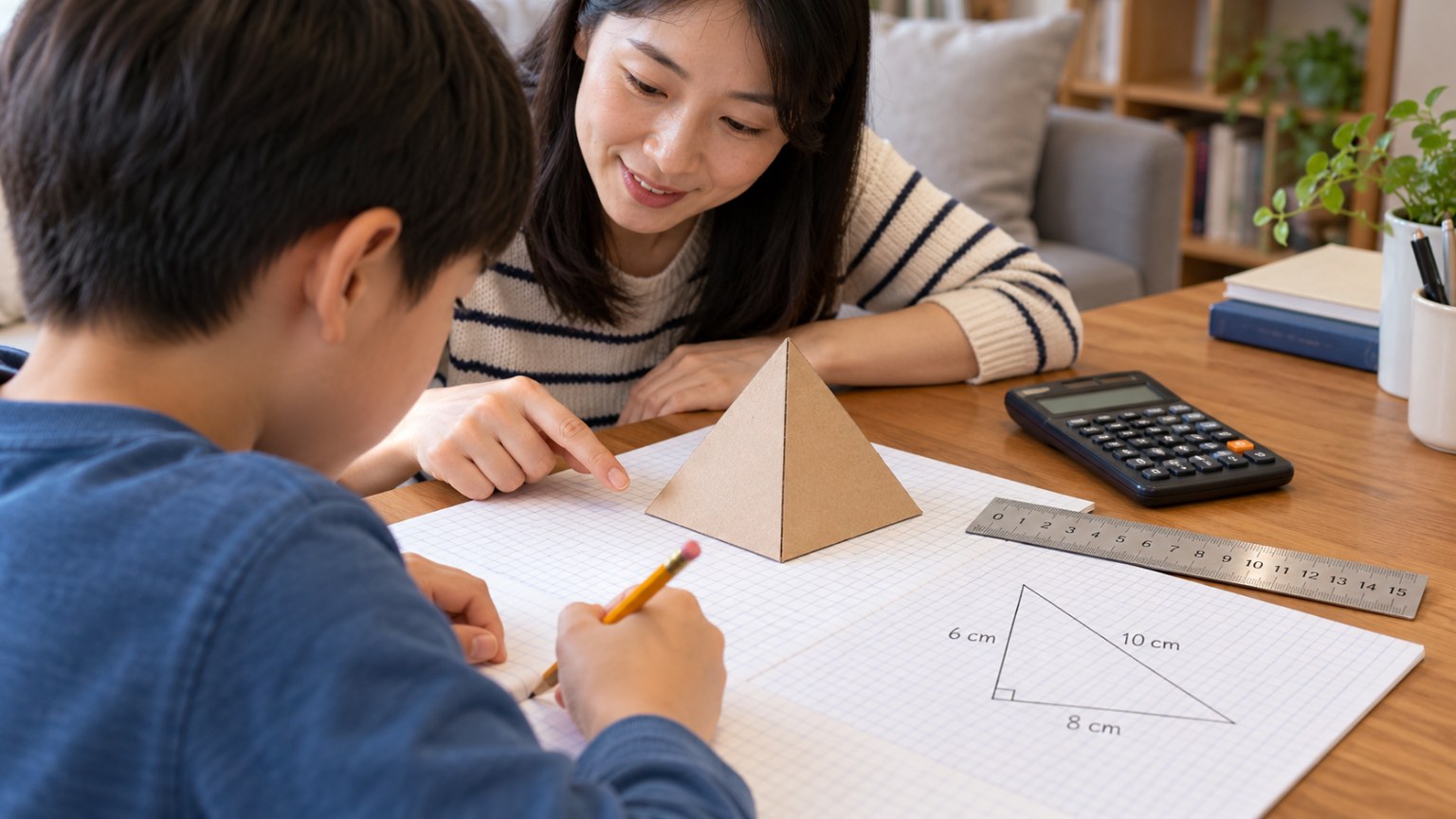
(14 min) Using the simplified model (body prism, two arm prisms and a head cube), your teen draws each net on cardstock at 1 cm = 1 m. They label each face with its dimensions.
3Step 3
Build the model
(10 min) Your teen cuts, folds and tapes each prism, then joins the arms to the body and the head on top. The finished model stands about 33 cm tall with a 28 cm arm span.
4Step 4
Calculate the surface
(12 min) Your teen finds the surface area of each prism, then subtracts the faces that are hidden where pieces join or sit on the pedestal. Convert the model area to the real statue (each 1 cm² on the model is 1 m² in real life).
5Step 5
Estimate the tiles
(7 min) If each soapstone tile covers about 4 cm², your teen converts the statue's surface to square centimeters and divides to estimate the number of tiles. They compare the estimate with the reported "millions" and explain why their simplified model might be off.
Conclusion
Ask: "What parts of the real statue does your box model leave out? Would those make the real surface area bigger or smaller?"
Make your own lesson plan in minutes
Describe a topic and Resource Portal AI writes the objectives, materials and steps for your group.
Try Resource Portal AI