Automation Then and Now: What History Teaches About AI and Jobs

Overview
Compare the Luddites' fears with today's AI job debate.
Description
Your teen reads four short source cards on the Luddite frame-breakers of 1811 to 1816, the power loom, the ATM and the spreadsheet, plus Lord Byron's 1812 House of Lords speech on the Frame-Work Bill as a primary source. They build a two-column chart of fears versus outcomes, note where the sources disagree, and write a paragraph predicting which jobs AI might change and how.
Objective
Your teen will integrate information from primary and secondary sources into a coherent understanding of how earlier waves of automation affected work, noting discrepancies among sources, and apply it to current debates about AI and jobs.
Standards
Materials
| Item | Quantity |
|---|---|
| Printed Source Cards A to D (from Additional Sections) | 1 set |
| Printed excerpt or summary of Lord Byron's 1812 maiden speech in the House of Lords on the Frame-Work Bill (public domain, free online) | 1 |
| Notepad | 1 |
| Pencil | 1 |
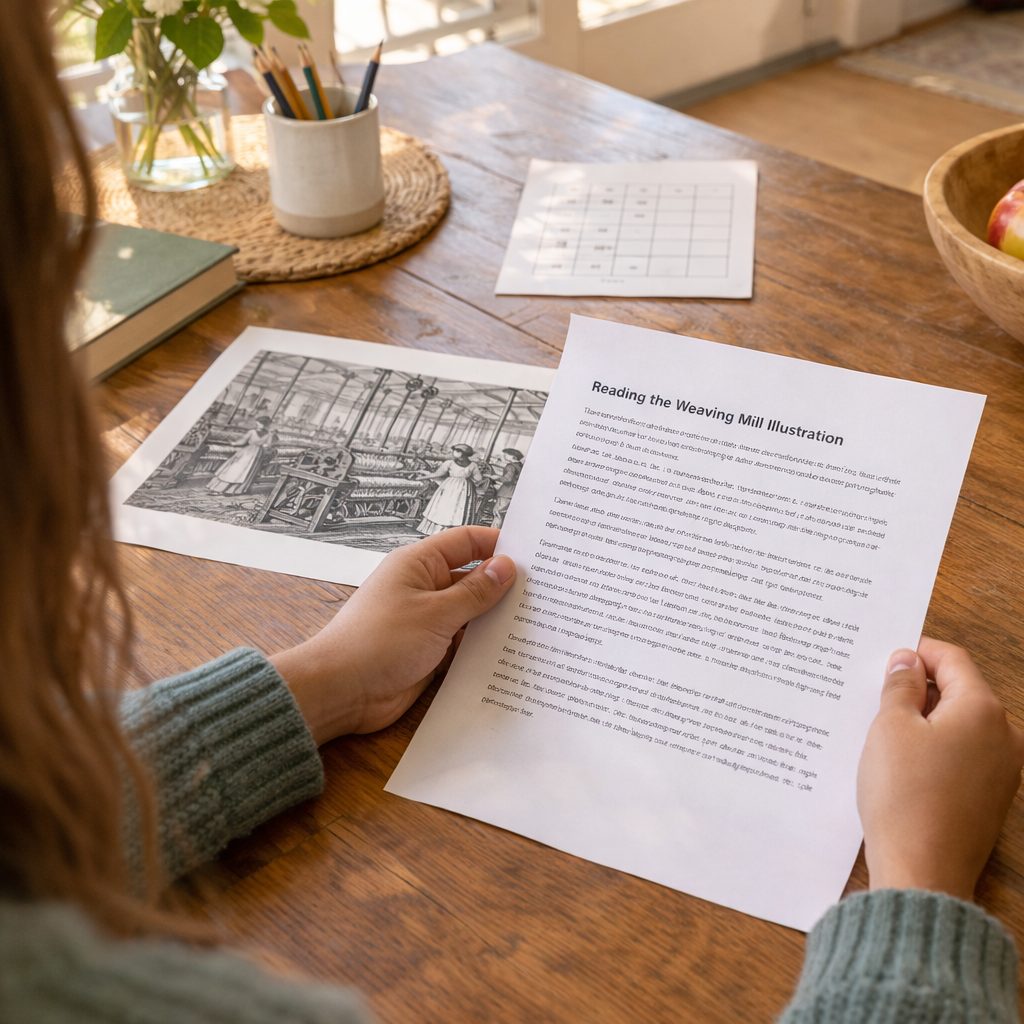
| Printed old illustration of a weaving mill or power loom (public domain image search) | 1 |
Vocabulary
Preparation
- Print the 4 source cards and find a free copy of Byron's 1812 Frame-Work Bill speech (search 'Byron Frame Work Bill speech 1812'); print the first few paragraphs.
- Print one public-domain illustration of a weaving mill or power loom.
Introduction
Show the mill illustration. In 1812 the British Parliament made breaking stocking frames a crime punishable by death. Ask: what would make workers so angry at machines that they risked that, and are any of their fears the same as today's worries about AI?
What jobs do you think AI will change most in the next 10 years?
Is a fear wrong just because things turned out okay in the long run, or can it be right for the people living through it?
Steps



Conclusion
Ask: 'History says the economy usually created new jobs, but the Luddites still lost theirs. What would a fair plan for AI look like for the workers in between?'
Make your own lesson plan in minutes
Describe a topic and Resource Portal AI writes the objectives, materials and steps for your group.
Try Resource Portal AI