Full lesson previewWhisk to Foam: The Layered Iced Matcha Latte
Cooking34 minutesGrades: 10th
Overview
Two test shots, one perfect layered latte.
Description
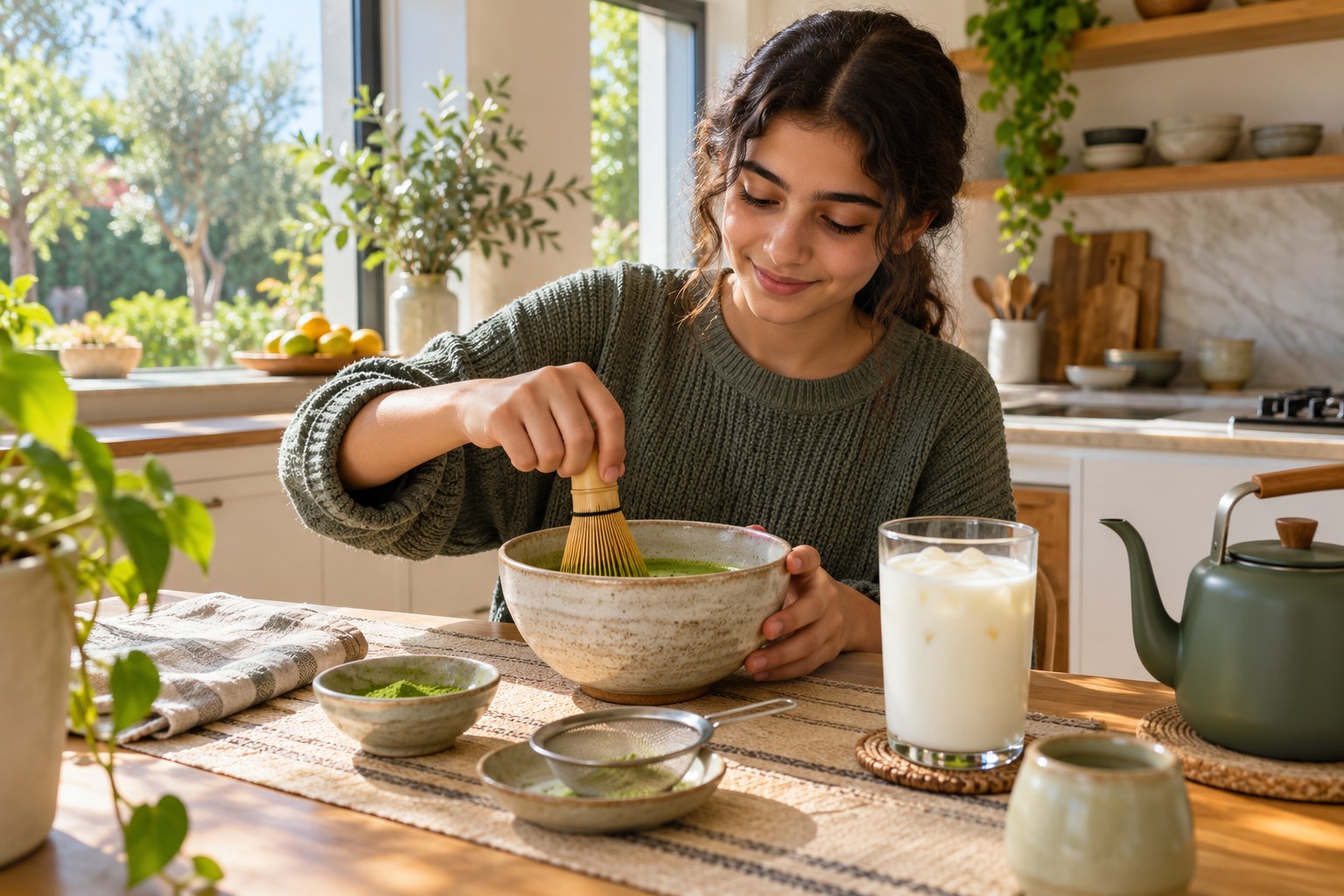
Your teen sifts matcha, whisks two test shots side by side, one with water just off the boil and one with water around 175°F, and compares foam, color and bitterness. They then build a three-layer iced matcha latte by pouring the best shot slowly over ice and milk and explain why sifting, temperature and density each matter.
Objective
Your teen will prepare matcha with a zigzag whisking technique, compare how water temperature changes foam and bitterness, and use liquid density to build a cleanly layered iced latte.
Materials
| Item | Quantity |
|---|
| Matcha powder | 2 tsp |
| Fine mesh sieve or tea strainer | 1 |
| Bamboo whisk, small wire whisk or a jar with a tight lid | 1 |
| Hot water from a kettle | 1/2 cup total |
| Kitchen thermometer (optional) | 1 |
| Milk or plant milk | 3/4 cup |
| Ice cubes | 1 cup |
| Wide bowls or mugs, a tall clear glass and a spoon | 2 bowls, 1 glass, 1 spoon |
Vocabulary
Sifting
Pressing powder through a fine mesh to break up clumps so it mixes smoothly instead of forming lumps.
Suspension
A mixture where tiny solid particles are spread through a liquid but do not dissolve. Matcha is ground leaf suspended in water, which is why it settles if it sits.
Density
How much mass is packed into a given volume. A less dense liquid can float on a denser one if it is poured gently.
Catechins
Natural compounds in tea leaves that taste bitter and astringent. Very hot water pulls more of them out quickly.
Preparation
- Fill and start the kettle so an adult can pour water for both test shots.
- Set out 2 matching bowls or mugs and label sticky notes "Hot" and "Warm" if you like.
Introduction
Hand your teen a pinch of unsifted matcha and ask them to rub it between two fingers, then push another pinch through the sieve and compare. Ask: if the powder is already this fine, why would cafés bother sifting it?
What do you think happens to green tea if the water is too hot?
How do you think cafés get those clean green and white layers?
Steps
1Step 1
Sift and set up the test
(6 min) Your teen sifts 1 tsp of the matcha into each of the 2 bowls by tapping it through the sieve with a spoon. An adult pours 1/4 cup of water straight off the boil into the first bowl and, after letting the kettle sit about 3 minutes (around 175°F if you have a thermometer), 1/4 cup into the second bowl.
2Step 2
Whisk in a zigzag
(8 min) Your teen whisks each bowl for about 30 seconds using a fast M or zigzag motion from the wrist, keeping the whisk just off the bottom, until a fine foam covers the surface. If using the jar instead, they pour each shot into the jar, close it tightly and shake hard for 20 seconds, rinsing between shots.
3Step 3
Compare the two shots
(8 min) Your teen looks at both bowls and writes down foam size, color and how long the foam lasts, then takes a small sip of each and rates bitterness from 1 to 5. They decide which water temperature they will use for the latte and explain the result using the word catechins.
4Step 4
Layer the latte
(8 min) Your teen fills the tall glass with the 1 cup of ice and pours in the 3/4 cup of milk. They re-whisk their chosen shot for a few seconds and pour it very slowly over the back of the spoon held just above the ice so the green layer settles on top of the white.
5Step 5
Explain the layers
(4 min) Your teen watches the glass for a minute and explains to you why the layers held: the milk is slightly denser than the watery matcha shot, and pouring onto ice and a spoon slows the stream so it does not mix. They stir it before drinking and note how the color changes.
Conclusion
Ask your teen to give their three rules for a good matcha latte and the reason behind each. Knowing why a step matters is what lets a cook adapt instead of just following a recipe.
Make your own lesson plan in minutes
Describe a topic and Resource Portal AI writes the objectives, materials and steps for your group.
Try Resource Portal AI