Lesson planLunar New Year Calendar Math: When to Add a Leap Month
Math40 minutesGrades: 6th, 7th, 8th
Overview
Calculate the drift that makes a leap month necessary.
Description
Your teen investigates the lunisolar calendar behind Lunar New Year, using decimal operations and rates to calculate how far 12 lunar months drift from the solar year, when a leap month must be added, and why 7 leap months every 19 years keeps the holiday between January 21 and February 20.
Objective
Your teen will multiply and divide decimals to compare lunar and solar years, compute a drift rate in days per year, model the drift in a table, and justify the 19-year, 7-leap-month cycle with calculations.
Standards
6.RP.3bMath · Grade 6 · Ratios & Proportional Relationships Solve unit rate problems including those involving unit pricing and constant speed.
7.NS.3Math · Grade 7 · The Number System Solve real-world and mathematical problems involving the four operations with rational numbers.
Materials
| Item | Quantity |
|---|
| Paper and pencil | 3 sheets |
| Calculator | 1 |
| Graph paper (optional) for a drift chart | 1 sheet |
| A calendar or the date list in the additional sections | 1 |
Vocabulary
Synodic month
The time from one new moon to the next, about 29.53 days.
Tropical year
The time for the seasons to repeat, about 365.24 days.
Lunisolar calendar
A calendar with moon-based months that adds a leap month when needed to stay with the seasons.
Drift
How far one calendar slides compared to another over time.
Metonic cycle
A 19-year cycle after which moon phases fall on almost the same solar dates again.
Preparation
- Copy the Investigation questions onto paper with space to work.
- Read 'Why a leap month' in the additional sections.
Introduction
Show your teen the list of Lunar New Year dates and ask: if the holiday moves about 11 days earlier most years, why hasn't it drifted into December by now? Something keeps pulling it back. Today they figure out exactly what.
What would happen to a spring festival if the calendar ignored the sun for 15 years?
How does our own calendar fix its drift? (Leap days.)
Steps
1Step 1
Lunar year vs. solar year
(8 min) Your teen calculates 12 x 29.53 to get the length of 12 lunar months (354.36 days) and subtracts it from 365.24. They interpret the answer (10.88 days) as the drift per year, a unit rate in days per year.
2Step 2
Model the drift
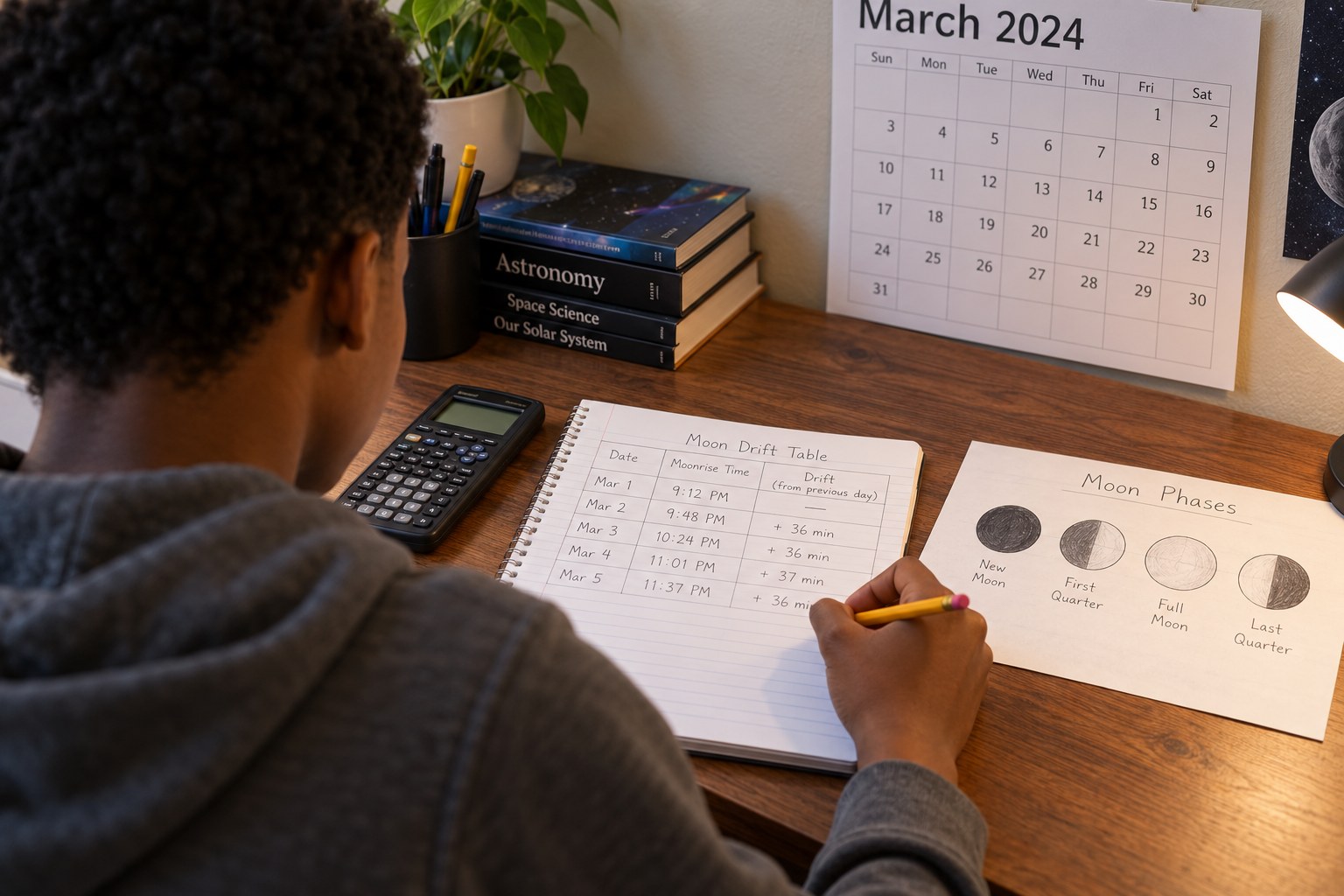
(10 min) Your teen builds a table for years 1 to 6 showing the total drift (10.88, 21.76, and so on). They find the first year where drift passes one whole month of 29.53 days and explain that this is when a leap month must be added to pull the calendar back.
3Step 3
Test the 19-year cycle
(10 min) Your teen calculates 19 x 365.24 and 235 x 29.53 (that is, 19 x 12 + 7 months) and finds the difference in days. They explain why adding 7 leap months every 19 years keeps the lunar calendar almost perfectly in step with the seasons.
4Step 4
Check against real dates
(8 min) Using the date list, your teen calculates the days between consecutive Lunar New Years and labels each year as a 12-month (about 354 days) or 13-month (about 384 days) year. They check their labels with the answer key.
5Step 5
Explain it
(4 min) Your teen writes 3-4 sentences explaining why Lunar New Year always falls between January 21 and February 20, using at least two of their calculations as evidence. Compare the explanation with the 'Why a leap month' section.
Conclusion
Ask: the Islamic calendar is purely lunar and never adds a leap month. What happens to its holidays over the years? (They move through all the seasons about every 33 years.)
Make your own lesson plan in minutes
Describe a topic and Resource Portal AI writes the objectives, materials and steps for your group.
Try Resource Portal AI